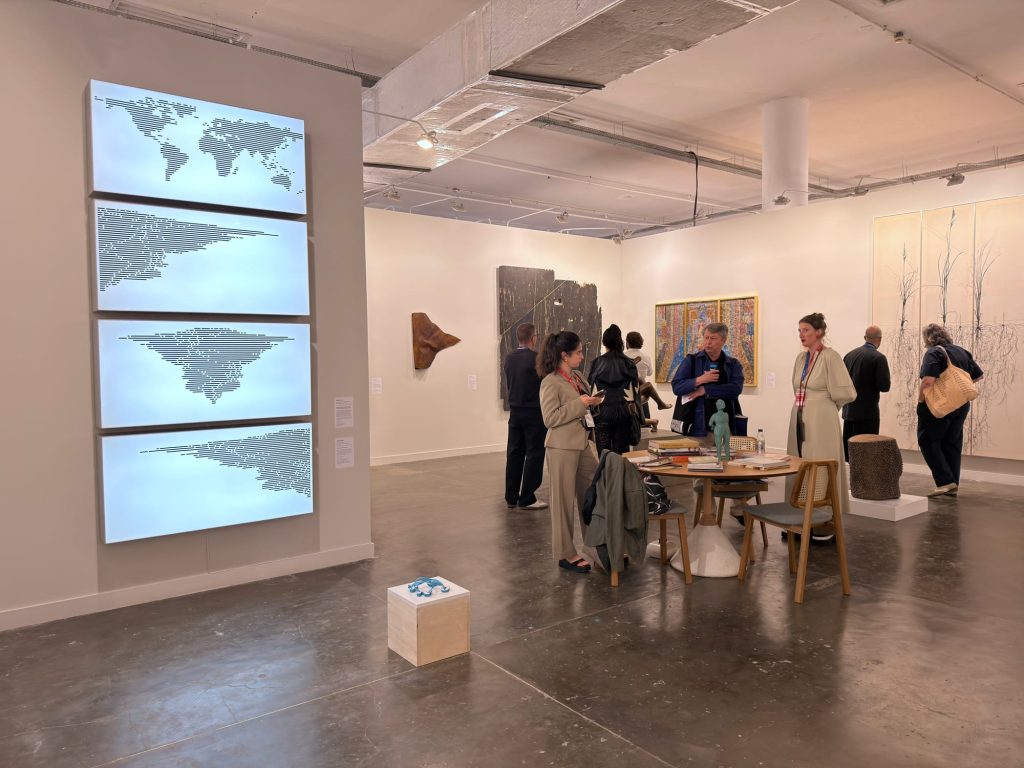
Exploring the Unique Features of South America’s Largest Art Fair
**SP-Arte 2023: A Celebration of Brazilian Art within a Global Context**
São Paulo has once again taken center stage in the art world, hosting the 22nd edition of SP-Arte, Latin America’s largest art fair. Following closely on the heels of the São Paulo Biennial, the event, which runs from April 8 to the weekend, has brought together 180 exhibitors, showcasing the strong presence of Brazilian galleries despite a slight reduction in size compared to previous years.
Among the notable attendees was Brinda Kumar, Associate Curator of Modern and Contemporary Art at the Metropolitan Museum of Art. For Kumar, who explored São Paulo’s artistic landscape for the first time, the city’s pivotal role as a connector of South-South artistic links was intriguing. Her exploration included a visit to the studio of Brazilian artist Rosana Paulino, organized through the Latitude program aimed at promoting Brazilian art. This studio visit highlighted the importance of understanding art within its creation context, as Kumar noted.
Despite SP-Arte’s paradoxical positioning as both a global nexus and a regional showcase, galleries like Mendes Wood DM have capitalized on this dual nature. With roots in São Paulo and branches in New York, Paris, and Brussels, the gallery has successfully navigated Brazil’s cultural complexities while extending its reach internationally. Their current fair exhibit includes works by both Brazilian and international artists like Patricia Leite and Edgar Calel, blending natural landscapes with surrealist motifs.
For Brazilian galleries like Almeida & Dale, SP-Arte is crucial in fortifying the local art ecosystem and establishes Brazil as an active interlocutor on the global stage. Their booth displays a diverse array of artworks, from Guga Szabon’s abstract textiles to Maxwell Alexandre’s poignant urban-centric oils alongside Maya Weishof’s expressionistic portraiture.
Foreign galleries, including London’s Lamb, have returned to SP-Arte, aiming to tap into Brazil’s collector base despite the financial challenges posed by the country’s tax system. Fernanda Feitosa, founder of SP-Arte, acknowledged the impact of high taxes on art sales, which have historically deterred top-tier galleries, although past temporary tax abatements had previously attracted names like Gagosian and White Cube.
Mexican-based RGR Gallery’s participation, driven by affinities between Venezuelan and Brazilian abstract art, underscores the fair’s broader regional connections. Their curated selections, including works by Jesús Rafael Soto and Wang Yi, highlight this synergy. Similarly, Piero Atchugarry’s gallery, with bases in Uruguay and Miami, featured a mix of established artists like Pablo Atchugarry and innovative newcomers, reinforcing these transcontinental links.
The Buenos Aires-based Ruth Benzacar Gallery brought an innovative display, featuring works by Tomás Saraceno and Alejandra Seebel, further enriching the fair’s diverse offerings. Noteworthy too was Galeria Foco from Lisbon, making its debut with striking textile sculptures by Maria Appleton.
Brazilian artists also made their mark on the fair. Yuli Yamagata’s whimsical multimedia creations and renowned ceramist Megumi Yuasa highlighted the influence of Brazil’s Japanese diaspora. Meanwhile, Denilson Baniwa’s provocative drawings at A Gentil Carioca offered a critical look at the intersection of Brazilian cosmopolitanism and colonial history.
In essence, SP-Arte 2023 has reinforced the vitality and resilience of Brazilian art, cementing its role not only within the Latin American region but also its intermittent yet growing connections with global art market hubs. Through its representation of distinct regional dialects and innovative exhibitions, SP-Arte continues to advance Brazil’s artistic identity on the international stage.