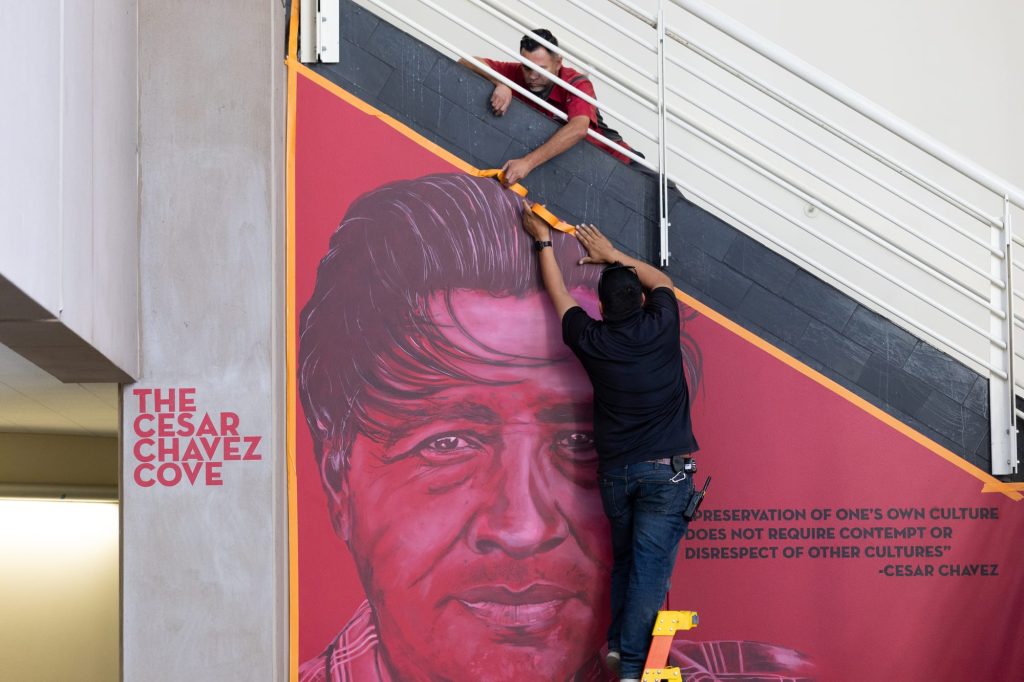
Artists Confront Cesar Chavez’s Legacy Following Abuse Allegations
In recent days, the art and cultural communities in California and beyond have been grappling with allegations of sexual abuse against labor leader Cesar Chávez. These allegations, brought forward by activist and United Farm Workers (UFW) co-founder Dolores Huerta and other women, have prompted a reevaluation of Chávez’s legacy, particularly within Latine artists and cultural institutions that have long celebrated his contributions to labor rights.
Cesar Chávez’s image has been a prominent fixture across California, from murals and public sculptures to school names and civic events. However, these symbols of admiration are quickly transforming as institutions respond to the allegations. For instance, in Watts, an artist is replacing a Chávez mural with one of Dolores Huerta, a pivotal figure accused of being among Chávez’s victims.
Artists, deeply entrenched in this legacy, face an arduous journey of personal and collective reflection. Photographer Christina Fernandez expressed the collective trauma felt by those whose families were intertwined with the UFW’s efforts and the broader Chicano Art Movement of the 1960s and ’70s. This movement was closely linked with the labor activism led by the UFW, as art played a critical role in communicating messages and inspiring change.
Institutions like Self-Help Graphics & Art have stood in solidarity with the survivors, strongly affirming their support. The organization has been central to the Chicano Art Movement, renowned for its role in popularizing printmaking to spread powerful images and messages. Their statement underscores the responsibility to prioritize victims’ voices and confront internal issues within movements to prevent further harm.
Cultural events celebrating Chávez’s legacy are being reconsidered, such as LA Plaza de Cultura y Artes canceling an event planned in his honor. Instead, they emphasize Huerta’s enduring contributions, aligning with efforts to reassert her role in the civil rights movement.
Some artists have taken creative steps to address the challenging news, modifying public artworks to shift focus away from Chávez and towards other figures like Huerta. For example, artist Lalo Alcaraz created a cartoon depicting the reimagining of a mural, showcasing the complexity of addressing Chávez’s legacy while maintaining the spirit of the UFW.
The recent allegations have reinforced a growing movement to recognize Huerta’s contributions more fully, evident in the ongoing curation of exhibitions like *Dolores*, which honors her enduring influence in feminist and human rights advocacy. These artistic endeavors aim to spotlight her achievements, ensuring they remain prominent against the backdrop of the current controversy.
In this moment of profound reckoning, cultural leaders and artists continue to challenge the legacies of influential figures, urging a reexamination of whom society elevates and why. As discussions evolve, this period demands a deeper understanding and acknowledgment of the multifaceted narratives that shape historical memory and cultural heritage.