The Met’s Recent Acquisition of a Mannerist Painting Captivates Internet Users
Online Reactions to Rosso Fiorentino’s Rediscovered Masterpiece Channel the Essence of Mannerism
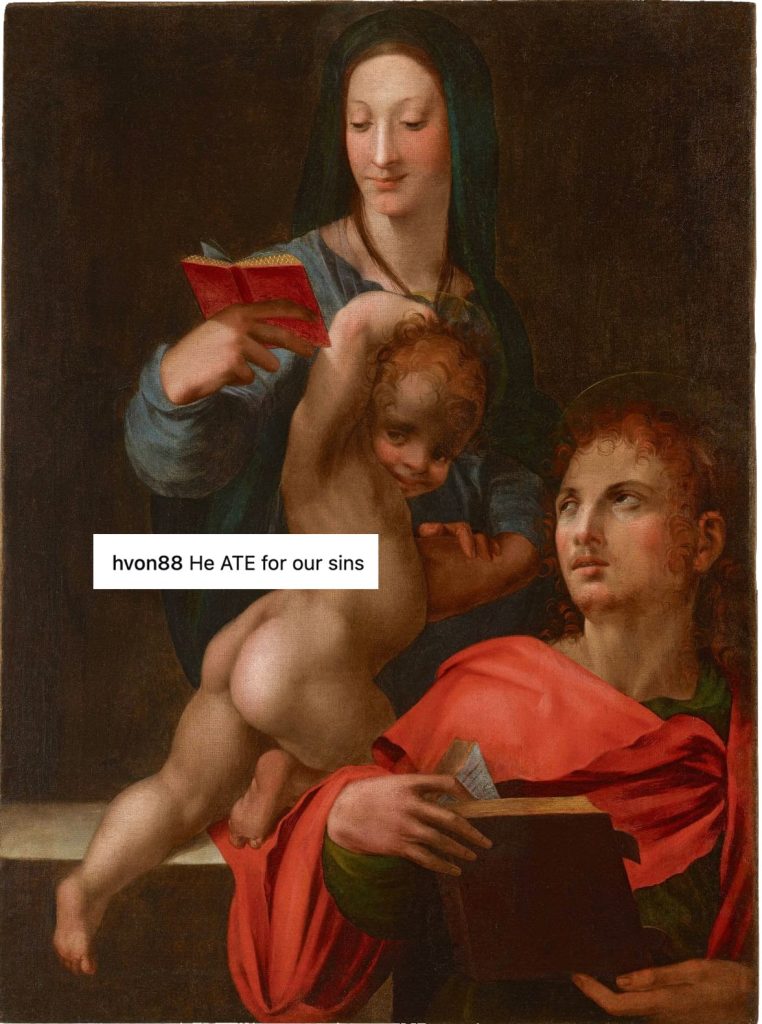
The discovery of Rosso Fiorentino’s “Madonna and Child with Saint John the Evangelist” has sparked a frenzy of online reactions, igniting discussions that capture the very spirit of the Mannerism art movement, even 500 years after its inception. The painting, recently identified as Fiorentino’s long-lost work, was unveiled by the Metropolitan Museum of Art, with its depiction of an infant Jesus whose muscular form and expression have outshone other elements in the artwork.
Social media platforms have seen an influx of comments expressing astonishment and admiration for baby Jesus’s exaggerated features. Descriptions such as “baddie,” “yasssified,” and “caked up” resonate with contemporary pop culture, drawing parallels to today’s obsession with physical aesthetics, reminiscent of trends like the Brazilian Butt-Lift and the rise of queer media influences. The playful and irreverent language employed in these reactions illustrates a modern-day reinterpretation of Fiorentino’s work, aligning with Mannerism’s hallmark of stylization and departure from classical ideals.
The Met’s Instagram post was flooded with comments reflecting a blend of digital nihilism and unabashed fascination. This phenomenon highlights society’s shifting boundaries around sacred art and religious iconography as realms once considered untouchable are now open to reinterpretation and humor.
Fiorentino’s painting exemplifies the defining features of Mannerism through its composition. The asymmetry between the Virgin Mary’s poised figure and the dynamic, curious form of baby Jesus, alongside saturated colors and unconventional proportions, were characteristic of an era marked by religious upheaval and conflict. The Mannerists, including Fiorentino, emerged as pioneers moving away from the naturalistic ideals of the Renaissance, opting instead for artificial beauty and emotional intensity.
The painting, believed to be among Fiorentino’s earliest surviving works, underwent a significant restoration process that revealed the previously obscured figure of Saint John the Evangelist. The contrast in expressions and positioning within the piece encapsulates the experimental ambition that Mannerism introduced in its time.
Identified via Giorgio Vasari’s “Lives of the Artists,” the painting belongs to a prestigious collection of Florentine commissions that Fiorentino completed as a young artist. Vasari’s text places it within a timeline linking Fiorentino’s development to significant creations like the “Assumption of the Virgin.”
Max Hollein, The Met’s director and CEO, describes the painting as a pivotal work that embodies experimental ambition and psychological depth, asserting its importance in the broader narrative of 16th-century art. Thus, Fiorentino’s rediscovered masterpiece not only commands attention for its historical and artistic value but also for its unbroken resonance with the spirit of innovation—a spirit that continues to echo in the contemporary world.