A Guide to 10 Must-See Spring Exhibitions in Chicago
Good news in the art world is — perhaps as always — scarce. Chicago has certainly been feeling the pain of change recently, with the city’s annual art fair, EXPO, shrinking by almost 25% (and excluding a section that featured many local nonprofits), university arts programs facing budget cuts and restructuring, and the DePaul Art Museum closing. However, what could be read as total doom also exposes a condition the city’s creative communities have always known: Artists here make their way, with or without institutional support.
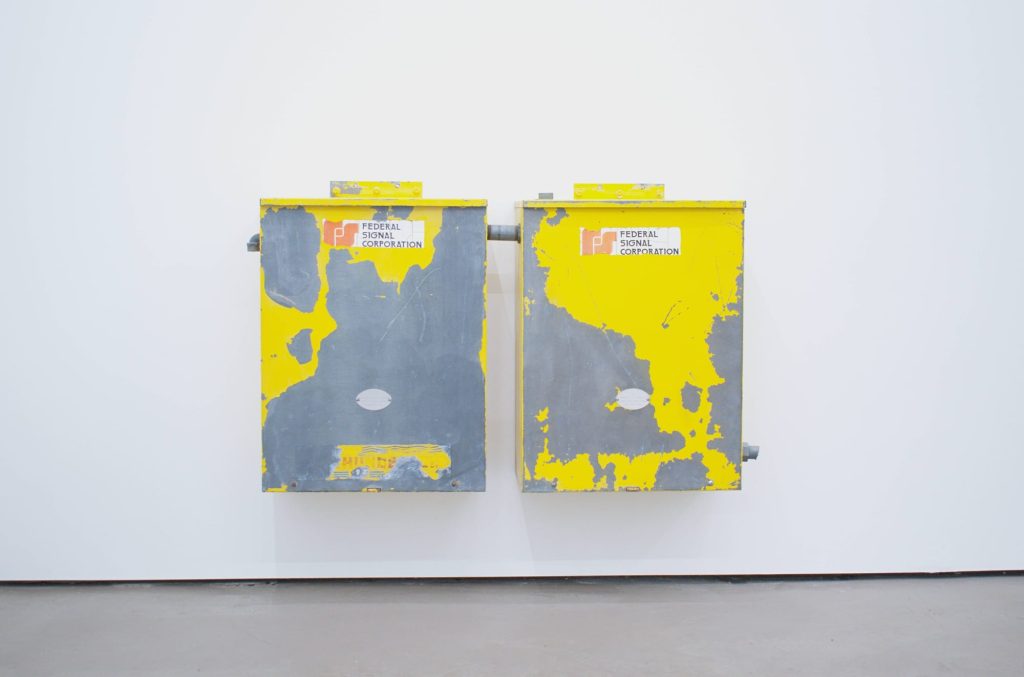
Chicago’s rich cultural history, after all, has as much to owe to its thriving ecosystem of apartment galleries and alternative communities as it does to its big-ticket arts institutions. Given this landscape, it’s no surprise that artistic work here remains strong, even if it often points to existential threats. Many are addressing political and environmental peril, as is evident in shows at the Hyde Park Art Center and the Ukrainian Institute of Modern Art. Others are considering infrastructure, seen at LVL3 and Weatherproof. In a moment of institutional failure, it’s a great time to seek art in community and artist-run organizations.
Hunter Foster: Involition
Good Weather, 1524 S. Western Ave, Ste. 119-121, Building A, Chicago
Through April 4
For an exhibition invoking the ever-present threat of natural disasters, Involition is disarmingly slow. The show’s central feature, a rusting Thunderbolt Model 1003 restaged by multimedia artist Hunter Foster, stands quiet and anachronistic, its hulking electromechanical profile a relic of times past. The Thunderbolt, a line of supercharged rotating sirens, is a standardized object of the Midwest, manufactured and installed in the region to warn against Soviet nuclear attacks during the Cold War. The sirens were later adapted to alert for tornadoes in yet another example of the inextricable relationship between war and American infrastructure. At Good Weather gallery, the retired siren rotates a few degrees every four minutes, its piercing wail omitted, leaving only the tired groans of aging metal and the creeping sense of crisis.
Alison Ruttan: The Paradox of Inaction
Hyde Park Art Center, 5020 S. Cornell Ave, Chicago
April 4–July 12
Expansive and arresting, Alison Ruttan’s solo show utilizes an overwhelming abundance of ceramic forms resembling rooftops to recreate a scene of submerged suburbia. The installation immediately recalls the apocalyptic imagery of a flooded New Orleans in the aftermath of Hurricane Katrina, a catastrophe from which the city has yet to fully recover 20 years later. As global warming increases the probability of extreme weather events, existing structural failures and impending cuts to key environmental and disaster-response agencies likewise increase the likelihood of displacement, destruction, and irreversible harm. By situating viewers in the middle of what is so often a distant encounter of disaster via screens, The Paradox of Inaction forces viewers to confront the urgency of climate change head-on.
It Will Destroy You
Ukrainian Institute of Modern Art, 2320 West Chicago Ave, Chicago
Through April 19
This exhibition is a real-time reflection of working artists as they process their places in the heart of a collapsing empire. Curated by Chicago local artists and organizers Samiah Fulcher and Isaiah Lee, the group exhibition makes room for works that explore the converging axes of decay and the emerging possibilities for imagining new futures. A frequent theme in the show is the alienating contrast between lived experience and distant awareness in a moment of global uncertainty, embodied in the sickly hyperreal closeups of skin in Chloe Harthan’s paintings, the dejected characters of the Blue Line in Ethan Shay-Cowell’s works, and the prone, dirtied bodies in Michelle Alexander’s floor mats.
Carriage
LVL3, 1542 N. Milwaukee Ave, 3rd Floor, Chicago
Through May 3
In this understated duo exhibition, artists Hyeseul Song and Häsler Gómez turn a keen eye to the unnoticed materials, textures, and spaces of contemporary life. Song’s sculptures reflect a manner of attention that is somehow both obsessive and lighthanded, exemplified in works that replicate and transform a single found doorstop. The original, cut hastily from scrap wood marred by a dead knot, is reiterated countless times through 3D printing in black plastic, abstracting its functional use and enhancing the void that once held a dead branch. Gómez’s work complements Song’s focus on ubiquitous materials through hand-carved cardboard panels that emulate the woodgrain and exact shade of the gallery’s existing gray strip flooring.
Leah Ke Yi Zheng: Change, I Ching (64 Paintings)
The Renaissance Society, 5811 S. Ellis Ave, Cobb Hall, 4th Floor, Chicago
Through April 12
As the title suggests, Leah Ke Yi Zheng’s