Guiding Lights in a Dark World
I went to Alexander Berggruen Gallery with the intention of reviewing [Kevin McNamee-Tweed](https://alexanderberggruen.com/exhibitions/kevin-mcnamee-tweed-the-weather/?ref=hyperallergic.com)’s work, as I have been following him since I read his monograph in 2020. While I was there, I saw [Tajh Rust](https://alexanderberggruen.com/exhibitions/tajh-rust-how-to-disappear/?ref=hyperallergic.com)’s debut New York exhibition, which is running concurrently, and decided that I would regret not writing about his work, too.
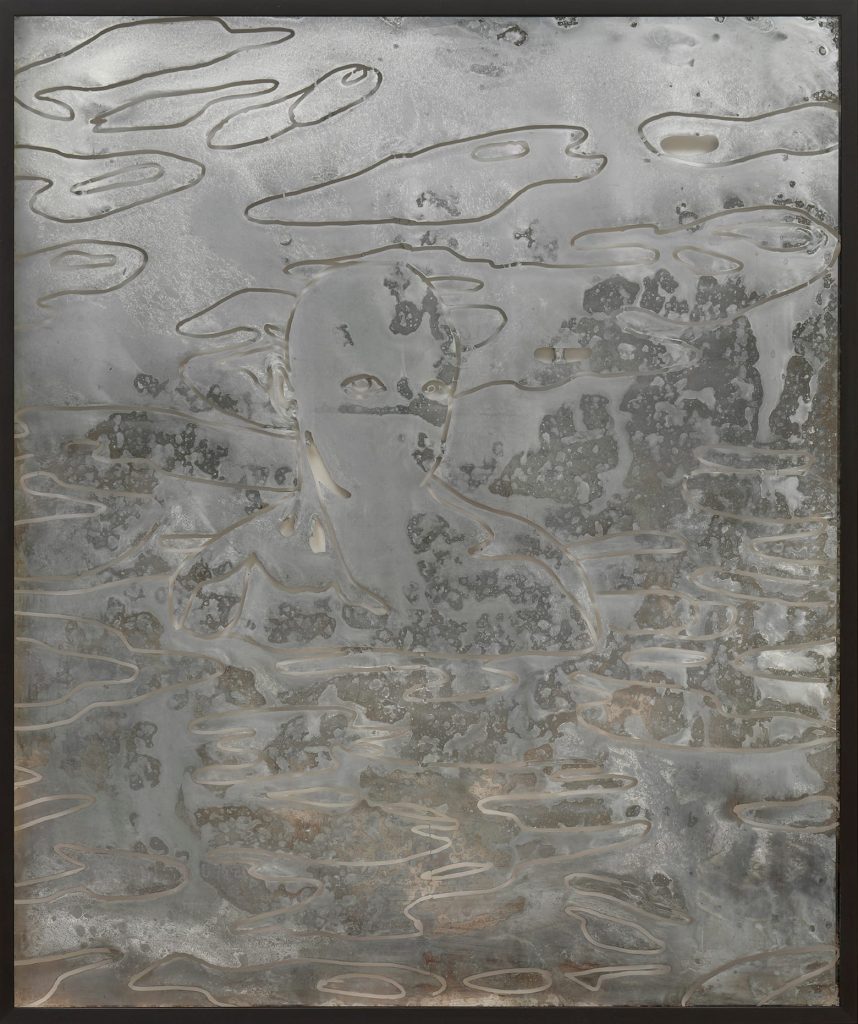
Rust’s exhibition consists of six figurative paintings. Two of them are acrylic on silvered glass and stand apart from the four oil paintings on canvas, suggesting his openness to experimenting with different material combinations.
Both silvered glass paintings depict a linear silhouette of a figure that took a while to discern because the silvered glass reflects the room. I kept moving around in front of the work, trying to separate what was there from my reflection. Reinforced by the paintings’ titles, “How to Disappear I” and “How to Disappear II” (both 2026), the experience of trying to see something that kept eluding me felt like the subject of the work as well as the exhibition. In a cultural landscape saturated with racist tropes, is the individuality of Black people ever fully legible? In the current climate, it is a question that has no satisfactory answer because it assumes the “I” can see the “Other” with equanimity. It’s a shame that the poet Arthur Rimbaud’s equation, “Je est un autre” (I is another/someone else), is not widely embraced.
The four paintings depict Black men, women, and teenagers at places of leisure, including a swimming pool, beach, and hammock. As with the silvered glass paintings, Rust crops these compositions with an eye to how much information he is giving. They are like full-length portraits: They show you the figure and immediate circumstances, usually in a room. Rust takes that format and changes the location, compelling the viewer to complete the story. In “Once in a Blue” (2026), who owns the swimming pool, and where is it? Why are the people swimming at night under a full moon? Why is the man standing on the diving board looking at us? Who are we? All of this destabilizes the relationship between the viewer and portrait, suggesting there is no such thing as objective or neutral looking.
In “Rückenfigur III” (2025), a young man, who is wearing pale blue swim trunks with an orange stripe and a lighter tank top, stands on a rock, hands on hips, looking down at the waves. The German title (“back-figure”) refers to a compositional technique popularized by the German Romantic painter Caspar David Friedrich, who depicted a figure, back to us, as a stand-in for the viewer. As a surrogate looking at the ocean, with its vastness, relentless movement, destructiveness, and mystery, what does it stir up in us? By elevating his figure so that we are looking up at him, and depicting two elongated clouds behind him, each extending from his shoulders, inviting us to read them as wings, Rust complicates our relationship. Combined with his paint handling and use of color, Rust’s undoing of the familiar relationship between viewer and subject is cause for celebration.
I have come to think of Kevin McNamee-Tweed, a pictorial ceramicist, whose offbeat, tenderly absurd, improbable scenes evoke an enigmatic world, as part of the family of New York School artists that includes [Joe Brainard](https://hyperallergic.com/joe-brainard-100-works-tibor-de-nagy/), the British-born [Trevor Winkfield](https://hyperallergic.com/tag/trevor-winkfield/), and more distantly, the British artists [Glen Baxter](https://hyperallergic.com/glen-baxter-flowers-central/) (whose cartoons have appeared in *The New Yorker*) and Paul Hammond (who was also a translator and historian of Surrealism). All of them, who met at Leeds College of Art, celebrate what Hammond called the “everyday marvelous.” McNamee-Tweed fits right in with this aesthetic.
McNamee-Tweed, whose inventively whimsical drawings are displayed on one wall, incises clay slabs with a sharp instrument. Employing paint and glazes, he turns the incised image into a painting that is unlikely and full of wonderment. In “Untitled (Robot in Clouds)” (2025), a robot, whose gray metal body evokes an earlier era of automatons, walks on a cloud, his large round eyes confounded. He seems utterly confused by where