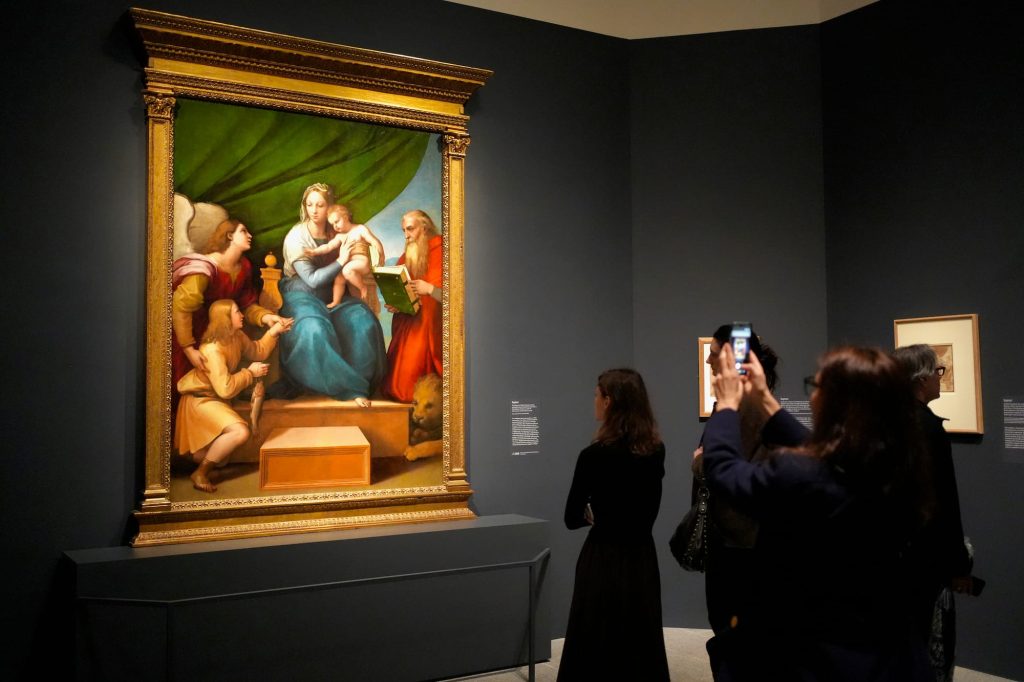
Exploring the Historic Raphael Exhibition at the Metropolitan Museum
**Nature Created Him as a Gift to the World: Raphael in the Renaissance and Beyond**
Giorgio Vasari, in his esteemed 16th-century work “The Lives of the Artists”, referred to Raphael with reverence, stating that “Nature created him as a gift to the world”. This sentiment, expressed more than 500 years ago, continues to resonate in the artistic realm today. Born in 1483 in the Italian city of Urbino, a hub of 15th and 16th-century art and culture, Raphael is the epitome of the Renaissance man. Within his brief 37 years, he emerged as a painter of unparalleled skill, matching the likes of Leonardo da Vinci and Michelangelo. His legacy expands beyond painting to include architecture and design, and his humanistic approach to art, reflecting his empathic nature, has left a lasting impact on generations.
This enduring legacy is celebrated with the exhibition “Sublime Poetry” at the Metropolitan Museum, marking the first comprehensive Raphael survey in the United States. Featuring more than 170 works from over 60 global collections, the exhibition covers the breadth of Raphael’s career, from his early apprenticeships to his period of fame. Highlighted works include “The Virgin and Child with the Infant Saint John the Baptist in a Landscape (The Alba Madonna)” and the delicate “Portrait of a Young Boy (Presumed to be a Self-Portrait)”. Curated by Carmen C. Bambach, known for her expertise from exhibitions like “Michelangelo: Divine Draftsman & Designer”, the exhibition required meticulous coordination to secure Raphael’s works, akin to soliciting royal treasures.
Though Raphael’s life wasn’t as extensively documented as Michelangelo’s, resulting in his name being less prominent in popular culture, his influence is undeniable. Known for advancing and refining styles swiftly, he added warmth and luminosity to devotional images and infused his drawings with a diary-like intimacy. As Bambach notes, Raphael’s works embody a poetic quality, reminiscent of the Renaissance comparison of painting to “mute poetry”. This reflects his upbringing by a poet-painter father and his interactions with literary icons of his time.
Putting together such an impactful exhibition involved eight years of research, negotiations, and original discoveries about Raphael’s work. For instance, Bambach’s identification of Raphael’s fresco fragment from a Vatican Palace fireplace and the reassembly of a portable altarpiece illustrate the depth of scholarship required. Raphael’s distinctiveness in the Renaissance canon comes from his combination of color mastery, anatomical precision, geometric understanding, and an unmatched narrative quality, which secured his veneration for centuries.
For exhibition visitors unfamiliar with Raphael, Bambach recommends not missing the “Alba Madonna” or the “Portrait of Baldassare Castiglione”. Even as historical perspectives may place him below Leonardo and Michelangelo today, Raphael’s broad capabilities ensured his lasting fame during his lifetime and beyond.
Discussing the possibility of what Raphael might have achieved if not for his early death, Bambach conjectures that his relentless workload might have contributed to his untimely end. Yet, had he lived longer, his penchant for innovation hinted at the potential for further masterpieces.
Raphael’s personal character, known for his sociability, generosity, and communication skills, is well-documented by his biographers, painting a picture of a person deeply integrated into the fabric of his time. For those interested in delving deeper into Raphael’s world, Bambach recommends her own writings, particularly the exhibition catalog “Raphael: Sublime Poetry”, and her research article “Raphael’s fireplace fresco for Pope Julius II rediscovered” in The Burlington Magazine.
Culminating a journey through Raphael’s art and life, Carmen C. Bambach’s personal preference, if she could live with one of Raphael’s works, would be the “Alba Madonna”, underscoring the profound impact of his artistry on both personal and public spheres alike.