An Analysis of Kamrooz Aram’s Deconstruction of the Grid
Kamrooz Aram: Bridging Cultures through Art in 2026
In the early months of 2026, Kamrooz Aram’s transformative art was showcased across various renowned venues, marking a significant presence in the art world. His exhibitions at Nature Morte in Mumbai during the Mumbai Art Week, currently on display at Alexander Gray Associates in Tribeca, and a notable appearance in the 2026 Whitney Biennial, highlight the artist’s extensive reach and influence.
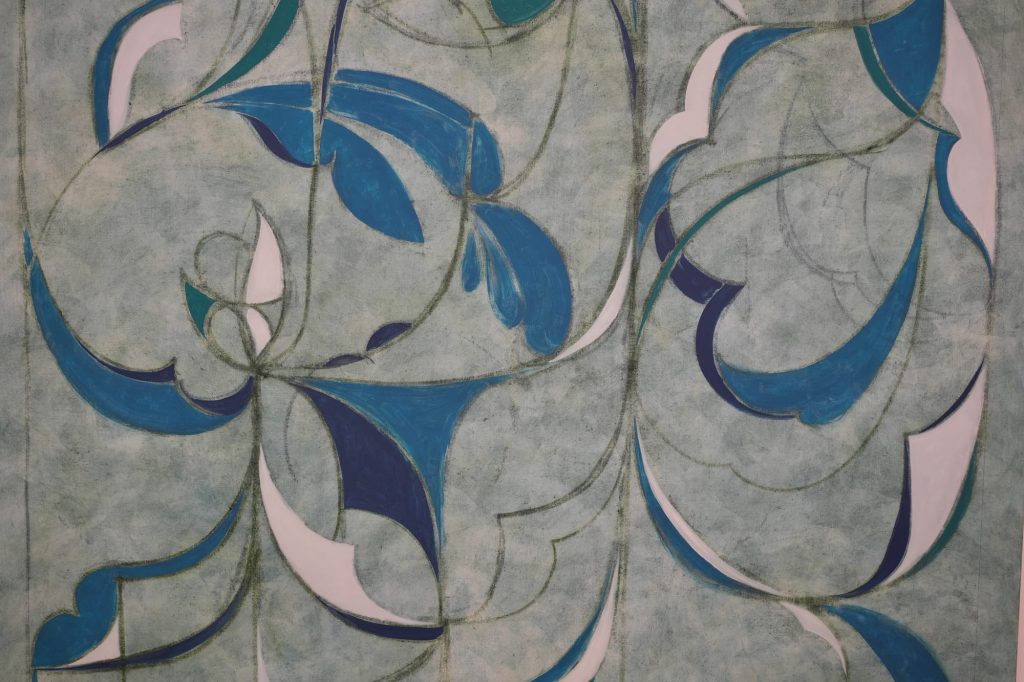
Aram, born in Iran and a Columbia MFA graduate, is celebrated for his innovative exploration of the grid. His work bridges the gap between Western modernist abstraction and Western Asian decorative arts, such as pottery and tilework. Aram challenges the notion of these sources as binaries, refuting Western modernism’s exclusive focus on self-referentiality and undervaluation of other visual languages. For Aram, the grid becomes a space where understanding line, shape, color, and arabesque meets cultural interplay.
At Nature Morte, Aram’s grid was prominently featured. His paintings utilized vertical arrangements intersected by curving forms, evocative of both organic and non-organic elements. The palette included reds, grays, blue-greens, and more, creating a liminal space between the natural and the abstract. Aram’s work invokes the rhythm and stylization reminiscent of Henri Matisse’s “Bathers by a River” (1917), not as a mere influence but a recasting. It recalls Matisse’s borrowing from Islamic decorative arts, challenging the modernist attempt to separate abstraction from decor.
In the Whitney Biennial, Aram tackled art history with “Descendants (Luster on Blue Glaze)” (2025), critiquing simplistic cultural binaries. The piece juxtaposes two book pages featuring a marbled vase within a grid of red lines and bars, with an important addition of Persian blue transforming the viewer’s cultural experience of the vase.
“Requiem for Perpetual Defeat” (2026) presents actual ceramic vessels in a tripartite walnut shadowbox. Each section displays a unique interaction of abstract compositions with an interplay of materials like textured glass, drawing parallels to James McNeill Whistler’s work.
The Art of Interplay and Cultural Narratives
Aram’s body of work does not merely reconstruct modernist abstraction or reincorporate Islamic idioms into contemporary practice. His practice intersects cultures, creating multifaceted and vibrant narratives without linear or hierarchical constraints.
The “Infrequencies” exhibition at Alexander Gray Associates offers a divergent approach with seven paintings, illustrating an irregular practice within Aram’s oeuvre. Loosening the grid, Aram embraces gestural brushwork, evident in “Exuberant Flâneuse” (2020), where dynamic colors and forms transcend the grid.
“Old World Telepathy” (2026) exhibits a fluid, surrealistic palette, resembling Aram’s absorption of diverse influences, creating a painterly language that symbolizes a fusion of global artistic expressions.
Kamrooz Aram’s work will be on display at Alexander Gray Associates until April 11 and continues to be featured in the Whitney Biennial until August 23. Through his art, Aram invites audiences to explore a world where cultural boundaries dissolve and art becomes a universal dialogue.