Melvin Edwards, Influential Political Sculptor, Dies at 88
Melvin Edwards, a renowned sculptor whose innovative abstract works intertwined the realms of traditional sculpture and the lingering shadows of Atlantic slavery, passed away on March 30 at the age of 88. His passing was confirmed by his gallery, Alexander Gray Associates.
Born in 1937, Edwards spent his formative years in the segregated society of Houston, Texas, before moving to the more integrated community of Dayton, Ohio. His family, not particularly religious but deeply political, instilled in him a belief in the power of education. His father was a pioneering Black official in the Boy Scouts and a co-founder of a Black political organization, emphasizing the importance of social and political engagement.
In Dayton, Edwards was profoundly influenced by his art teacher, Mrs. Bang, and had his first exposure to the arts at the Dayton Art Institute. As one of six Black high school students selected to visit museums closed to the public on Mondays, his artistic journey began. Although an accomplished football player, he chose to focus on art, eventually studying in Los Angeles, where he was inspired by the works of iconic artists such as Picasso and Michelangelo, graduating from the University of Southern California.
During his final college term, Edwards discovered welding, a medium that allowed him to explore the intersection of aesthetics and social issues. His great-grandfather’s legacy as a West African blacksmith and his family’s history of slavery informed his work, contributing to its rich historical and cultural resonance.
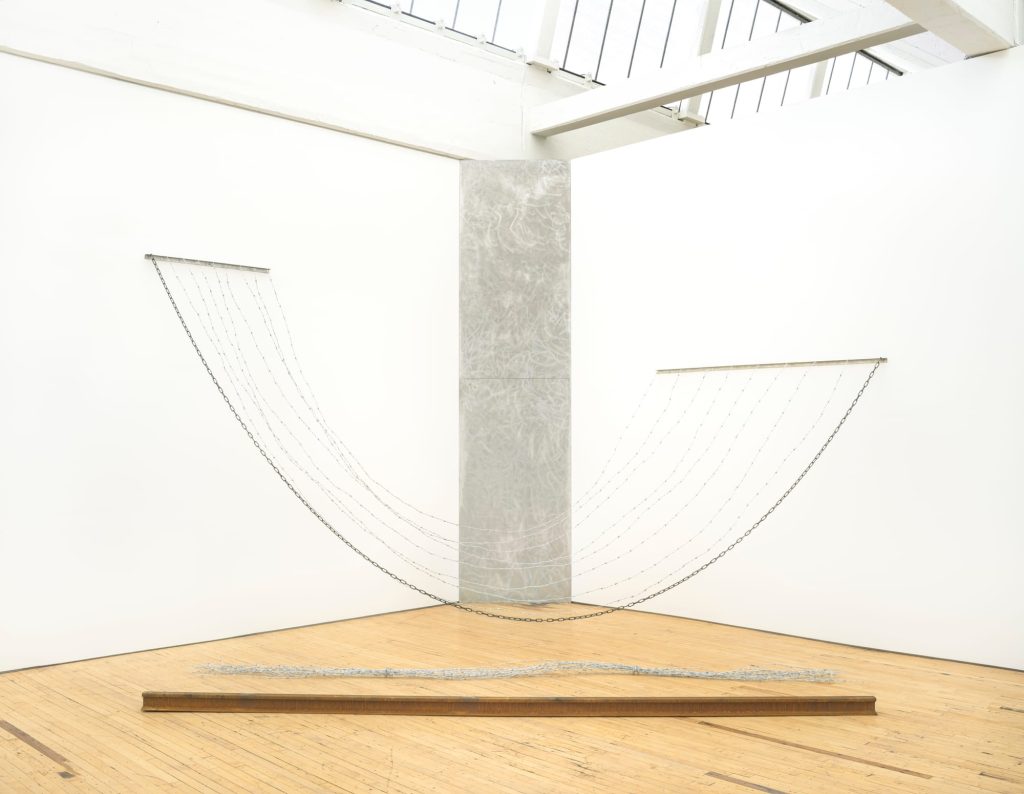
Edwards often utilized materials like chains and barbed wire, symbolically loaded with themes of violence and racial oppression. His work questioned American art developments, particularly Minimalism, and posed challenging questions about the role of abstract art in addressing racial politics.
In 1963, Edwards created “Some Bright Morning,” a piece that began the “Lynch Fragments” series, reflecting racial violence and the materiality of oppression. This series brought Edwards early acclaim, with museums like the Whitney and the Museum of Modern Art featuring his work in the mid-1960s.
Despite moving to New York in 1967, Edwards faced challenges within the institutional art world, contrasting with his profound connections formed in West Africa. A pivotal 1970 trip to the region deepened his understanding of its history and culture, leading him to establish a studio in Dakar, Senegal. His ties to Cuba, fueled by political sympathies, grew over several decades, beginning in 1981.
Edwards’s influence extended to artists such as David Hammons and Glenn Ligon, with his work later gaining broader institutional recognition. He collaborated with several galleries, culminating in significant retrospectives, including one at Paris’s Palais de Tokyo.
Edwards’s legacy is one of bridging cultural, historical, and artistic divides. His work, characterized by its oscillation between abstraction and figuration, continues to inspire and provoke, offering new insights into the intersection of art and politics. His sentimentality and embrace of cultural roots, coupled with his innovative approach, have left a profound and lasting impact on the art world.