An Artist Explores Metaphorical Themes Through Matzah Cracks
During her final year as a painting student in the Bachelor of Fine Arts program at Carnegie Mellon University, artist Emily Drew Miller placed a piece of paper over an old heater in her studio. When she rubbed a stick of graphite over the paper-covered lattice heater, the result reminded her of something familiar: matzah.
“That was around Passover in 2016,” Miller told Hyperallergic. “And since then, I’ve been experimenting with matzah around this time, and now that I’m saying this out loud, I realize that it is kind of my own Passover ritual.”
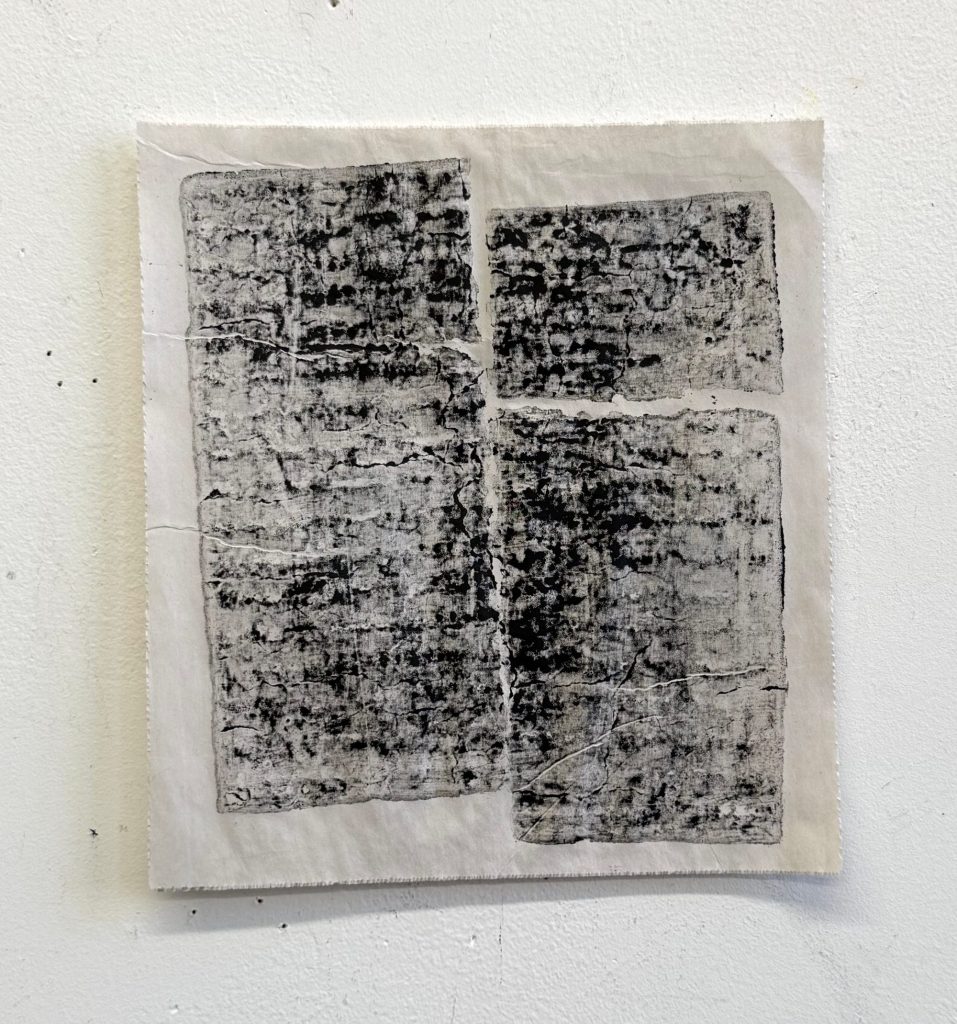
A decade later, the now New York and New Jersey-based artist has incorporated the unleavened bread into her practice of grid-based painting. For an ongoing series, Matzot, which she began in December, Miller runs sheets of matzah through a printing press to produce dark collographs. These black-and-white impressions showcase the range of textures found on the cracker-like sheets, including their natural and intentional cracks.
Miller’s prints translate the ubiquitous food, traditionally consumed on Passover to commemorate the Israelites’ exodus from Egypt and their journey to the biblical Promised Land, into a political exploration.
“They’re ominous,” Miller said, describing her square, roughly seven-inch matzah works, “but also kind of geological and ancient. It feels like there are fractures.”
The artist breaks apart and arranges some of her matzah sheets, but lets others crumble naturally under the press.
“The fractures in these images reflect how disconnected a lot of Jewish people feel from each other right now,” Miller said, “the metaphorical cracks between us, of Jews like myself who are rooted in texts and tradition and diaspora versus those who are motivated by territorial claims, domination, supremacy, Zionism.”
“If someone does not want to confront the politics of the current situation or see those cracks, they can choose to just see matzah,” Miller continued. “But if you are looking at them on a deeper inspection, maybe you can go there.”
As they dispel an imposed idea of a monolithic Jewish perspective, the collographs also call attention to a point of convergence, a shared tradition.
“Everyone I know who grew up Reform has consumed matzah, and every Orthodox person I know has consumed matzah,” Miller recounted. “This is something that unites us — food — but there are fractures.”
Miller lived in Israel and Palestine for some time, where she began questioning the pro-Israel beliefs she was raised with. While there, Miller maintained a plein air painting practice, depicting the architecture of the West Bank, Jerusalem, and Tel Aviv and observing the infrastructural discrepancies of life under occupation.
“I’m super proud of my identity as a Jewish person,” Miller explained. “But this feeling of love and pride feels somehow uncomfortable and murky when acts of violence are being committed under this banner of Jewish safety.”
Miller reflected on the threads that bind the Jewish diaspora as the holiday unfolds around the world. Globally, those observing Passover consume matzah at the Seder table to mark the biblical exodus, during which Jewish people left in such haste that their bread did not have time to rise.
“We have so much complexity within our different groups: who we are, what we actually believe, how we act as Jews,” Miller said. “Foods, or in this case, matzah, is one of the main consensuses that unites us.”