“Psychological Investigation of Existence and Mortality via Headless Girl Installations”
Late last month, nearly 92,000 attendees flocked to Hong Kong for Art Basel’s latest art exhibition. As usual, the organization’s Hong Kong edition brought together some of the most renowned artists and galleries from Asia and beyond, showcasing the contemporary art landscape of the region in all its variety. However, among the fair’s more than 170 presentations, one booth distinguished itself: Perrotin.
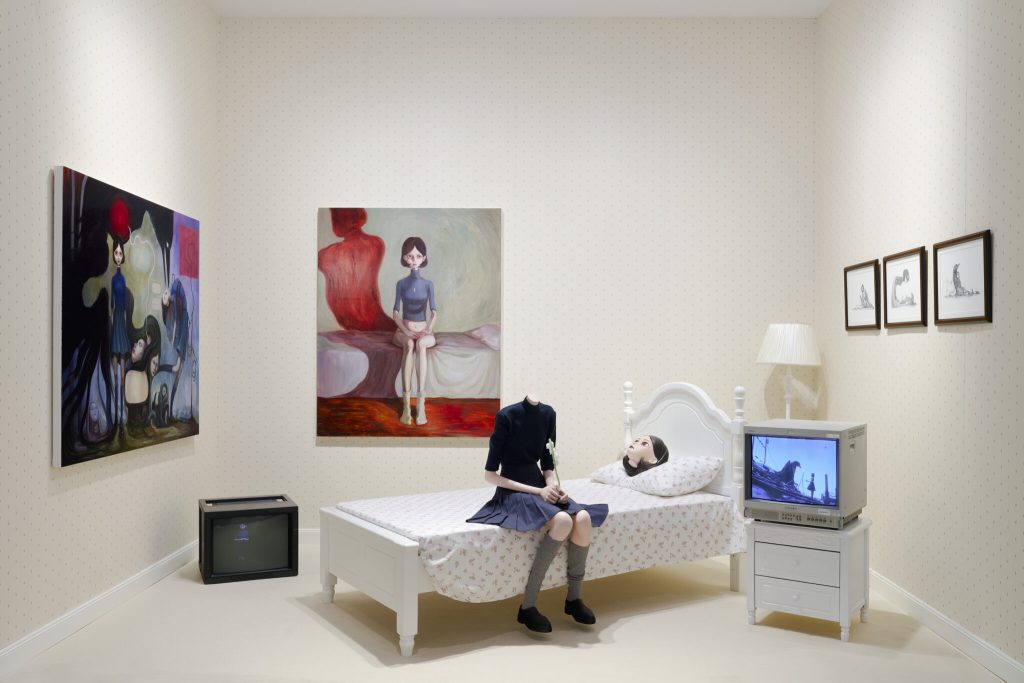
This year, the international gallery featured works by Mehdi Ghadyanloo, Steph Huang, and, perhaps most notably, Lauren Tsai. “This is my first collaboration with Perrotin and my debut at an art fair,” the multidisciplinary artist shared in a recent Instagram post. If there was any apprehension about her first time at an art fair, Tsai’s installation certainly didn’t show it. The immersive display illustrated the wide scope of her work, including drawings, grand paintings, stop-motion animations seen on vintage TVs, and a version of her installation Poison Little Girl.
Initially crafted in 2025, Poison Little Girl certainly formed the core of Tsai’s exhibition in Hong Kong. The sculpture portrays one of Tsai’s recurring figures, Astrid, sitting on the edge of a simple bed, her gray skirt fanned out around her. Even upon first sight, it’s obvious that something is amiss: the girl’s neck ends abruptly, entirely severed. Her head lies just a short distance from her body, resting on a pillow, eyes weary and sunken. The disquieting tableau is completed by a glowing lily-of-the-valley flower, its stem tenderly held by Astrid’s hands.
Like much of Tsai’s artistry, Poison Little Girl delves into psychological and transitional landscapes. The installation is part of a broader project known as The Dying World, where Astrid must confront themes of memory, transience, transcendence, loss, and death, which have underpinned Tsai’s work for years.
“Astrid herself grapples with the concerns I have regarding my identity and my body,” Tsai confessed in a 2025 interview with IndieWire. “The sensation of wearing a mask and feeling like a puppet.”
That’s exactly why Astrid appears vacant, a character that isn’t so much embodied as it is projected onto. Rather than merely being a human, this girl serves as a conduit for emotions to be visualized or comprehended, existing in what Perrotin describes as an “environment influenced by psychological rather than narrative logic.” That notion emphasized Tsai’s entire showcase, encouraging attendees to draw out their own interpretations based on the ensemble of interconnected works.
“I was intrigued by someone who might have slipped into being forgotten while they were still alive,” Tsai noted, “so that’s Astrid. And Astrid can navigate between these two realms, although in my mind, the Dying World and the real world are all one entity.”
Beyond this, the Perrotin presentation also experimented with scale. The Dying World incorporates various media, each assuming different dimensions—a fact Tsai aimed to emphasize during Art Basel. “I knew I wanted to create something that played with scale,” the artist explained to Vogue Hong Kong in a video interview, “because the project is rooted in stop-motion, which involves puppet animation. I sought to create a version of [Astrid’s] bedroom at a real scale while presenting elements at a miniature scale.”
In addition to Tsai, Perrotin also exhibited works by Takashi Murakami, Mr., Emi Kuraya, Emily Mae Smith, Danielle Orchard, Lee Bae, and Makiko Kudo, among others. To find out more about Perrotin’s booth and the 2026 art fair in Hong Kong, visit the Art Basel website.