Joan Semmel’s Exceptional Artwork Continues to Inspire at Age 93
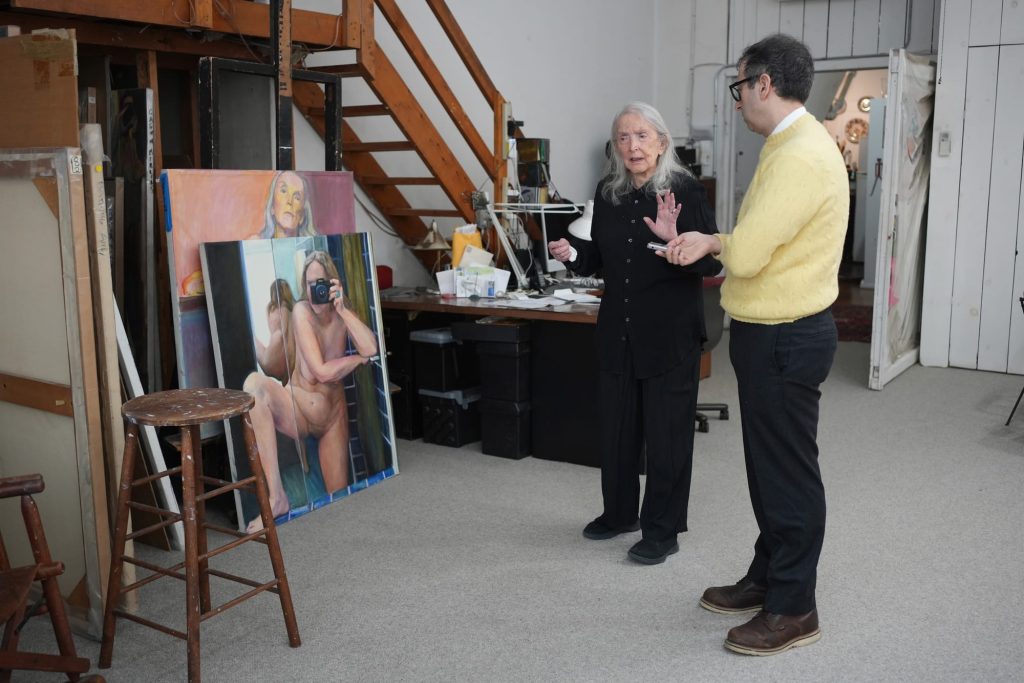
The entrance to Joan Semmel’s Soho loft immediately sets the tone with an evocative oil self-portrait titled “Mirrored Screen” (2005). This piece, reflecting not only Semmel’s likeness but also her exploration into themes of narcissism and self-perception, signals the deeply personal and introspective nature of her work. The artwork is part of a series from over 20 years ago focused on locker rooms, inspired by her interest in how popular culture reflects self-obsession. During this project, Semmel used a point-and-shoot camera in a fitness center on Bleecker Street to capture candid images of artists and dancers, inadvertently including herself when her camera’s flash caught her reflection. The resulting images presented an almost prophetic view of the 21st-century self-portrait—or the selfie.
Semmel’s body of work captivates audiences today, with her portraits experiencing heightened demand. Exhibitions like her retrospective at the Pennsylvania Academy of the Fine Arts in 2021 and the Xavier Hufkens show scheduled for 2024, alongside the current “Joan Semmel: In the Flesh” at the Jewish Museum, underscore this resurgence. Semmel expresses surprise at how younger generations find inspiration in her work, which she attributes to simply continuing her artistic journey into her 90s.
Born in 1932 in the Bronx, Semmel deviated from societal expectations to pursue art fervently. Her journey took a pivotal turn after a period of introspection during a tuberculosis hospitalization that propelled her beyond family-imposed limitations. Her exposure to the avant-garde art scene while living in Spain added a new dimension to her abstract art, influenced by contemporary Spanish artists who embedded political nuances into their works under Franco’s regime.
Upon returning to New York in 1970, Semmel sought to portray sexuality from a woman’s perspective amidst a predominantly male-dominated art world. Her “Erotic Series” (1972–73) challenged conventional depictions of sexuality, integrating a distinctly female viewpoint that was both empowering and radical.
Semmel’s embrace of feminist themes, coupled with her innovative artistic approaches, did not immediately translate into commercial success. Facing resistance, she took the bold step of showcasing her work independently. This determination underscored her commitment to exploring themes of female empowerment and autonomy, themes vividly present in her later “Intimacy Autonomy” (1974), which visually interlaces human intimacy with natural landscapes.
Over decades, Semmel has continued to refine and express a narrative centered on female agency and identity. Her more recent self-images convey the strength and presence of women, challenging flat portrayals by drawing viewers into the subject’s lived space.
Her latest works, on view at Alexander Gray this spring, such as “Blue Space” (2025) and “Satin Wrap” (2026), reflect her enduring vigor and are considered by Semmel among her finest. As her legacy cements, Semmel acknowledges the impact of her extensive career with pride, yet remains deeply engaged in the world she expresses through her art. Her ethos reinforces the power of persistence and evolution in the face of societal and artistic challenges.