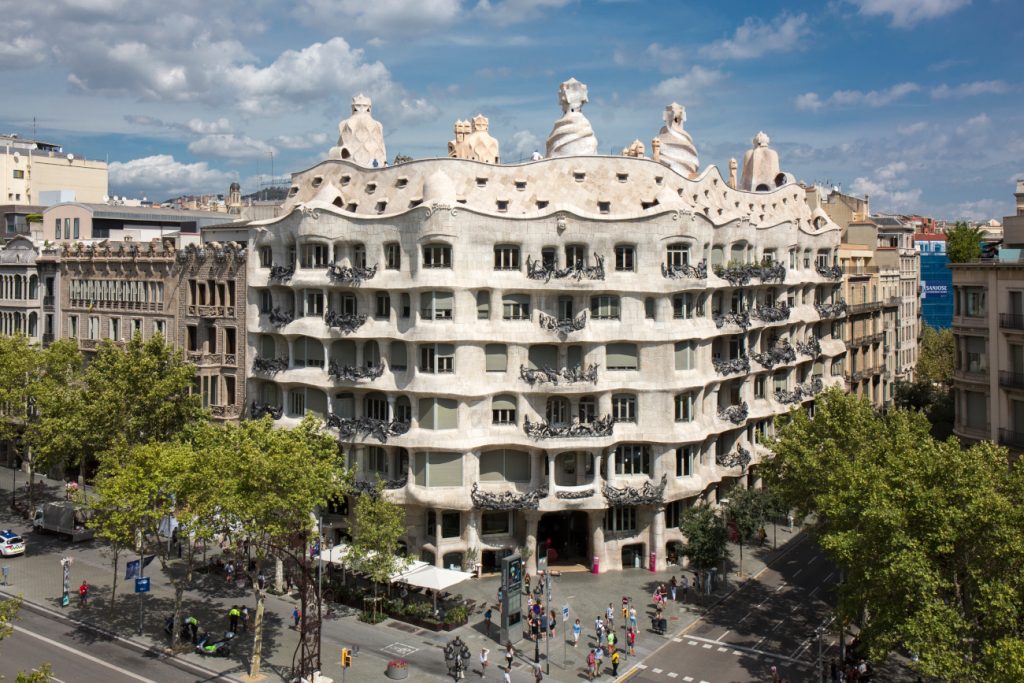
Casa Milà: The Renowned Residential Masterpiece of Antoni Gaudí in Barcelona
Image: ©Fundació Catalunya La Pedrera
Barcelona served as the imaginative canvas for architect Antoni Gaudí. From the intricate storytelling features of Sagrada Familia to the whimsical aquatic design of Casa Batlló, he portrayed his distinct perspective, deeply rooted in an appreciation for nature and geometry. Nonetheless, no edifice embodies his philosophy like Casa Milà, famously referred to worldwide as La Pedrera. This residential structure also functions as a museum dedicated to Gaudí’s legacy and the influence of his work on the city’s evolution.
Constructed from 1906 to 1912, Casa Milà stands as Gaudí’s final private dwelling. Commissioned by the affluent couple Pedro Milá y Camps and Rosario Segimon, the intent was for them to reside on the main level while leasing the remaining units. Today regarded as a hallmark of Barcelona and a UNESCO World Heritage Site, it faced skepticism from locals during its inception, who believed that the unconventional building would depreciate their property values.
This modernist masterpiece is globally recognized for its flowing stone exterior, complemented by wrought iron balconies embellished with organic designs. The name La Pedrera translates to “The Quarry” in Catalan, reflective of its distinctive look. Comprising two structures, it overlooks the Passeig de Gràcia, widely considered the most prestigious street in Barcelona. The building’s nine floors include a basement, ground level, mezzanine, main floor, four upper stories, and an attic.
Among all its groundbreaking features, the terrace of Casa Milà is truly stunning. This area is crowned by the “Garden of Warriors,” a series of towering sculptures that serve functional purposes; it boasts 29 chimneys, six stairwell exits or badalots, and two ventilation towers. Some are adorned with trencadis, a mosaic technique utilized by Gaudí, created from varied broken tiles.
“In Gaudí’s own words: ‘Buildings require a double roof, just as humans have both a hat and an umbrella.’ This illustrates Gaudí’s comprehension of the attic’s protective role and the dignification and personalization inherent in the roof,” states Fundació Catalunya La Pedrera, the non-profit organization that currently preserves the building. “Every component of the roof is meticulously designed with functionality in mind. The roof terrace is marked by organization, aesthetic finesse, and highly practical architectural elements.”
Though the terrace is alone worth the trip, Casa Milà also houses the Espai Gaudí, a cultural hub that delves into Gaudí’s life and creations via models, images, and videos. At the same time, the Pis d’Epoca restores the top-floor apartment to its historical grandeur, offering visitors a glimpse of how it looked as an elegant residence for a wealthy family during the early 20th century.
If you find yourself in Barcelona and wish to explore this iconic establishment, visit the Casa Milà website to purchase your tickets. To discover even more and take a virtual look inside, scroll down to view a video by My Modern Met’s Editor-in-Chief Eugene Kim at Casa Milà.
In Barcelona, Casa Milà serves as a museum exhibiting the legacy of architect Antoni Gaudí, illustrating how his work has influenced the city’s landscape.
Image: ©Fundació Catalunya La Pedrera
Among all its pioneering features, the most awe-inspiring aspect of Casa Milà is the terrace.
Image: ©Fundació Catalunya La Pedrera