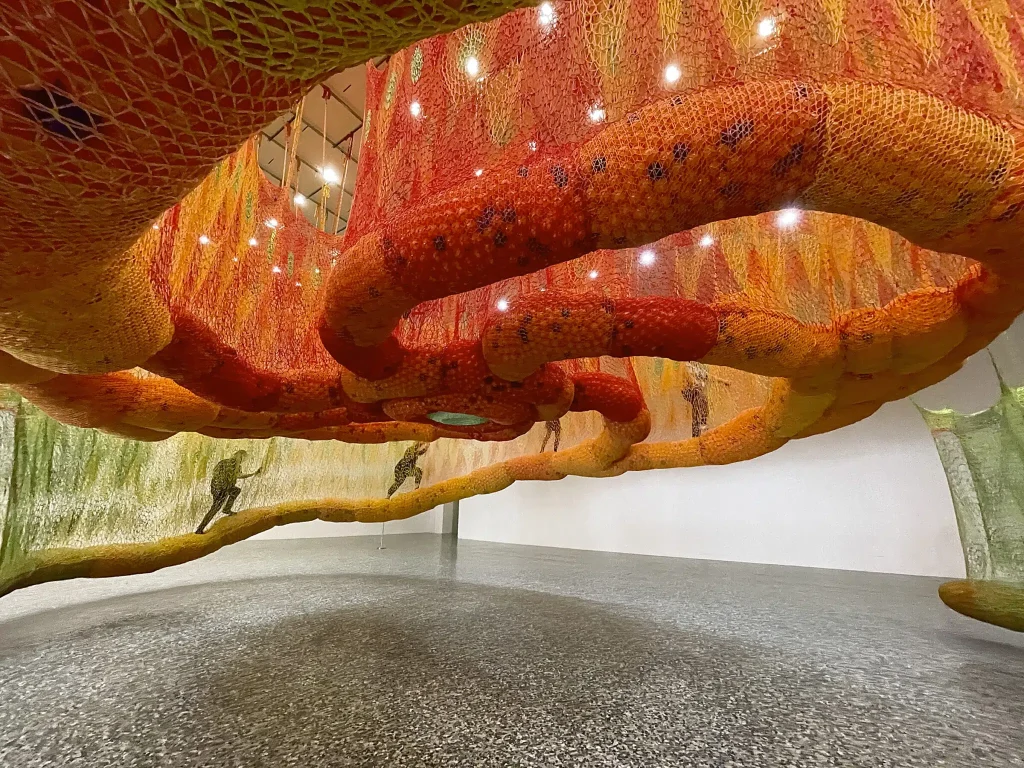
“Guests Can Navigate Aerial Routes in Hanging Maze Setup”
In 2019, the Museum of Fine Arts, Houston (MFAH) commissioned Ernesto Neto to create a monumental, site-specific artwork for one of its galleries. Approximately a year later, the museum revealed the commission, which has become one of the largest crochet pieces by the Brazilian artist to date. Now, following considerable anticipation and weeks of reconstruction, SunForceOceanLife has made its return to MFAH’s Cullinan Hall after its initial debut.
Suspended an impressive 12 feet above the ground, the immersive installation encourages visitors to navigate a maze of hand-woven paths. When seen collectively, these paths merge into a striking gradient, transitioning from buoyant greens and vibrant yellows to earthy oranges and deep reds. Though colorful in its own right, this palette serves another function, reflecting the cyclical connection among the sun, the sea, and the earth. This thematic exploration is deepened by Neto’s structural design, where each pathway is intricately stitched together in a spiral arrangement.
As guests ascend SunForceOceanLife, they may encounter a sensation of vertigo or imbalance. This is intentional—the installation is filled with soft, plastic spheres that alter underfoot. While traversing what initially appears to be perilous terrain, we are invited to confront our bodies and discover the best ways to maintain our balance, fostering a familiarity with ourselves that might otherwise go unnoticed or be taken for granted. As we progress, Neto hopes that our movements will relax further, leading us into a meditative mindset. By the conclusion of the experience, the structure might even take on the form of an existential hammock, enveloping us in the artist’s crocheted webs.
This interpretation holds true. “Neto observes that the feeling of floating, with the body supported by the crocheted results of our work, evokes the image of a hammock,” said Mari Carmen, MFAH’s curator of Latin American art, last month during an exhibition preview. “[It’s] the quintessential Indigenous creation that lifts us up and connects us to the wisdom and traditions of our forebears.”
Neto’s artistic approach has consistently centered on the vernacular and Indigenous cultures that characterize Brazil. Notably, it was his grandmother who first taught him how to crochet, a beloved Brazilian craft traditionally carried out by women on a small, delicate level, according to Carmen. However, in Neto’s art, crochet is anything but diminutive; his sculptures take on such grand dimensions and configurations that they become integral to the environments they inhabit. SunForceOceanLife exemplifies this; the installation measures 30 x 53 x 35 feet and has a weight of 6,000 pounds. Thus, it stands as a meaningful tribute to the natural world and the sun as the fundamental source that “supports all life on this planet.”
“I aspire for the experience of this piece to feel like a chant of gratitude to the immense ball of fire we refer to as the sun, an expression of thanks for the energy, truth, and strength it bestows upon us as it interacts with our lands, our oceans, and our lives,” Neto expressed regarding the installation.
SunForceOceanLife is presently on display at the Museum of Fine Arts, Houston, until September 7, 2026. To experience the installation, visitors are required to sign a waiver, wear MFAH-provided socks, and confirm their ability to walk unassisted. For additional details, please visit the MFAH website.