Venice Biennale Awards Jury Excludes Russia and Israel from Consideration
**Venice Biennale 2026 Takes Stand Against Nations with ICC Charges**
The 61st International Art Exhibition of the Venice Biennale has made headlines with its international awards jury’s groundbreaking decision to exclude any countries whose leaders are currently accused by the International Criminal Court (ICC) of crimes against humanity from consideration for awards. This decisive action reflects the jury’s commitment to ethical principles and a broader discourse on the relationship between art, artists, and the nation-states they represent.
In their statement, articulated on e-flux, the jury underscored the intertwined nature of artistic practices and national representation at the Venice Biennale, highlighting the responsibilities artists have to the actions of the state they embody. The statement resonated with the artists involved in the central exhibition “In Minor Keys,” including Carolina Caycedo, Walid Raad, and Zoe Leonard, who previously issued an open letter supporting such ethical foundations for international participation.
This year, the jury, chaired by Solange Farkas and comprising other influential figures such as Elvira Dyangani Ose and Giovanna Zapperi, is tasked with bestowing two Golden Lions—one for the best national pavilion and another for the best artist in the coveted international exhibition curated by the late Koyo Kouoh.
While the jury refrained from naming specific countries, Russia and Israel are prominently implicated due to existing ICC warrants against their leaders, President Vladimir Putin and Prime Minister Benjamin Netanyahu, for alleged war crimes in Ukraine and Gaza, respectively. These exclusions align with mounting global criticism towards the Biennale Foundation’s tolerance of Russian and Israeli participation, resulting in widespread backlash, including petitions and threats to cut funding from the European Union.
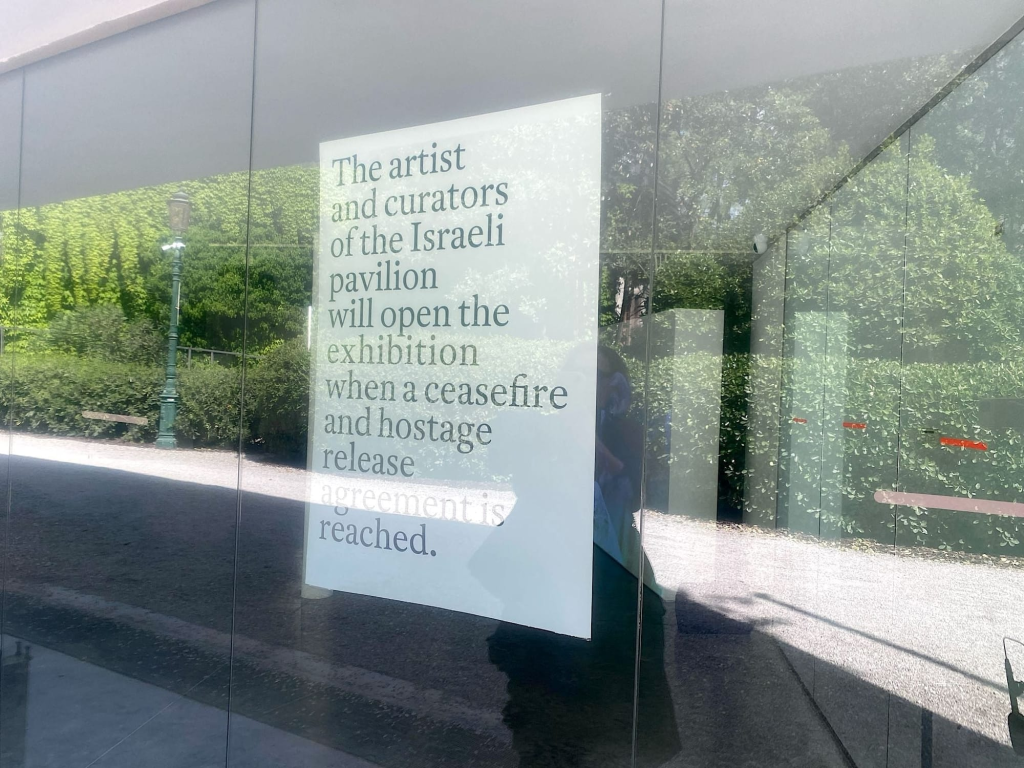
The controversy has not spared Israel’s pavilion, reportedly under renovation, yet temporarily situated within the Arsenale complex. Its participation has continued to spark protests and was partially suspended in 2024 by artist Ruth Patir and curators Tamar Margalit and Mira Lapidot, who demanded an end to hostilities as a precondition for reopening.
These responses echo the calls for a boycott led by the Art Not Genocide Alliance (ANGA), bolstered by signatures from numerous artists and curators demanding Israel’s exclusion. Despite commendation for the jury’s declarative actions, ANGA expresses that the failure to explicitly name Israel limits the statement’s impact and contributes to ongoing impunity.
The Biennale’s unfolding scenarios embody a complex narrative of art confronting geopolitical realities, reminding us of the critical need to heed not just the dominant narratives but the softer, quieter voices that advocate for the dignity of all living beings. The Biennale Foundation has yet to issue a formal response to these developments.