The Decline and Closure of Traditional Art Schools
In a faculty meeting last year at Purchase College in New York, a colleague in the administration referred to students as “consumers.” It was a casual statement, and I pushed back. The exchange was brief, but it has deeply bothered me ever since. Not because the intention was sinister. Because their statement was precise. Once you call students consumers, you have already restructured every relationship on which the university depends.
Definitions matter. Terms like participant, member, student, client, user, customer, citizen, and constituent carry distinct social logics. A participant or member belongs to a shared institution. A buyer or subscriber belongs to a market.
Students are not buyers or consumers. They are participants in the production of knowledge. More importantly, they are future members of a public that does not yet exist. In that sense, an art school, college, or university is a factory. But what it produces is not a commodity. It is a capacity for thinking, for argument, for questioning without a predetermined answer. Faculty do not work for students the way a salesperson works for a client. They work with students toward something larger. That is not a transactional relationship. Faculty and staff are meant to serve a public. Tuition is not proof that students are customers. It is proof that the liberal state has failed them, just as it has failed them in healthcare. Rather than treating education as a public good, elected officials shift the burden onto individuals, underfund institutions, and protect a system that redistributes wealth upward. Financialization destroys the relation between education, citizenship, and the public world that the university is supposed to build.
The neoliberal university has been doing this for decades. Tenure lines have been replaced with precarious contracts. Public funding has been cut. Austerity returns again and again. When success is evaluated by market metrics, every relationship collapses into a transaction. Students become customers, knowledge becomes a product, and faculty become service providers. The institution is increasingly run like a business rather than a public good.
Then there is “administrification.” A study by the American Association of University Professors has shown that between 1976 and 2011, non-faculty professional positions, especially in student services and administration, grew by roughly 369%, while full-time tenured and tenure-track faculty grew by only 23%. In recent years, that pattern has only intensified. Universities have added more administrative layers while shifting teaching onto cheaper, less secure, and more precarious labor. At Purchase, where I teach, the local record reflects the same trend. Tenure-track positions are being eliminated, often justified by the “demographic cliff,” and replaced with visiting lecturer lines, not even visiting assistant professorships.
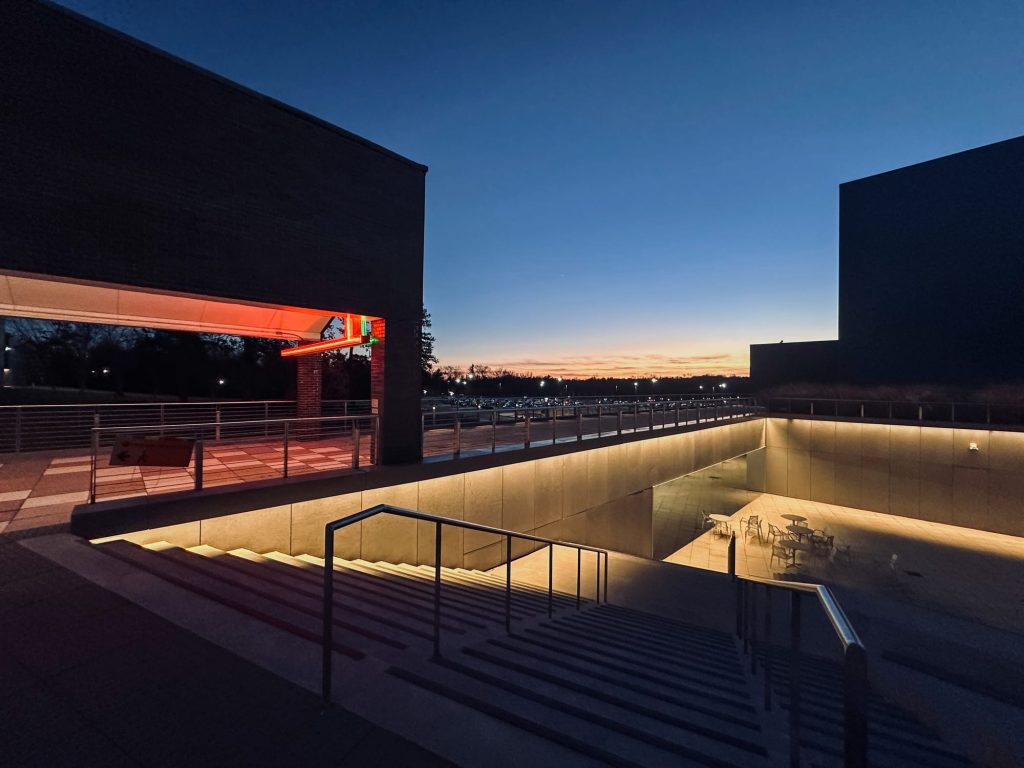
Sunset at Purchase College, looking across the courtyard of the 75,000-square-foot Center for Integrated Technology & Learning, designed by FXCollaborative.
In the meantime, between 2016 and 2024, average top salaries for administrators at Purchase College rose by more than 45%, while average assistant professor salaries rose by just around 14%. Cumulative inflation over the same period was 31%. In real terms, the people doing the intellectual work lost ground while the managerial and policing apparatus grew. Among the 25 highest-paid positions at the college, only one is held by a professor. Fifteen are held by administrators and nine by police officers. The Purchase numbers are not a local anomaly. According to a recent CUPA-HR study, which tracks compensation across more than 1,000 institutions, administrator salaries have outpaced inflation nationally for three consecutive years while tenure-track faculty have seen no real salary increase in over a decade.
The new administrative order sets the terms and decides what counts. What this produces, beneath the numbers, is steady deintellectualization. And it is students who ultimately bear the cost of this transformation, even if they are the last to see it. Learning does not happen under bureaucratic control. It happens in a free community where the people responsible for producing knowledge are encouraged, respected, and not silenced by administrative pressure.
The aftermath of the Gaza protests made this concrete. When students organized for human rights on several campuses in May 2024, the response was swift. Police were called in, and encampments were cleared. Students were suspended or even expelled. The same institutions that had dedicated years to publishing statements about critical thinking, civic engagement, decolonization, and land recognition moved against all of it the moment it became inconvenient. The response revealed how quickly universities abandoned their stated commitments once political pressure intensified. The university had effectively become a policing institution, controlling speech and disciplining bodies in the name of public order.
There is another ledger worth examining. In New York alone, universities have been spending heavily on capital projects as architectural statements of ambition. The New School built a 16-story University Center at 65 Fifth Avenue, its largest capital project ever. Cooper Union, which