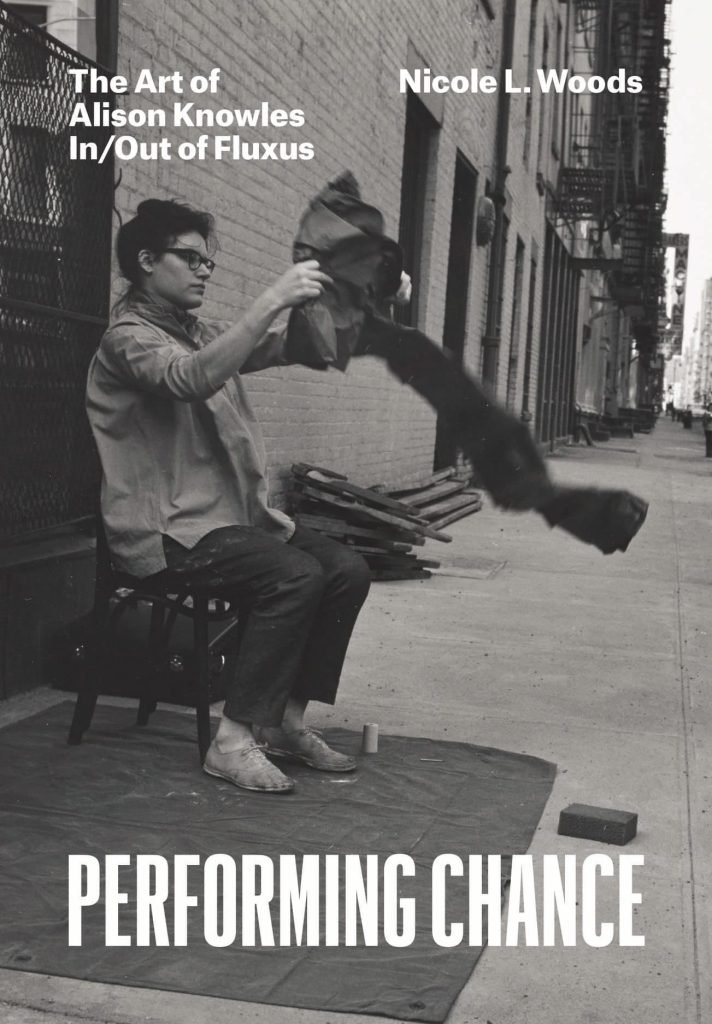
Exploring the Enigmatic Life and Work of Fluxus Artist Alison Knowles
In October 1962, Alison Knowles transformed the ordinary act of making a salad into a novel form of art. Her piece, “Proposition #2: Make a Salad,” was first performed at London’s Institute of Contemporary Arts during the Festival of Misfits—a lively event curated by poet and art dealer Victor Musgrave, which marked the introduction of the Fluxus group to Great Britain. On stage, Knowles and her collaborators prepared the salad in a pickle barrel and served it to nearly 100 attendees, elevating this simple task into a communal and transcendent performance. This early work exemplified Knowles’s talent for crafting unexpected situations that drew from ordinary life, a tendency that would characterize her artistic career for over sixty years.
Nicole L. Woods’s book, “Performing Chance: The Art of Alison Knowles In/Out of Fluxus,” is the first comprehensive study of Knowles, who passed away last year at the age of 92. Although Knowles was a prominent figure as the only female founding member of the international Fluxus group, her work has remained relatively unexplored. This is due to several factors: the ephemeral, multidisciplinary, and challenging nature of her art, her marginalized status among male Fluxus peers, and her own habit of destroying artwork once she moved beyond it. Woods describes Knowles’s art as “stubbornly subtle,” much like the artist herself—a woman of remarkable humility.
The book focuses on the first two decades of Knowles’s career, from about 1958 to 1975, with each chapter dedicating itself to one or two pieces of her work, thereby chronicling her artistic journey. Woods details a pivotal moment in Knowles’s career when she transitioned away from painting, a decision made following a strained experience with Josef Albers at Syracuse University. From then on, Knowles embraced a range of experimental works that included performance, installation, poetry, sculpture, and even computational art.
Woods’s detailed analysis of Knowles’s artworks is a strong point of the book, drawing art historical connections and parallels with broader cultural movements. However, there are times when Woods seems to overinterpret Knowles’s intents, as with the performance “Identical Lunch,” where she suggests themes of ecological and public health concerns without enough supporting evidence.
While Woods aims to present both Knowles’s art and life, the personal aspects remain underexplored in the text. Significant personal relationships, particularly with her husband, Dick Higgins, are only briefly discussed, and the challenges of balancing her career with family life receive minimal attention. Though the book is positioned as a monographic study rather than a biography, the lack of personal detail detracts from a comprehensive understanding of how Knowles’s identity as a woman influenced her work.
Woods undoubtedly is an authority on Knowles, informed by extensive research and many years of interviews with the artist. However, Knowles’s own voice is infrequently represented, and the book could benefit from more of her personal reflections to offer deeper insights into her innovative contributions to art and her enduring legacy.
“Performing Chance: The Art of Alison Knowles In/Out of Fluxus” by Nicole L. Woods (2026) is published by the University of Chicago Press and available in bookstores and online.