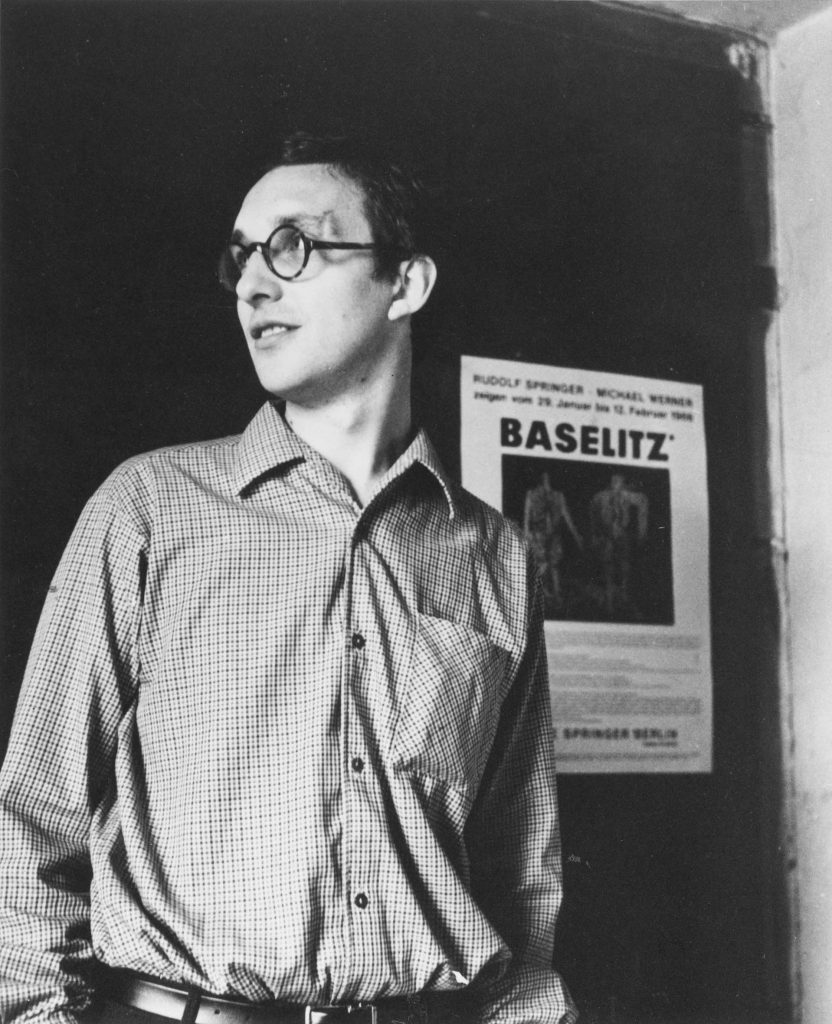
Artist George Baselitz, Known for Exploring the Tortured Male Genius Myth, Dies at 88
Georg Baselitz, an Intense Influence on Neo-Expressionism, Passes at 88
Georg Baselitz, a towering figure in the art world known for his vigorous and often controversial Neo-Expressionist paintings, has passed away at the age of 88. The announcement came today, April 30, from his representative gallery, Thaddeus Ropac. Baselitz, whose artwork had a significant impact internationally, leaves behind a legacy characterized by powerful and frequently unsettling imagery.
Tragedy and Controversy
Baselitz attracted both acclaim and controversy throughout his career. In 2013, he made headlines with his remarks to the German newspaper Der Spiegel, asserting that “women cannot paint very well.” Such provocations were reflective of the themes present in his work, many of which centered around the machismo of male creativity. His impactful 1960s series, “Heroes,” metaphorically stacked the drama of male struggles through portraits of soldiers, reflecting a tragic grandeur reminiscent of German romanticism.
Shaped by Wartime Experiences
Born in Deutschbaselitz, Saxony, in 1938, Baselitz’s early life was shaped profoundly by World War II. Experiencing the destruction of the war first-hand, including the bombing of Dresden, these events sewed roots of trauma and introspection that would later surface in his paintings. Baselitz’s academic journey took him from studying Social Realism in East Berlin to embracing more expressive forms after being exposed to American Abstract Expressionism in 1958.
Radical Transformations and Neo-Expressionism
Baselitz’s artistic evolution was marked by his encounters with Abstract Expressionism, which prompted him to embrace a more dynamic and emotional style. Admiring artists like Willem de Kooning, he incorporated elements that foregrounded the organic and vulnerable aspects of the human body. His work “The Big Night Down the Drain” (1962-63), which depicted a grotesque male figure, was once seized for its explicit nature, manifesting his confrontational approach to art.
The 1969 debut of his “upside down” paintings marked a pivotal shift, rerouting viewer focus from representation to the language of form and medium. As a progenitor of Germany’s Neue Wilde, Baselitz influenced a younger generation who echoed his rebellion against the minimalist and conceptual art movements dominating the 1980s.
Monumental Works and Revisitation
Increased momentum saw Baselitz’s works grow in scale and complexity, as with “Dinner in Dresden” (1983), reflecting not only historical but also existential crises. His later works revisited earlier themes through series like “Remix,” where he re-imagined previous pieces with a looseness that added layers of nuance and commentary.
Final Chapters and Legacy
In his twilight years, Baselitz’s work touched on themes of aging and mortality, evidenced in later pieces such as “Surdororeal” (2019). His final contributions, including the 2025 painting “What is, is was not,” spoke to the inevitability of death, painting a poignant conclusion to a career defined by intensity and introspective exploration.
Baselitz’s final paintings will be presented posthumously in the exhibition “Eroi d’Oro” at the Fondazione Giorgio Cini in Venice, opening May 6. This obituary pays tribute to an artist whose bold dissection of the human condition left a profound and indelible mark on art history.