Monumental Paper Art Installations Showcase Japan’s Shinto Traditions
In the Shinto belief system of Japan, kami signifies the spirits that inhabit the natural world. These divine beings exist as ethereal yet frequently unseen forces, enlivening the environments around them as they navigate through ancient forests, towering peaks, and drifting clouds. In the Japanese language, kami also translates to “paper,” a more common yet equally meaningful term. This duality serves as the foundation for Ayumi Shibata’s artistic approach, exploring the connection between animist beliefs and paper as a creative medium.
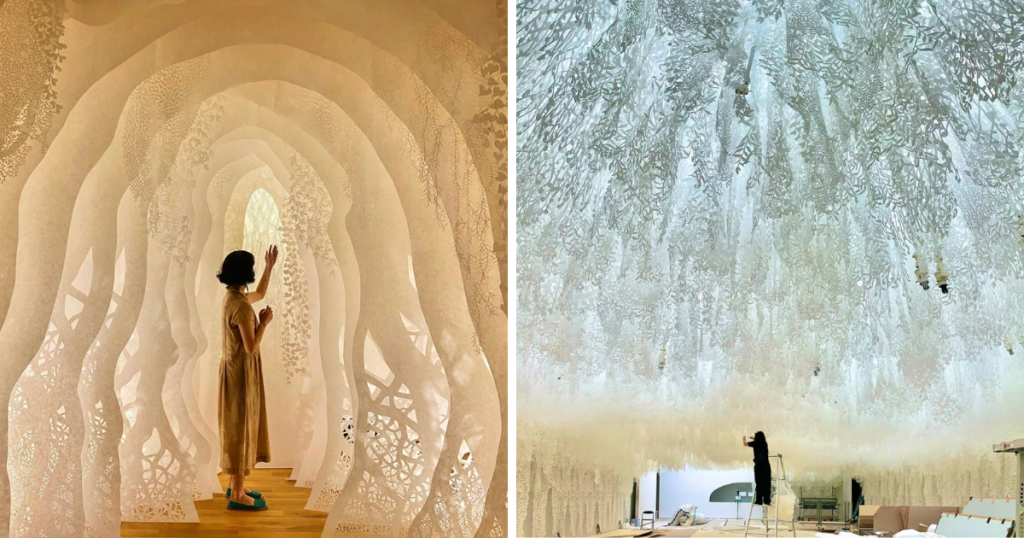
For many years, Shibata has pushed the boundaries of paper, transforming this delicate substance into immersive, intricately detailed sculptures that invite prolonged observation. The artist typically favors organic motifs, reflecting the bond between kami and the natural realm. These Shinto elements are accentuated by her use of white paper, regarded as sacred within the faith. Indeed, white paper, or shide, is frequently utilized to mark sacred areas, acting as a tangible representation of kami and their existence in the locale. Accordingly, Shibata’s sculptures carry these elements of sanctity, offering a refuge not only for our visual appreciation but also for the spirits that oversee our environment.
“Invisible kami inhabit various objects, events, and locations, including our homes and bodies,” the artist remarked in a 2022 discussion with Colossal. “I employ my technique to convey my gratitude to kami for being born into this life. Each sheet of paper I cut serves as a prayer.”
Across her body of work, Shibata has molded paper into everything from illuminated metropolises to floating canopies, whose leaves gracefully dance in the breeze. One of her most ambitious installations, Kamigami Forest, showcases a thick woodland topped with intricate arrangements of leaves and roots. Central to the installation is a layered void, a passage or threshold through which viewers are invited to journey. This participatory experience, as Shibata implies, resembles a pilgrimage, traveling through sacred ground alongside kami.
“I believe my work [offers] a space to encounter both the tangible and intangible realms,” Shibata shared with deMilked. This perspective reveals that Kamigami Forest, as well as Shibata’s other works, orchestrate interactions between what is visible and what lies beyond perception. Under these conditions, we can perceive the vastness of existence, even if only fleetingly.
Recently, Shibata has been creating slender, airy sculptures, reminiscent of both whirlpools and coral structures. These more abstract forms represent a natural progression in the artist’s evolution, providing an alternate gateway into sacred spaces and the spirits residing within. They also deepen Shibata’s comprehension of material and immaterial contexts, building upon the figurative vocabulary that initially characterized her work.
“Kami traverse freely across time, universes, and locations,” Shibata noted. In many respects, her art operates similarly, seamlessly moving among places of spiritual significance.
To discover more about the artist and receive updates, visit Ayumi Shibata’s website and follow her on Instagram.
Through her artwork, Ayumi Shibata connects paper with Japan’s Shinto beliefs, delving into the connections between sacred spirits and artistic expression.
The Japanese artist frequently uses white paper, which is deemed sacred in the Shinto tradition.
Mirroring the deep ties of Shintoism to nature, Shibata is also drawn to organic representations, spanning from lush forests and canopies to swirling vortexes.
Ayumi Shibata: Website | Instagram
Related Articles:
– Laser-Cut Paper Art Showcases the Astonishing Intricacy of Living Organisms
– Artist Transforms Traditional Korean Paper Into Poetic Floating Landscapes
– Artist Crafts Detailed Paper Sculptures To Address Our Continuous Climate Crisis