The Cost of Painting a Pompeii Room with Egyptian Blue
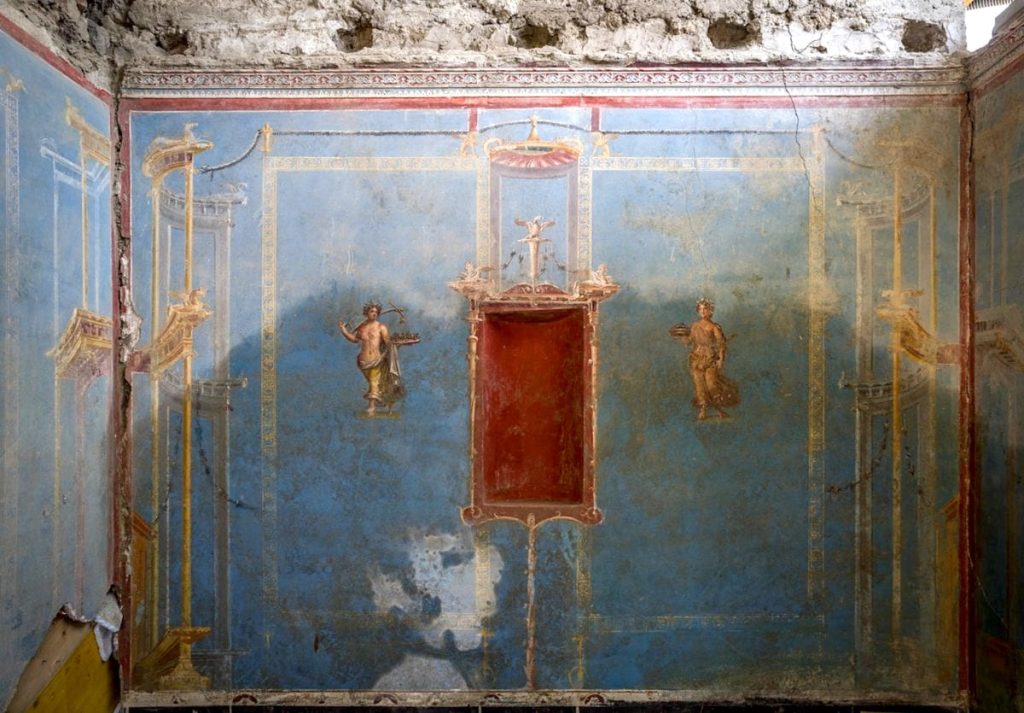
In the summer of 2024, a dazzling “Blue Room” emerged from the ashes of Pompeii during ongoing excavations within the ancient Italian city. The striking Egyptian blue covering its walls hinted at a shrine, or sacrarium, used for rituals or storing sacred objects. A new study revealed the high cost of using Egyptian blue in the first century CE, estimating the price of painting the room as equivalent to between 50% and 90% of a Roman legionary’s annual salary.
Blue, though beautiful, was rare in nature. Lapis lazuli, a natural source, was mined from faraway Badakhshan in modern northeastern Afghanistan and was exceedingly costly. In response, the synthetic Egyptian blue was developed using a mix of sand, lime, copper, quartz, and alkali. This pigment appeared in Ancient Egypt as early as 3300–3200 BCE, later spreading to Anatolia and Mesopotamia, and even made its way to Puteoli, near Pompeii.
Inside the Blue Room, researchers found that artisans likely used between 2.7 and 4.9 kg of pigment to cover the space. By using Roman literature and new scientific techniques, the study estimated the painting cost between 93 and 168 denarii, or roughly the value of 744 to 1344 loaves of bread. Comparatively, a Roman foot soldier earned about 187 denarii annually.
Additionally, the labor involved in pigment preparation was significant. Prior research suggested that grinding the pigments alone required 31 to 56 labor hours. Despite these costs, Egyptian blue was popularly used by Pompeii’s wealthy citizens, not just for aesthetic reasons but also as a statement of wealth and status. The study not only highlights the expense of art in ancient Rome but also showcases how modern technology and scientific methods can uncover the colorful past of ancient civilizations.