The Official Declaration of Frida Kahlo’s Canonization
An exhibition blasts apart any crystallized conception of the artist until no easily digestible singular figure emerges.
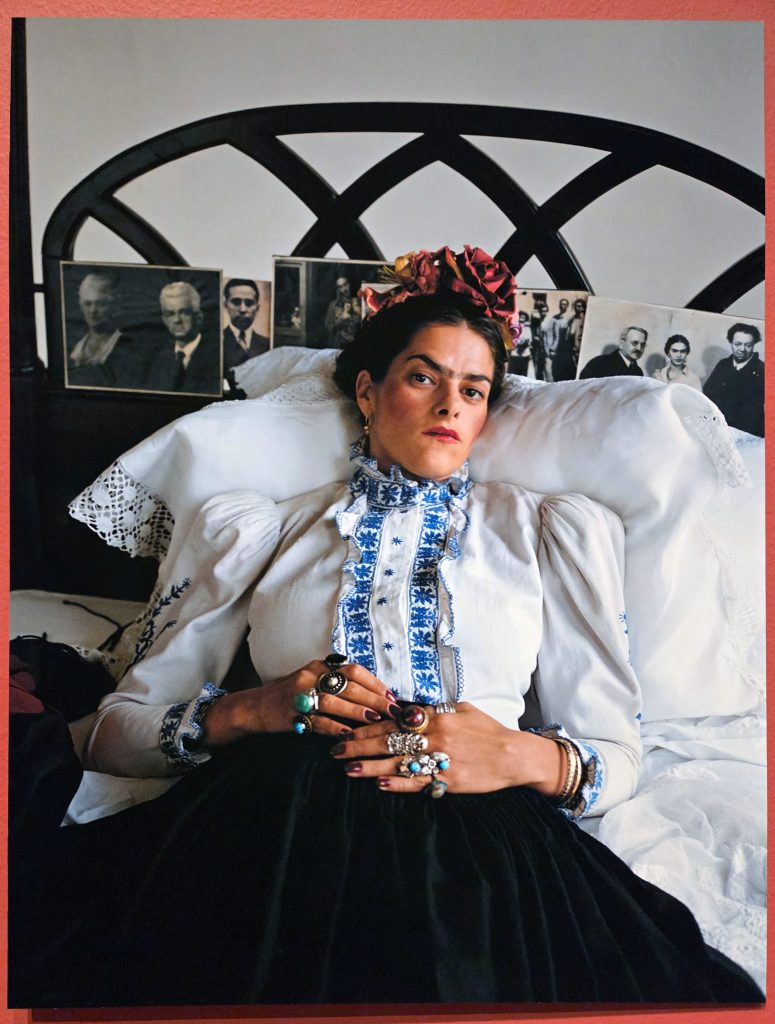
HOUSTON — Frida Kahlo is already a canonical Mexican artist, but Frida: Making of an Icon at the Museum of Fine Arts, Houston positions her as an emblem of the metaphorical and geographical borderlands. With an emphasis on the reception of Kahlo’s work across times and cultures in the past century, the exhibition blasts apart any crystallized conception of the artist until no easily digestible singular figure emerges. That is, indeed, the point.
The show is organized by theme and consists of both Kahlo’s work and those by artists who were part of her community as well as those she influenced. Three of the sections, consisting of a majority of the 35 works total, are dedicated to the artist’s work, while a whopping 13 explore her impact and influence via more than a hundred works by related and subsequent generations of artists.
Left: Frida Kahlo, “Untitled (known as Pancho Villa y Adelita)” (1927), oil on canvas; right: Frida Kahlo, “Retrato de Miguel L. Lira” (1927), oil on canvas
The section “Early Experimentation” displays four of Kahlo’s works from the mid-1920s, made during her student years, alongside two family photos. Here, Kahlo was finding her voice, and not all of her experiments were successful, including her brief foray into Cubism in “Untitled (known as Pancho Villa y Adelita)” (1927). Kahlo’s stylistic interest in Mannerist Renaissance portraiture, on the other hand, is a revelation, as seen in works that showcase shallow depths of field and delicate linearities.
“Surrealist Affinities” brings into view Kahlo’s connection to André Breton, who organized a Parisian exhibition of her works alongside that of José Guadalupe Posada and Manuel Álvarez Bravo in 1939, titled Mexique. This section also highlights self-portraits from Kahlo’s contemporaries, such as María Izquierdo, whose “Sueño y presentimiento” (1947) depicts the artist holding her own decapitated head. Taken together, this part of the show situates the artist as not only a Surrealist, but also an active participant in larger regional and artistic circles.
The exhibition’s strength is in historicizing how Kahlo came to mean so much to so many, crediting Chicana/o artists with rediscovering her to forge an art history in their