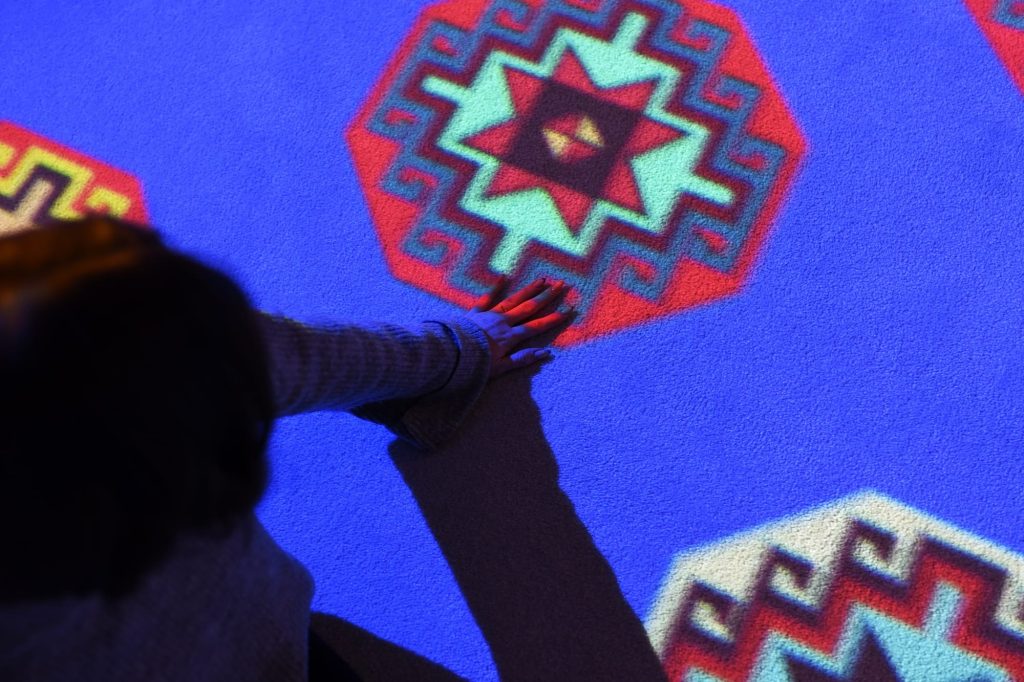
Artists Initiate the Islamic Futurism Movement
What might a Muslim future look like? Who gets to imagine it, and on what terms?
In the visual arts, these questions are unfolding in real time across studios, exhibition spaces, and online platforms. Artists are drawing from Islamic philosophy and long-standing visual traditions in expanded ways, working through code, installation, digital environments, and speculative image-making. Some embrace the terms “Islamic” or “Muslim futurism”; others move alongside it. What’s taking shape is a living framework grounded in inheritance, tracing back to medieval Islamic astronomers who mapped the skies, and oriented toward what comes next.
Of course, Islamic futurism does not emerge in isolation. Afrofuturism established a powerful and inclusive precedent, demonstrating how subaltern histories and cosmologies could be mobilized to imagine collective futures. The term “Islamic” does not describe a single culture or aesthetic, nor does it refer only to religious practice. It moves across regions shaped by Muslim presence, trade, scholarship, and empire. Rather than fix the term in a single place, it may be more useful to treat it as a proposition — one that asks how historical consciousness shapes visions of the future informed by global Islamic art.
Calligraphy offers a clear point of entry: As the visual medium of Qur’anic revelation, it carries devotional authority and formal discipline, shaping manuscripts, objects, and architecture across centuries. Long before the term “Islamic futurism” circulated widely online, Sudanese modernist painter Ibrahim El-Salahi was already asking what that script could become.
Often described as a pioneer of the Hurufiyya movement — in which artists across Southwest Asia and North Africa brought Arabic letterforms into modern painting in the 1950s to ’70s — El-Salahi folded calligraphy into modernist composition, drawing on his training in London. Over time, legible letters loosened into fragments, stretching and unfolding until faces and animals surfaced from fields of abstraction. He often begins with prayer and meditation before beginning what he calls a “seed” drawing that expands across the canvas.
“I have finally arrived at the conclusion that the work of art is but a springboard for the individual intellect,” El-Salahi wrote in an essay for the catalog accompanying his 2013 show at Tate Modern. “The picture floats freely … an invitation to visual meditation and to a better knowledge of the self.”
El-Salahi’s abstraction marks one trajectory of calligraphy and a mode of introspection. Artist Soraya Syed, who is of mixed Pakistani-French origin, represents another, demonstrating how the form’s classical foundations remain alive and dynamic.
Long captivated by Arabic calligraphy, Syed undertook a seven-year apprenticeship in Istanbul and earned her icazetname — a formal license certifying mastery and authorizing transmission of the classical form — making her the first British person to receive this distinction.
For Syed, the relationship between the human body and the letterform is foundational.
“I was never convinced by the idea we were taught at university that Islamic calligraphy flourished simply because figurative art was restricted,” she told Hyperallergic. “The classical system itself is proportioned through bodily geometry.” Within this system, letters are measured through ratio and movement; transcribing them correctly requires an embodied understanding of how the hand, breath, and pen align. Script, in this sense, is choreographic.
In Syed’s collaborative animation installation “Hurriyah” (2013), set to music by Nitin Sawhney and accompanying dance by Salah El Brogy, and in later immersive works, the letter leaves the page and enters the environment. In these contemporary translations, Syed insists on rigor. “Remaining in dialogue with tradition does not mean preserving it unchanged,” she reflected. “It means understanding it deeply enough to respond to it.”
Like calligraphy, architecture emerged from a philosophical understanding of order. Architectural forms often labeled “Islamic” — domes, arches, intricate surface patterning — draw on Byzantine, Roman, and Sasanian precedents that predate Islam, later reoriented within sacred and civic settings. Across mosques, palaces, and manuscripts, interlocking stars and tessellations extend without a central figure. Within Islamic thought, geometry articulates tawhid, the unity of all things, and mizan, the principle of balance that governs creation.
Islamic intellectual traditions understand geometry as a bridge between the material and spiritual worlds, translating metaphysical principles into proportion and pattern, and that lineage continues in the practice of Zarah Hussain. Since the mid-2000s, the artist has used digital systems to extend geometric traditions and animate Islamic patterns through programming languages such as C++, grounded in the cosmology of structure and expansion. Mathematical sequences generate motion from within the work itself. By programming structures that never repeat, Hussain activates the spiritual logic embedded in Islamic geometry, with infinity gesturing toward a universe beyond human control.
“I want the