Zarina’s Global Influence Reaches New York
Zarina Hashmi, professionally known as Zarina, was a peripatetic artist whose life and work navigated themes of dislocation and home. Born in 1937 in Aligarh before the Indian Partition, she experienced a life of constant movement, living across Pakistan, Bangkok, New Delhi, Paris, Tokyo, and eventually New York, where she passed away in 2020. Her artistic creations — minimalist prints, drawings, paper reliefs, and sculptures — explore mapping and migration, marked by her nomadic existence.
In New York since 1976, Zarina became influential within the art scene, engaging with entities such as the New York Feminist Art Institute and participating in pivotal projects, including co-editing the 1979 “Third World Women” issue for Heresies magazine. She was a co-curator of “Dialectics of Isolation: An Exhibition of Third World Women Artists in the United States” at A.I.R. Gallery in 1980. Museums, including the Museum of Modern Art and the Guggenheim, recognized her work early on. Zarina’s exhibition “Beyond the Stars” at Luhring Augustine Gallery, showcases her influence and legacy.
New York was more than a location for Zarina; it shaped her as an artist and beacon for South Asian American artists, particularly women. Despite challenges, including eviction attempts and marginalization by White feminists, Zarina defied erasure, emphasizing the overlooked presence of South Asian American artists in broader American art narratives, often limited to stereotypical cultural representations.
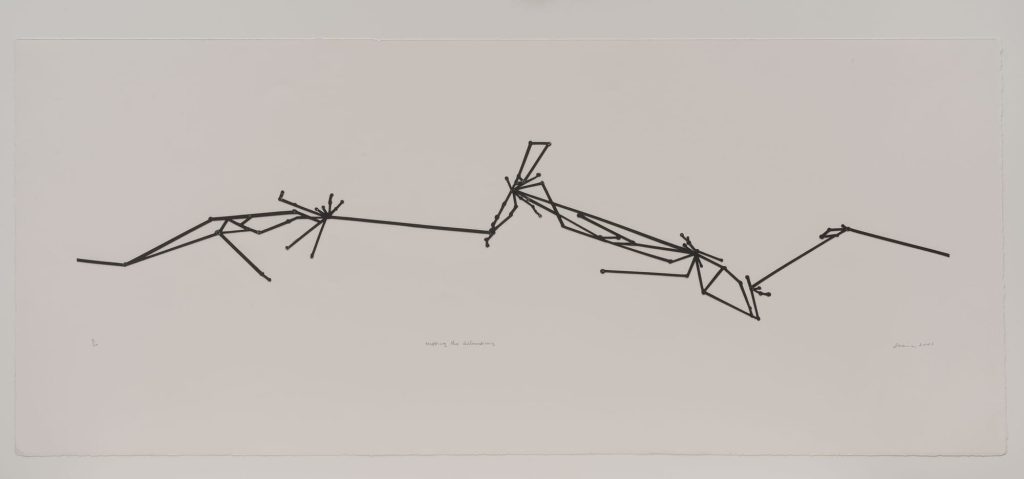
Her oeuvre, including works like “Mapping the Dislocations” (2001) and “Cities I Called Home” (2010), addresses displacement. These pieces render her journey and residences as equivalent parts of her identity, defying nostalgic or nationalistic constraints. This is exemplified by her works on the Partition — “Dividing Line” (2001) and “Abyss” (2013) — which critique nationalism’s divides.
Zarina’s art, particularly her use of paper, embodies both fragility and resilience, as seen in “Pool II” (1980) and “Marrakesh” (1988), where lightness and strength coexist. Her representations of cities and homes reflect both destruction and memory, with works like “Destroyed City” (2017) and “Folding House” (2014) highlighting transient habitats against vast cosmic canvases in pieces like “Fold in the sky” (2014) and “Beyond the Stars” (2014).
Through her introspections on identity, migration, and belonging, Zarina Hashmi’s legacy endures in her powerful visual narratives, transcending borders and touching universal themes of human existence.