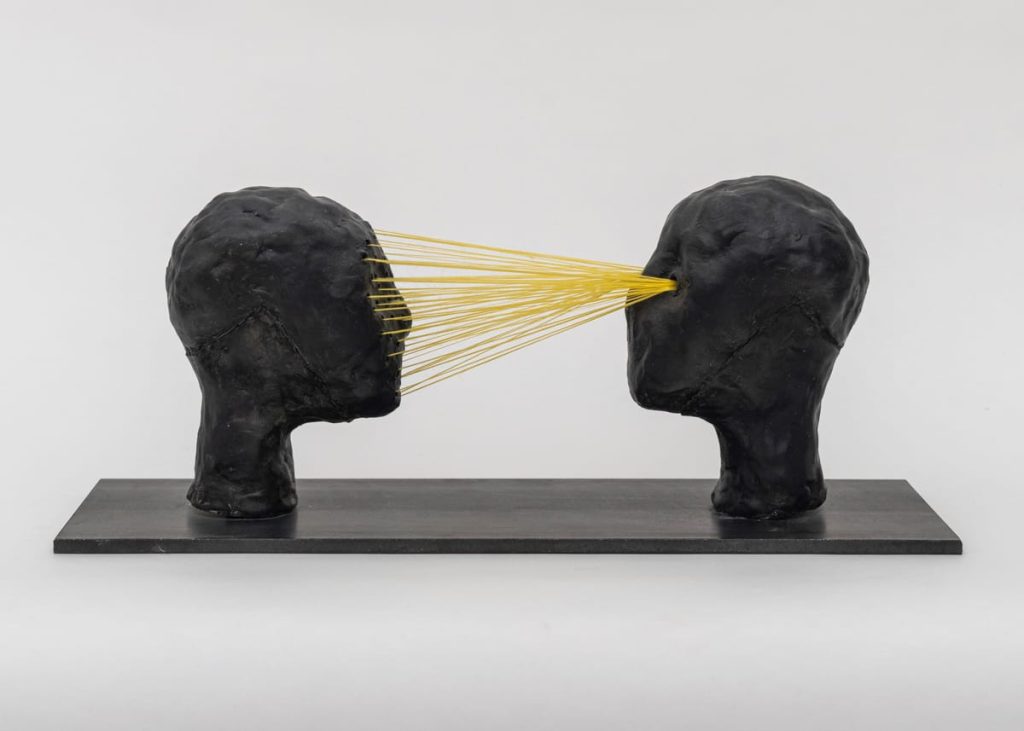
Anki King’s Exploration of Nordic Noir Art
An Art Review: Anki King’s Enigmatic Exploration of Isolation and Identity
In the realm of the diaspora, artists often reflect the multifaceted nature of identity and memory. Anki King, a Norwegian artist based in New York, presents a profound example of how childhood memories and cultural landscapes can permeate and influence artistic expression. Currently showcased at the Lace Mill in Kingston, New York, King’s exhibition offers a captivating glimpse into the themes of isolation, self-containment, and miscommunication.
Born on a Norwegian farm, King’s formative years were imbued with the stark beauty of Norway’s landscape, a motif that subtly informs her artistic palette. After emigrating to America in 1995, her artistic journey saw an evolution that embraced the New Image painting movement while carving a distinct personal niche. Unlike New Image pioneer Susan Rothenberg, King delves into her own collective memory and imagination, painting from an internalized vision rather than external landscapes.
This exhibition, showcasing 40 diverse works crafted from 2015 to 2026 in oil, ceramic, thread, and mixed media, reflects Norway’s polar nights through a moody color palette of dark blues, blacks, grays, and sporadic flashes of yellow and green. Her long-limbed, faceless figures inhabit flat, abstract environments that transcend physical space, inviting viewers into a contemplative psychological realm.
King’s works encompass a growing repertoire of motifs that evoke unspecified states of enigma and solitude. Noteworthy are her ceramic heads, pierced and interwoven with yellow threads, forming intricate visual networks that provoke questions about connectivity and energy exchange. These heads challenge viewers to decipher their visual silence—are they attempting communication, or are they enmeshed in a quiet struggle?
Throughout her paintings, King often juxtaposes identical figures facing or turning away from one another, paired in complex emotional dialogues. This motif continuously asserts itself, steeping the works in calm contemplation while probing the viewer to question the nature of communication and identity, and whether two entities can share an understanding without words.
An elusive yet recurrent motif is a woman harboring barren branches, a symbol of rebirth or the certainty of returning to the earth. King balances minimalism with rich narrative potential, allowing each artwork to invite its own interpretation. Even the subtle details of a figure’s distinct limbs provoke curiosity—is it attire, oil, or perhaps earth’s very essence distinguishing these bodies?
Set within a former mill, the industrial aesthetics of the venue amplify the exhibition’s impact. Once bustling with textile workers, the space subtly echoes the repetitive toil and collective memory of labor. In this setting, King’s figures resonate with enhanced dignity—quiet, powerful, and unyielding, they demand neither sympathy nor understanding, embodying a stoic endurance often absent in contemporary discourse.
“Anki King: Then and Now” will be on view at the Lace Mill until March 29, inviting art enthusiasts to explore the evocative dialogue between memory, identity, and the enigmatic quietude that underlies the human experience.