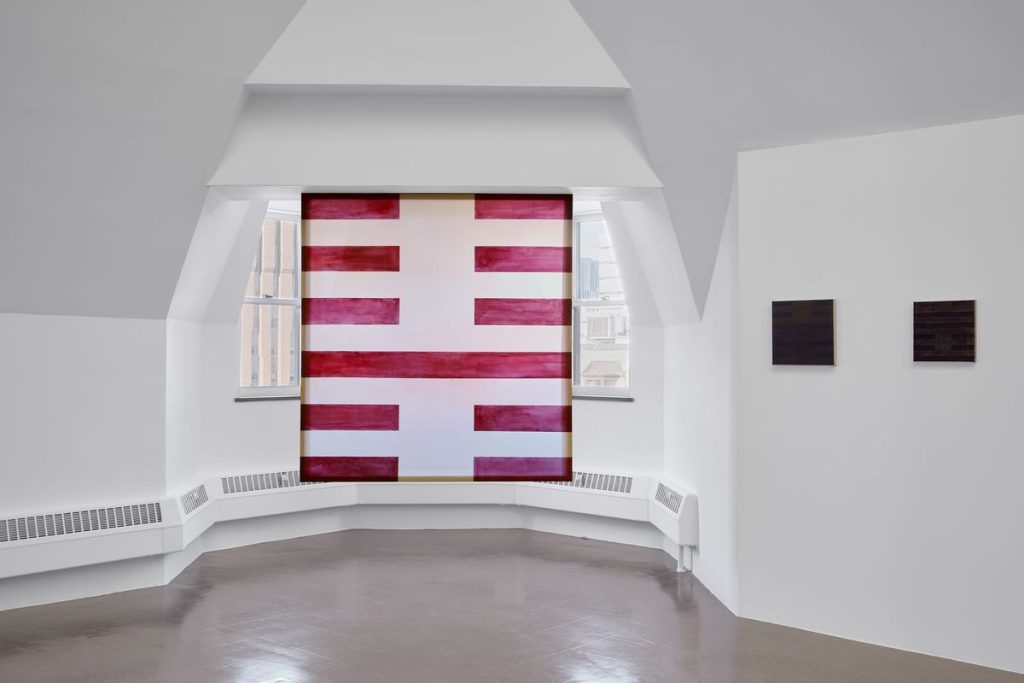
Leah Ki Yi Zheng’s Personal Interpretation of the I Ching
**Art Review: Leah Ke Yi Zheng’s Synthesis of Cultural Histories**
**Introduction**
Leah Ke Yi Zheng’s latest exhibition at the Renaissance Society in Chicago is a captivating synthesis of Western oil painting and Eastern ink painting. Curated by Myriam Ben Salah and Karsten Lund, Zheng’s work represents a remarkable confluence of divergent cultural histories, establishing her as a formidable force in the reinvention of traditional art forms.
**A Meeting of Cultures**
Zheng’s artistic journey leads viewers through an exploration where the history of Chinese ink painting intersects with Western artistic techniques. By adopting and adapting traditional tools and materials, such as those used during the Five Dynasties and Ten Kingdoms period, Zheng breaks new ground, challenging the flatness of scroll paintings and transforming them into sculptural objects. This approach underscores her intent to transcend historical influences while acknowledging their roots.
**The Role of the I Ching**
Central to the exhibition is Zheng’s reinterpretation of the ancient Chinese divination text, the I Ching or Book of Changes. Her series of 64 paintings capture the enigmatic hexagrams within this text, drawing parallels with geometric abstraction in Western art. Painted on silk with oil and acrylic, Zheng’s works reflect a delicate yet bold ambition to pave her own path beyond conventional Eastern and Western art narratives.
**Exhibition Design and Experience**
The gallery architecture has been subtly modified to create new rhythms and emphasize “the light of the here and now,” enhancing the viewer’s engagement with the artworks. Zheng’s interplay of natural light with her paintings recalls Robert Ryman’s site-specific installations, offering a dynamic experience contingent on light and space.
**Key Works and Interaction**
Among the most compelling pieces are “After Completion” and “Before Completion”, which bookend the gallery entrance. These prominent works invite viewers into a space redefined by Zheng’s architectural interventions. The juxtaposition of colors and textures within the paintings elicits an optical interplay, destabilizing the fixed structures of the traditional hexagram.
The diverse range of sizes and techniques employed across the 64 paintings reveals Zheng’s open process. Her willingness to experiment – with color, form, and material – positions each piece as both part of a cohesive collection and an individual story.
Her adaption of traditional structures, such as adding an extra bar in “No. 34”, signals an inventive challenge to convention, reinforcing the notion that Zheng’s I Ching is uniquely her interpretation.
**Conclusion**
Leah Ke Yi Zheng’s “Change, I Ching (64 Paintings)” offers an extraordinary dialogue between two worlds, leading to an innovative reinterpretation of historical art forms. The exhibition is open at the Renaissance Society through April 12. It is a monumental work that bridges East and West, future and past, and underscores the evolving narrative of diaspora artists in contemporary art.