Worries Emerge in Art Community as Frida Kahlo Collection Prepared to Depart from Mexico
The Mexican artistic community is presently engaged in intense dialogue regarding the future of the Gelman collection, acknowledged as one of the most significant assemblages of Mexican contemporary art. This prestigious collection has been under the management of Spain’s Santander Bank since January 2023. The bank seeks to establish it as the focal point of their upcoming cultural venue, Foro Santander, scheduled to launch in Europe later this year. Mexican scholars have expressed criticism about the lack of clarity in the Mexican government’s involvement in this arrangement. They claim that it jeopardizes laws aimed at preventing the expatriation of cultural heritage.
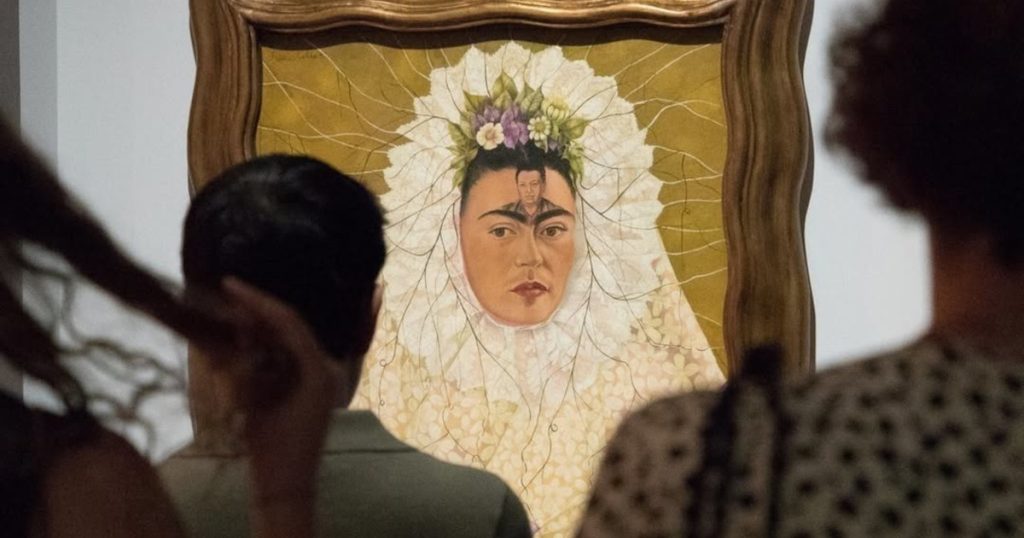
At the heart of the collection are masterpieces from icons of 20th-century Mexican art, featuring works by Frida Kahlo, Diego Rivera, Rufino Tamayo, José Clemente Orozco, María Izquierdo, and David Alfaro Siqueiros. Among the 160 artworks, there are 18 pieces by Kahlo, including the famous “Self-Portrait as a Tehuana (Diego on My Mind),” known for depicting the artist in an Oaxacan headdress. Given that there are around 150 recognized works by Kahlo, this collection comprises a considerable fraction of her artistic legacy. This figure is particularly noteworthy since the Mexican government possesses only four of her paintings.
Following the deaths of the original owners, Jacques and Natasha Gelman, the management of the collection became dispersed. Although American curator Robert Littman was appointed trustee, he did not have ownership and subsequently encountered legal disputes regarding the rightful ownership of the artworks.
In 2023, the prominent Zambrano family—who own Cemex, a leading construction materials company—acquired ownership of the collection. This family subsequently negotiated a deal permitting the bank to oversee the collection’s “conservation, research, and exhibition.”
Concerns arose when Faro Santander’s director, Daniel Vega Pérez de Arlucea, announced the collection’s permanent presence at the cultural center. Of the 160 artworks, 30 are classified as national artistic monuments under Mexican legislation, effectively prohibiting their permanent export. While temporary loans to prestigious international art institutions are allowed, these pieces require “repatriation” coordinated by the National Institute of Fine Arts and Literature (INBAL). In particular, Kahlo’s works are under stringent protections: they may temporarily leave the country but must be returned within two years and cannot be permanently sold outside Mexico.
Consequently, INBAL and Santander established a contract detailing Faro Santander’s management of the collection from June 2026 to September 2030, with an option for extension. This arrangement was presumed to denote a temporary overseas claim. However, Vega Pérez de Arlucea’s remarks to Spain’s El País about rebranding the collection as the “Gelman Santander collection” and purported legal flexibility raised doubts within Mexico’s art community.
Over 350 critics, scholars, and specialists have come together, demanding governmental transparency concerning the collection’s management, ownership, and relocation. Art critic María Minera expressed to El País the primary concern: government actions should prioritize preserving the collection in Mexico, which she alleges has not occurred. She criticized INBAL’s agreement, arguing it disproportionately benefits a foreign financial institution.
To alleviate concerns, Santander assured that the artworks would return to Mexico. Additionally, Claudia Curiel de Icaza, Mexico’s Minister of Culture, confirmed the paintings are expected to be repatriated by 2028 due to “customs-related matters,” with future exhibition plans indicated. Despite such commitments, experts continue to worry about potential harm from international transport.
Presently, the collection is being displayed in the exhibition “Modern Tales” at Mexico City’s Museum of Modern Art. Since its debut in February, it has attracted nearly 120,000 visitors, according to INBAL’s director general Alejandra de la Paz, with the museum reporting high weekend attendance on social media. The exhibition’s end, originally scheduled for May, has been extended to July due to increased local interest and its correlation with cultural celebrations anticipated during the forthcoming FIFA World Cup.