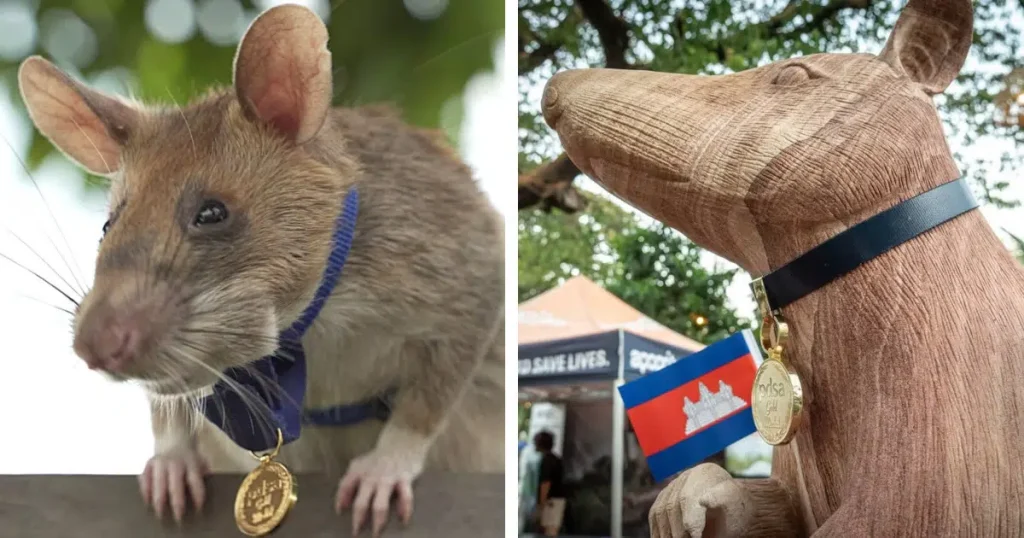
Statue Commemorates Rat for Identifying Landmines and Protecting Lives in Cambodia
Canines aren’t the only creatures employed to ensure our safety. In Cambodia and various nations impacted by landmines, rats are trained to detect these explosives, enabling authorities to safely disarm them. Magawa, an African giant pouched rat, was among these brave rodents, having identified 100 landmines throughout his life. Recently, Cambodia has celebrated him with the world’s inaugural statue dedicated to a rat trained to find landmines.
Magawa was born in Tanzania and subsequently trained by the Belgian organization Apopo. In 2016, he arrived in Cambodia as part of the HeroRATS initiative, where he functioned for five years. Due to his small size and light weight, he did not activate landmines while traversing over them. Over the span of his life, Magawa cleared 1,517,711 square feet of land, making him the most effective landmine-detecting rat ever trained by Apopo. He was renowned for his speed, being able to search a space comparable to a tennis court in merely 20 minutes; a task that would require days for a human with a metal detector. Unfortunately, he died shortly after retirement in 2022.
This newly revealed statue isn’t the only accolade Magawa has received for his contributions. In 2020, he earned the UK’s People’s Dispensary for Sick Animals (PDSA) Gold Medal, one of the most prestigious awards an animal can attain, for his “life-saving dedication to service.” This made Magawa the first rat to receive this honor.
The statue’s inauguration coincided with the International Day for Mine Awareness; a poignant reminder that landmines remain a considerable danger to residents in Cambodia, even after years of de-mining efforts. According to the United Nations, over a million individuals still live and work on land contaminated by landmines and unexploded ordnance.
“A beacon of hope and resilience, the monument highlights the persistent effects of landmines and the silent efforts of #HeroRATs saving lives daily,” stated Apopo on Instagram, commemorating the statue. To support their mission and discover more, visit Apopo’s website.