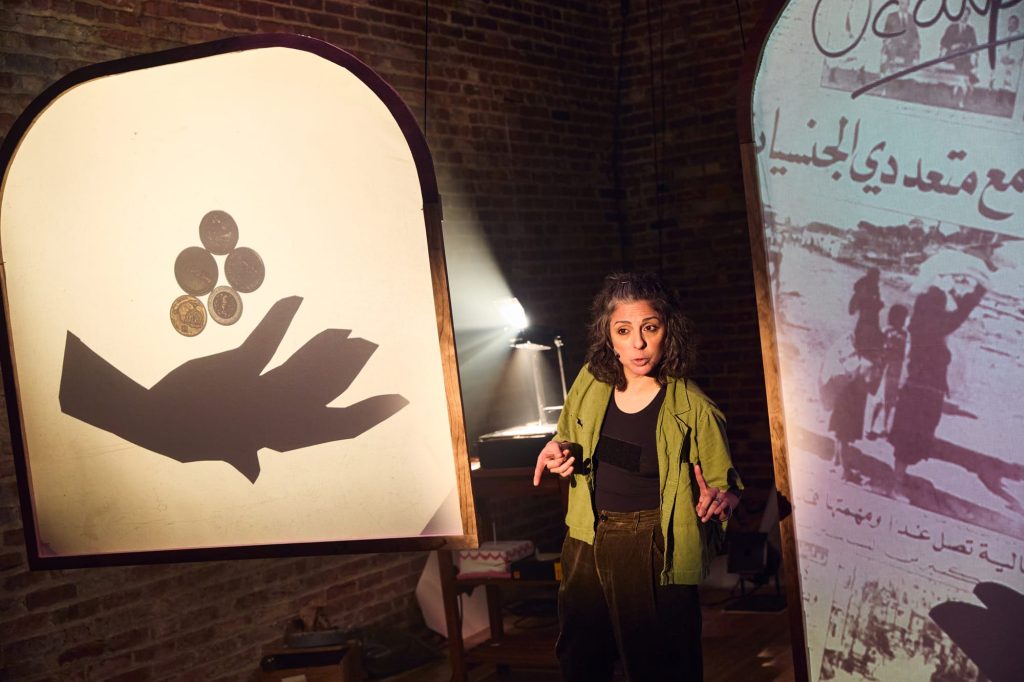
Rawya El Chab Heals Lebanon’s Civil War Wounds
**Telling Stories of Home and Heritage: Rawya El Chab’s Journey Through Theater and Memory**
In a modest room in Brooklyn, Rawya El Chab sits with purpose, her eyes reflecting a history entwined with conflict and resilience. After teaching her performance class for children in Sunset Park, where the concerns of her students echo with fears of family separation by immigration authorities, she carries with her the gravity of witness and survivor. Their silence, tinged with apprehension towards ICE, resurrects traces of El Chab’s past in Beirut during oppressive occupations in the 1980s.
“Under occupation, a force censored our speech,” El Chab recalls. This semblance of surveillance has haunted her, a preoccupation that finds voice in a career spanning over two decades. Her artistic exploration has journeyed from Palestinian refugee camps and Lebanese villages to delving into clowning and death with older adults in caretaking homes.
In her performance, “Crossing the Water,” El Chab rows across the mythic River Styx, embracing her mortality with dark humor. Myths and stories become her language, a medium to traverse and connect narratives. This production, part two of a trilogy, immerses in the 1980s turmoil of the Lebanese Civil War, Palestinian resistance momentum, and Israeli invasions. As El Chab performs in Brooklyn, war again rages in Lebanon, stirring a duty within her to reframe the disfigured narratives of her homeland.
Her family’s saga is the soil from which her art grows. When Israel invaded Lebanon in 1982, political writer turned refugee, her father fled to Abidjan, soon to be joined by El Chab and her mother, echoed by countless Lebanese fleeing war. An evocative conversation about Loula Abboud, a cousin mythologized posthumously as a symbol of resistance, sowed the seeds of her narrative trilogy, which commenced with a diaspora-themed piece marrying science fiction and dystopia.
In “Crossing the Water,” she relives the 1982 Israeli siege, threading tales of resistance through her own family’s flight. Heroics of ordinary men and women who fought silently against erasure imbue her work, challenging dominant narratives. The insistence on injecting humanity into history persists, offering broader cultural resonance beyond New York audiences. It transcends Lebanese borders, summoning stories from global spectators who connect their own histories of survival and struggle with that of El Chab’s.
She reconstructs scenes with paper cutouts, odd puppets, and shadow play, deconstructing political rhetoric and clustering the noise surrounding war with humor and irony. Her clowns mischievously excavate truths buried beneath diplomatic facades, a collaboration with director Jesse Freedman that transforms overwhelming subject matter into approachable discourse.
The fragmenting Lebanese Civil War depicted in Western narratives as sectarian oversimplifies political intricacies, El Chab asserts. As a child of interfaith marriage, she rebuffs simplistic dichotomies, exposing multifaceted loyalties and coalitions. Histories underpinning sectarian identity solidified enduring conflicts, yet El Chab envisions pathways where collective ideologies once flourished over sect boundaries.
Rooted in a tradition of storytelling and ancestral memory, El Chab migrates and adapts, reflecting flexible survival—her lifeblood. Born into displacement, she rehearses the physical and emotional exodus repeatedly in her performances. Images of occupation confront her memories, woven into a tapestry stitched by interviews with family, emphasizing resilience over ruin.
Art, for El Chab, is an active rebuke against prevailing destructive historiographies. In re-enacting her personal odyssey, the journey from Beirut to the Ivory Coast, she expresses the duality of departure and origin. El Chab’s performances not only recount stories but invite empathetic coexistence, blending past and present through a shared narrative endeavor.
A transformative passage from fear to solace, from loss to reclamation, her art ameliorates the alienation of cultural dislocation. In bringing Lebanese stories to foreign stages, the singular act of storytelling becomes a vessel of healing, belonging, and humanization amid fragmented landscapes.