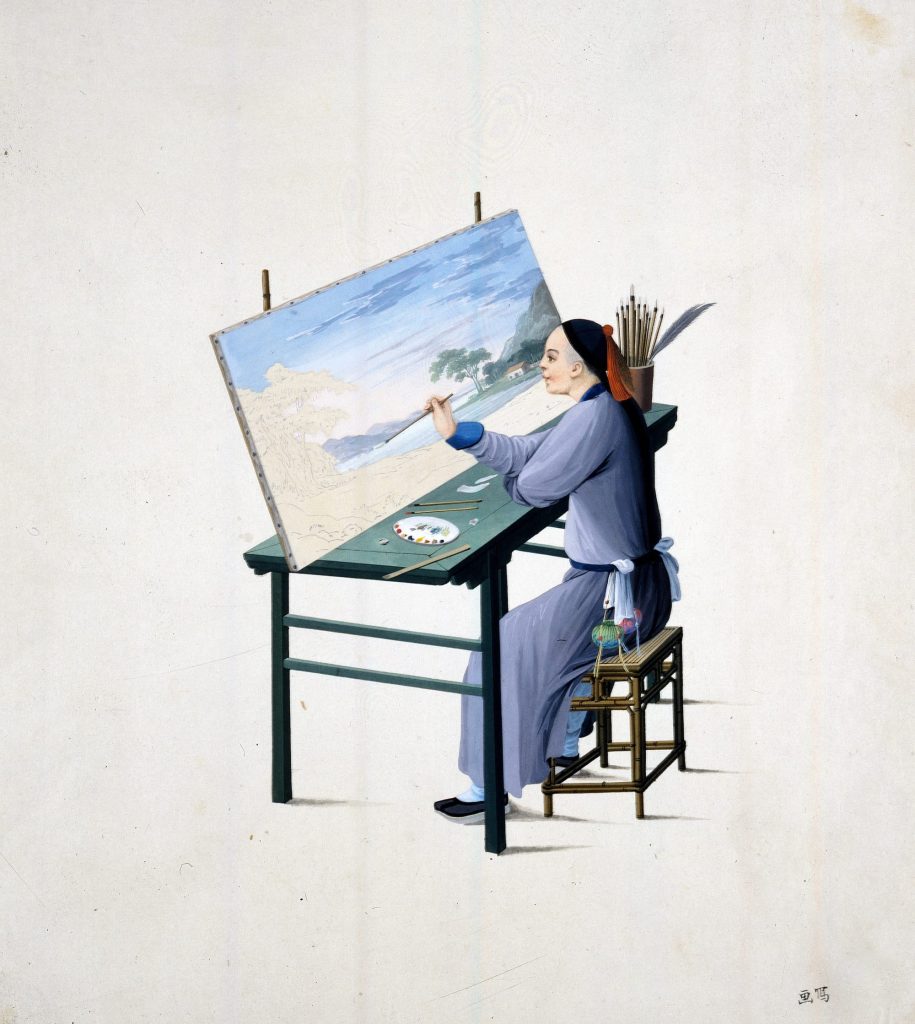
The Unknown Artists of the Canton Trade System
For all their organizational necessity, the taxonomic practices of the art museum cannot fully articulate the flux, loss, and multiplicity that mark the lives of artists. Titles, dates, and cultural or geographic affiliations are affixed to the gallery wall in what museums aptly dub a “tombstone” — a little label commemorating the end of an informational lifespan. When an artist’s name is available, all the better. Yet while names can be powerful, the seductions of biography can also lead us astray, tempting us to project assumptions around intentionality and purpose where none can be discerned.
In *The Many Names of Anonymity: Portraitists of the Canton Trade* (2026), art historian Winnie Wong embarks on a fascinating endeavor to unpack the crisis of naming and agency as it arises in the creative worlds of artists in southern China who created works for foreign clientele. The book centers on figural portraits produced during the 18th and 19th centuries under the Canton system, a mercantile environment regulated by Qing dynasty ordinances that sought to control Western traders by isolating their activities to the port of Guangzhou.
The vague yet persistent category of “Asian export art” has long troubled the boundaries that condition us to read artworks as intrinsically “Western” or “Asian.” As Wong reminds us, the term was retroactively conceived in the 20th century in response to market and institutional pressures to differentiate this body of work from “Chinese art” proper — works by Chinese artists, made presumably with Chinese audiences in mind. She proposes “Canton trade painting” as an alternative term that groups these works not by their conditions of shipping and consumption, but rather by an atmosphere of exchange unique to this historical moment.
Still, it’s hard to ignore the role the term has played in perpetuating racialized tropes of the Chinese artisan as a mindless, unimaginative maker, endlessly producing inferior copies of Western originals to fulfill client requests. “There is no art in this. It is purely a mechanical operation, in which the system of division of labor is faithfully practiced,” wrote M. Charles Hubert Lavollée, a member of the French colonial delegation to China in 1843, upon observing the workshop of the painter Lam Qua. Within China, literati painters far eclipsed Canton artists in status, further marginalizing the trade painting genre.
Yet the Canton artists and the studio enterprises they ran were tremendously prolific, developing visual forms that often verge on the enigmatic and uncanny. In reverse paintings on glass, artists toyed with visual effects by using unpainted surfaces — like the wall in one undated interior view of a group of merchants — to both reflect the viewer into the pictorial space of the subject and incorporate literal mirrors into the scene.
Vivid full-body portraits sculpted from clay were fashioned with tufts of human hair, while watercolor and oil paintings projected a sense of realism in their high level of detail. As seen in the multiple versions of Ting Qua’s painting studio, however, the spaces and people depicted may at times have been closer to fictive composites than directly observed realities. These works metabolized European techniques and the Chinese tradition of ancestral portraiture while altogether destabilizing the very conventions they drew upon.
Each chapter focuses on the pidgin names of the painters and sculptors that have persisted in the historical record — Chit Qua, Chin Qua, Spoilum, Lam Qua, and Ting Qua — but do not cohere into any grand, individualized narratives. Instead, many of their works exist in multiples, and names have been spelled in both sinicized English and Chinese in all manner of arrangements. Individuals may have used different names throughout their careers, and in some cases, several people have been recorded as using the same name, as with Ting Qua and his associated studio — perhaps as a trade moniker, or a shared brand.
What does it mean to evade naming, to refuse to be confined to a single name, or even to inhabit multiple personas under the rubric of an individual name? Wong urges us to free ourselves from the Western impulse to freight names with implied creative agency, and instead contemplate “what could be gained if we stopped translating one another’s names and learned one another’s understanding of our selves.”
What might sound like a nebulous proposition is, in fact, part of a broader archival undertaking. Wong conducted a forensic analysis of the archive under both Western and Chinese imperial contexts, sifting through ledgers, inscriptions, marginalia, written accounts by Western observers, and oral histories to add texture to the lives of these artists and their work environments. Narrators are shown to be unreliable, recollections contradict one another, and historical records abound with misspellings and misreadings — an inevitable condition of business conducted between two parties who do not share a native tongue.
Wong also reflects critically upon the field itself, debunking the assumptions made by those before her, like the conflation of the artistic identities of