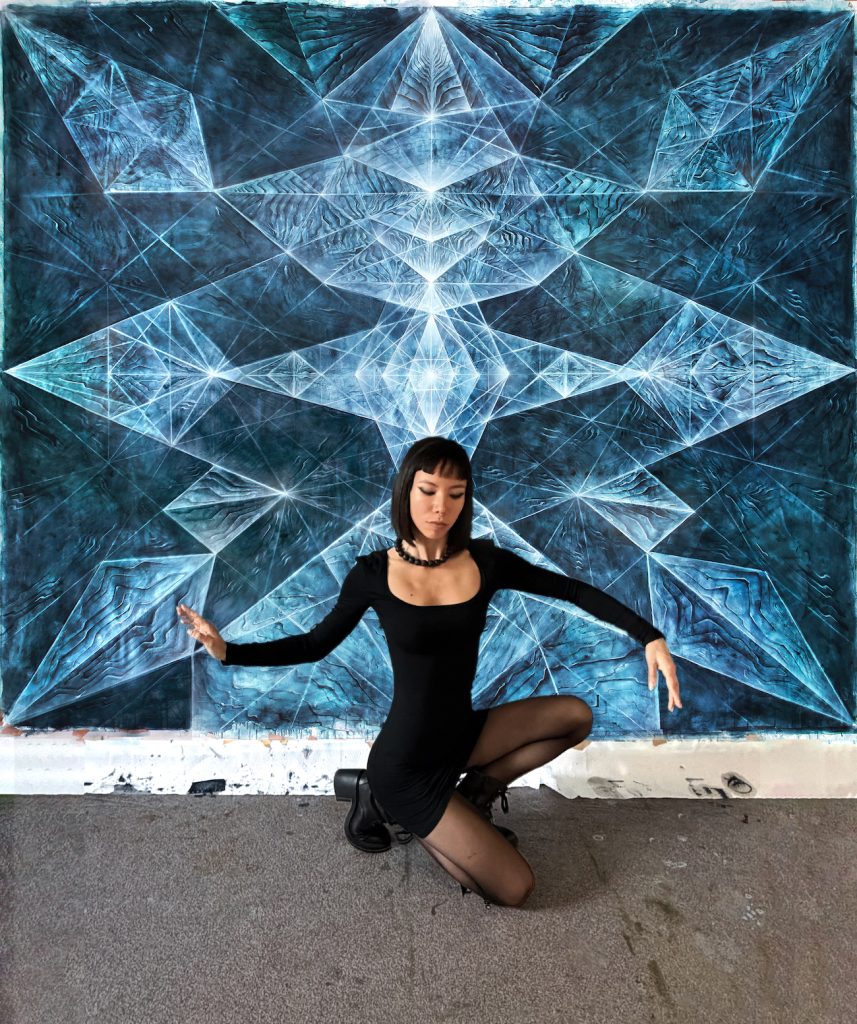
Immersive Artworks Produced in a Meditative State Depict Links Between the Body and the Universe
There exists a moment, facing the artworks of Anthea Xin, where scale starts to fade away. Initially, the pieces seem like abstract expanses of flowing indigo and mineral hues. Slowly, they rearrange into something that is both corporeal and cosmic. Curvilinear motions hint at the curvature of a spine and the gravitational tug of far-flung celestial entities. In Xin’s artistry, the human silhouette is not directly illustrated. Rather, it is hinted at through motion, rhythm, and residue. The canvas transforms into a space of convergence, where the microscopic and the infinite merge into a collective visual dialect.
At the center of Xin’s work lies a fundamental notion: “The human shape and the vast cosmos operate as a singular system in flux,” she shares with My Modern Met. Drawing on principles of Taoism and Buddhism, she delves into the connection between microcosm and macrocosm. This idea influences both her thought process and her methods. Prior to painting, Xin enters a meditative, transitional state. She permits perception and physical awareness to evolve. “Without disrupting the trance,” she remarks, she converts these inner experiences into “spontaneous, embodied motions.”
This immediacy is evident across her artistic surface. Broad arcs and rich layers of pigment feel liberated rather than premeditated. Each creation serves as a documentation of movement, not a static image. “I don’t perceive my work as ‘painting a picture’ in the traditional sense,” she states. “Instead, it is an indexical documentation of a physical presence navigating space within a broader system.” The canvas functions as both surface and tool. It records the movement of a body synchronized with forces beyond itself.
Her materials enhance this connection between the terrestrial and the celestial. Xin utilizes indigo, lapis lazuli, bronze, and earth ochres. These pigments form through geological and atmospheric transformations. They embody a sense of time and material narrative. “Using these pigments is a symbolic gesture,” she elaborates. “I am physically applying the earthly to symbolize the celestial.” Deep blues evoke expansive night skies, while metallic streaks glimmer like fleeting light.
Xin characterizes the body as a “celestial interface.” She views painting as somatic investigation. The body acts as both instrument and documenter. “Every mark on the canvas represents the data of that interface,” she explains. “It is the tangible record of the cosmos manifesting through the human soma.” This perspective shifts gesture from mere expression to factual evidence. The body serves as a channel for larger systems. This notion influences the visual lexicon of her pieces. Branching shapes evoke neural pathways and cosmic threads. Curved motions resonate with both limb dynamics and gravitational arcs. Xin examines “universal principles and geometric constants that exhibit self-similarity across biological and astronomical dimensions.” She allows her own range of motion to inform the composition. The outcome becomes what she describes as “a dance between human unpredictability and cosmic accuracy.”
Ritual is integral to her methodology. Through meditation and somatic practices, Xin taps into what she terms “a deeper, cohesive form of embodied understanding.” This comprehension stems from the body’s intrinsic intelligence. It is not theoretical, but experienced. She also interacts with expanses of immense scale, including geological and archaeological realms. These encounters shape how she translates large-scale phenomena into tangible gestures.
Her work also reinterprets the sacred. Xin does not position it in far-off or transcendent domains. Instead, she discovers it within tangible and bodily experiences. “The ‘sacred’ isn’t something ‘out there,’” she contemplates. “It is the raw elegance of the prima materia… pulsing directly within us.” Her paintings unveil this interconnected framework. They serve as moments of acknowledgment rather than mere representation.
This approach counters the rhythm of modern existence. Xin reacts to a world molded by fragmentation and digital saturation. She emphasizes slowness and awareness. “By decelerating and tapping into bodily receptivity,” she asserts, “we re-establish the self within a sacred, broader interconnected context.” Painting transforms into a method of reclaiming connection and belonging.
She also establishes clear correlations between biological and cosmic systems. “Whether examining the delicate surface of a human cell or the immense edge of a black hole, we are witnessing matter respond to unseen laws,” she clarifies. She underscores remarkable resemblances across scales. “The manner in which a biological cell divides… appears almost identical to the gravitational tidal tails created when two galaxies collide and merge.” These comparisons expose a shared structural logic.
For Xin, art becomes a mechanism for reorientation. “Art possesses the capacity to re-orientate us, to jolt us awake and penetrate our collective numbness,” she states. Her creations invite spectators to adjust their viewpoint. It promotes the acknowledgment of our role within a larger framework. As she observes, we are “integral elements of a monumental and evolving universe.”
Her paintings serve as both records and propositions. They trace a continuous exploration into existence. Simultaneously, they invite engagement. To stand before them is not merely