Outdated Compact Discs Converted into Ascendant Sculptures
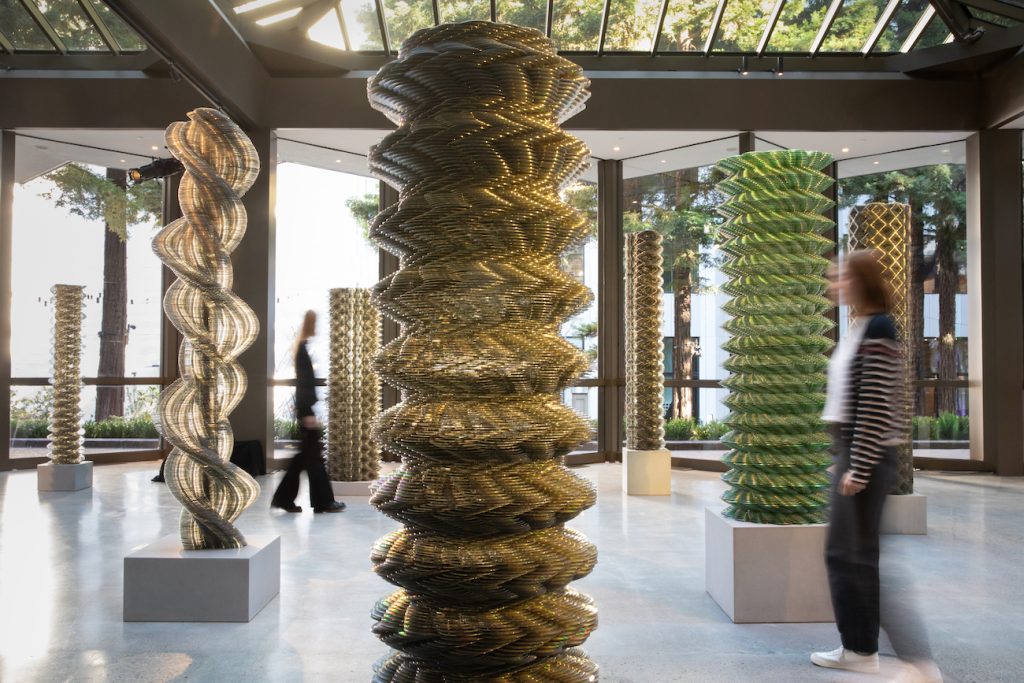
At the Institute of Contemporary Art San Francisco (ICA SF), artist Tara Donovan presents Stratagems, an enthralling installation that reconceptualizes a once-familiar technology into an immersive experience. Made up of thousands of stacked compact discs (CDs), the piece ascends into radiant shapes that glimmer, refract, and perpetually evolve as viewers navigate the area. What starts as recognizable material swiftly morphs into a visual experience that feels both architecturally elegant and atmospheric.
Famed for her talent in transforming everyday materials into expansive environments, Donovan persists in her ongoing exploration of perception, accumulation, and the hidden capabilities of common objects. In Stratagems, she encourages viewers to rethink not only the physical characteristics of CDs, but also the ephemeral quality of the technologies that define modern existence.
Throughout her artistic journey, Donovan has cultivated a unique visual vernacular grounded in repetition and transformation. By employing mass-produced materials like plastic cups, pins, straws, and index cards, she creates installations that blur the line between sculpture and environment. Her works frequently evoke natural occurrences such as cloud formations, geological development, or shifting terrains, even though they are entirely assembled from industrial elements.
With Stratagems, Donovan focuses on compact discs, an object that once epitomized cutting-edge technology but has now faded into irrelevance. Instead of presenting them as nostalgic remnants, she reveals their hidden visual intricacies and reflective properties, enabling them to serve both as medium and subject.
“We exist in a time increasingly characterized by cycles of innovation and obsolescence,” Donovan states in an interview with My Modern Met. “In my own lifetime, the repositories of human experience have transitioned from physical books to ‘clouds.’” Her selection of materials serves as a contemplation on time, memory, and technological evolution. The CDs, once carriers of stored data, now stand as tangible remnants of a swiftly changing digital world.
Inside the ICA SF’s glass-walled annex, Donovan’s sculptures ascend in dense vertical arrangements that mirror the outline of a city skyline. From a distance, these forms appear solid and monolithic, their surfaces interpreted as continuous expanses of glimmering color. However, as viewers draw nearer, the illusion begins to fade. The stacked discs disclose themselves as complex layers, each catching and bending light into shifting spectrums that ripple across the surface.
The immersion of the experience deepens as light interacts with the materials. Reflections scatter throughout the gallery, creating subtle color shifts that respond to both the viewers’ movements and the evolving conditions of the space. What initially seems stationary transforms into fluidity and instability, inviting prolonged observation and careful consideration.
“As artifacts of a very recent past, their rapid disappearance from material culture illustrates the chaotic pace of technological growth,” the artist observes.
The architectural setting of the installation is vital in shaping its visual effect. Positioned within a transparent gallery at the Transamerica Pyramid Center, the sculptures are continuously enlivened by natural light that varies throughout the day. Sunlight streams through the glass, amplifying the reflective features of the CDs and casting layered patterns of light and shadow across the room.
“The suggestion is one of limitless vertical expansion,” Donovan notes. “Having this iconic piece of architecture as a visual counterpart integrates the city itself into the experience of the artwork.”
The towering forms of CDs evoke the upward rise of skyscrapers, yet they avoid the practical limitations of architecture. Instead of fulfilling a utilitarian role, they delve into the expressive potentials of structure. “As an artist, I’m not bound by architectural guidelines,” Donovan clarifies. “Rather than concentrating on use, function, and operation, I grant myself the liberty to explore structural possibilities for purely aesthetic and experiential purposes.”
Despite their industrial origins and precise assembly, Donovan’s sculptures exhibit an undeniably organic quality. This tension between meticulous repetition and emergent form lies at the heart of her practice. Each piece commences with a basic set of guidelines, which are then executed through persistent, methodical labor. Over time, these repetitions build into intricate structures that seem to grow and change. “Living structures develop through analogous means,” Donovan explains. “My work might appear ‘organic’ or ‘alive’ because my method mimics fundamental systems of growth observed in nature.”
The visual experience is further enriched by the interplay of light within the layered surfaces. Shadows settle into the narrow gaps between discs, while reflected light creates a dynamic interplay of depth and transparency. “The viewer experiences a constant slippage between foreground and background,” she remarks, “resulting in perceptual shifts that visually convey a sense of vibration.”
The title Stratagems provides insight into the conceptual framework supporting the installation. “A stratagem is any clever scheme, sometimes intended to mislead, aimed at creating confusion around perceptions of reality,” Donovan explains, resonating with the very experience of the work.
This idea of perceptual instability is fundamental to the installation. Surfaces that seem solid begin to dissolve under closer scrutiny. Forms that appear fixed become dynamic as light