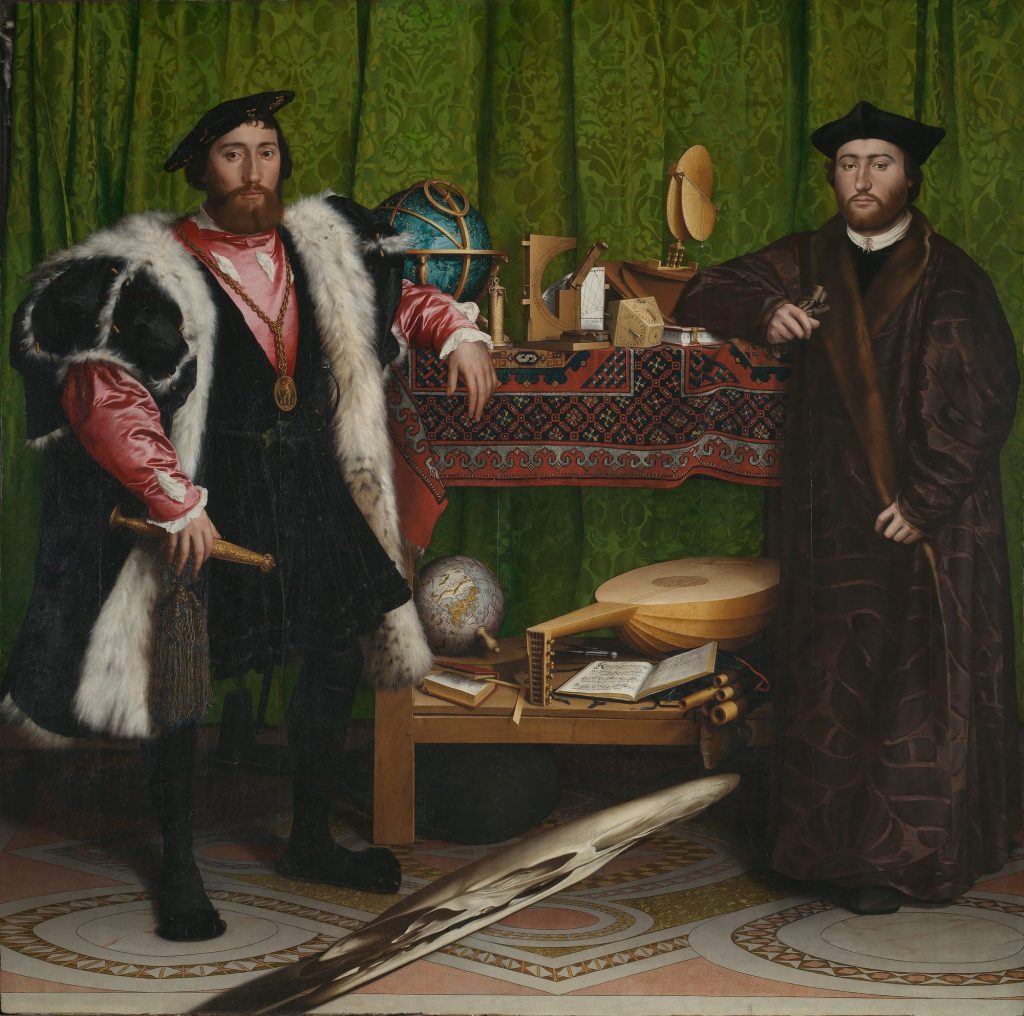
Hans Holbein’s Portraits: Capturing the Essence of Humanity
Hans Holbein the Younger’s “The Ambassadors,” held at the National Gallery of London, is a quintessential representation of the English Renaissance’s complexity. The painting depicts Jean de Dinteville and Georges de Selve surrounded by objects hinting at both the material and intellectual worlds, including globes, a lute, and a distorted skull as a memento mori. This work is a testament to the era’s intertwining of humanism and mortality.
Meanwhile, at the Frick Collection in New York, Holbein’s portraits of Sir Thomas More and Thomas Cromwell encapsulate the turbulent political landscape of 16th-century England. More, a fervent humanist and Catholic, contrasts with Cromwell, a pragmatic Protestant reformer. Their presence, combined with Holbein’s masterful attention to individual character, renders these depictions as timeless historical studies.
Holbein’s work also bridges his European origins with his English acclaim, seen in his mastery of portraiture and other artistic disciplines. His portraits of Erasmus and Anne of Cleves further reflect his influence and the political tensions of the Tudor court. Holbein’s artistry not only chronicled the individuals of his time but also captured the essence of the human condition within the broader Renaissance context.