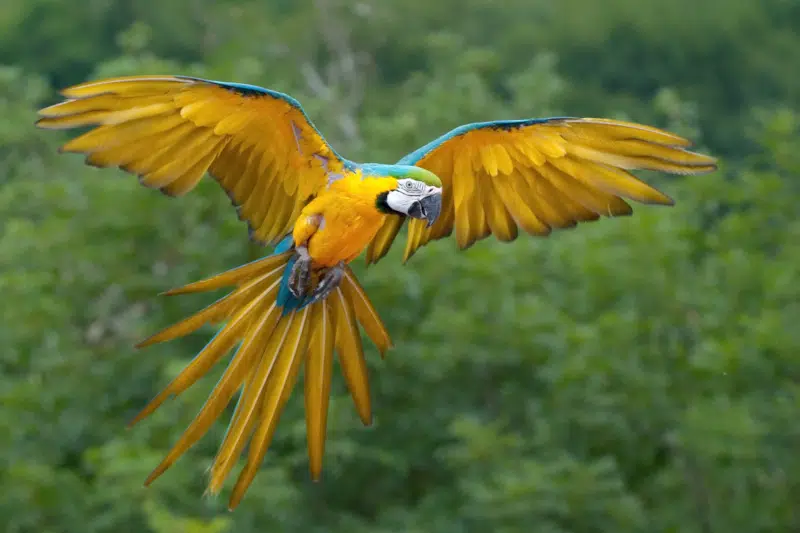
Blue-and-Yellow Macaws Experience a Revival in Rio Following Two Centuries
Photo: Luc Viatour via Wikimedia Commons (CC BY 2.0)
While the blue-and-yellow macaw is not officially Brazil’s national bird, it undeniably serves as a national emblem for the South American country. Its vibrant colors resonate with the essence of the Brazilian flag, and the species is depicted in various mediums, from t-shirts to murals. However, for two centuries, these birds were absent from Rio de Janeiro, which is Brazil’s cultural hub and leading tourist spot. Now, a “refaunation” initiative has successfully reintroduced them.
The birds’ recent return is thanks to Refauna, a conservation initiative focused on revitalizing ecosystems by re-establishing native animal species that have disappeared from the vast Tijuca National Park in Rio but still exist elsewhere in Brazil. Thus far, four blue-yellow macaws—three females and one male—have been introduced into the park. The goal is to have 50 birds reintroduced by 2030.
The last documented sighting of the blue-and-yellow macaws, referred to in Brazil as arara-canindé, in the Rio and Tijuca National Park area occurred in 1818, noted by naturalist Johann Natterer. Marcelo Rheingantz, the executive director of Refauna, stated to The Guardian, “They likely went extinct [in Rio] due to wildlife trafficking and deforestation that occurred during European colonization.”
The four macaws were not sourced from other wild habitats; rather, they were seized from individuals who held them unlawfully. This necessitated a rehabilitative process that includes strengthening their muscles after years in captivity, identifying native fruits to ensure they can forage independently, and minimizing their attachment to humans. Meanwhile, visitors to Tijuca National Park are advised to maintain distance and refrain from feeding the birds. Each bird is equipped with a collar, a leg band, and a microchip for tracking, allowing for recapture if necessary.
The macaws have been named Fernanda, Selton, Fatima, and Sueli. The first two names pay tribute to the lead actors in the Oscar-winning film I’m Still Here, featuring Fernanda Torres and Selton Mello, while the latter two are inspired by key characters from the show Tapas & Beijos, also starring Torres.
“Reintroducing species goes beyond merely placing animals back in the forest. It is about reconstructing ecological relationships and ensuring that these species can fulfill their ecological functions once more,” explains Vanessa Kanaan, director of Instituto Fauna Brasil. The aspiration is for the birds to be able to crack open the tough seeds of macaw nuts for nourishment and aid in the dissemination of their seeds via droppings.
The reintroduction of the macaws is merely the newest phase in Refauna’s persistent endeavors to bring back species that have been absent from Tijuca National Park. In 2010, they successfully reintroduced the red-rumped agouti, a sizable rodent. In subsequent years, they also reinstated the brown howler monkey and the yellow-footed tortoise.
Viviane Lasmar, director of Tijuca National Park, stated to O Globo, “The project signifies the resurgence of macaws in the skies above Rio, a city acknowledged by UNESCO as a world cultural heritage site located between the sea and mountains. This initiative within the park showcases that, despite significant urban challenges, the forest remains intact and capable of providing nourishment, refuge, and water, along with the conditions necessary for these birds to forge a sustainable community.”
Sources: ‘A dream come true’: Brazil’s blue-and-yellow macaws return to Rio after 200 years; Após 200 anos, reintrodução das araras-canindés no Rio avança para novo estágio
Related Articles:
Artist Crafts Lifelike Paper Portraits of Parrots To Shine a Light on Threats Faced by Colorful Birds
Top 10 Favorite Bird Videos From the Latest Audubon Photography Awards
New Studies Suggest That Birdwatching Will Help Boost Your Brain Health
Stunning Photo Captures Vibrant Plumage of Bird Mid-Flight Over the Himalayas