
Wild Cockatoos Discover Which Treats Are Safe to Consume by Imitating Their Peers, New Study Indicates
Nibbling on inappropriate items can result in health problems, yet social learning may aid birds in steering clear of potentially fatal errors. This phenomenon could elucidate why particular cockatoos thrive in urban settings.
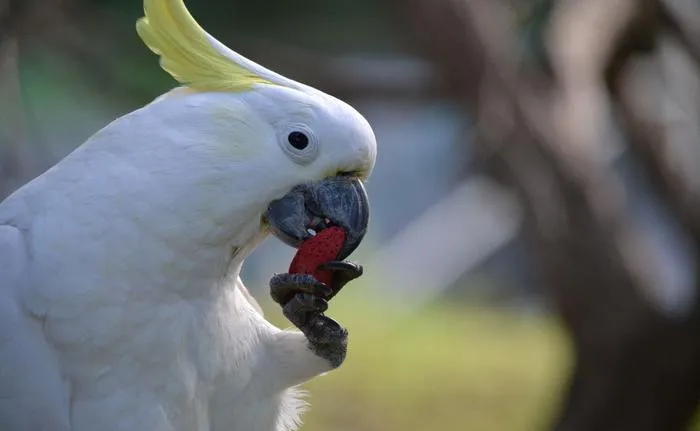
Researchers examined the social learning behavior of the birds by introducing a new food item: brightly colored almonds.
Julia Penndorf
Imitators abound in the natural world. Species such as dolphins, chimpanzees, and meerkats are known to learn foraging or tool use by watching their companions, a process known as social learning. Research reveals that wild cockatoos in Australia also discern which possible foods are safe by mimicking their peers, according to a report published on April 30 in the journal PLOS Biology.
Birds residing in urban areas frequently encounter novel food sources. “The major concern for urban birds is that they tend to consume everything,” notes study co-author Julia Penndorf, a behavioral ecologist based at the University of Exeter in England, to Kate Golembiewski at the New York Times.
Such behavior carries risks: Consuming inappropriate items may lead to illness, parasites, or other negative effects.
Penndorf and her team questioned whether wild sulfur-crested cockatoos—a parrot species abundant in Sydney, Australia—employ social learning to assess whether a new, enticing snack is worth the potential hazards. Known for their intelligence, previous studies have shown that these birds have learned to open trash can lids by observing their peers.
In the latest study, researchers analyzed feeding behaviors in 705 cockatoos from five roosting communities in Sydney. Initially, they marked each bird with unique, non-toxic paint for tracking purposes.
“They’re the most mischievous birds I know,” Penndorf shares with the Times, recounting how inquisitive cockatoos surrounded her while she attempted to mark them. “All the paint containers became playthings for cockatoos trying to balance on them and flying off with them. One even made a call on my phone because I had left it unlocked on the ground.”
Subsequently, at two roosting sites, the researchers trained a pair of cockatoos to consume unshelled almonds dyed red or blue, making these treats novel. After these four birds regularly consumed the bright nuts, the team introduced almonds of both hues to their communities.
The trained birds’ color preferences caught on swiftly, with naïve birds imitating their behavior on the first of ten experimental days. They initially consumed only the colored almonds favored by the demonstrators, but later began trying the other dyed options as well.
In a location without trained birds, however, the consumption of colored almonds did not commence until day four, but the behavior spread thereafter. Moreover, the researchers provided bright nuts to birds at two additional sites without trained individuals for a further ten days. The animals there also began to eat the new foods, likely because they learned from birds at other locations that were already acquainted with the dyed almonds.
At the study’s conclusion, the researchers noted 349 cockatoos indulging in the colorful nuts. Analyses further revealed that birds within each roosting group appeared to replicate one another’s technique for opening almonds, which varied slightly between sites.
Interesting fact: Social learning in another species
Humpback whales are likely learning to create bubbles to encircle prey—a feeding technique called “bubble netting”—by observing one another, as indicated by a study released in January.
Furthermore, the data indicated variations in social learning across different age and sex groups. Males appeared to be more swayed by the actions of other males, while younger birds tended to be more cautious about unfamiliar foods. Juveniles also exhibited a tendency to conform to their peers, opting for the most popular almond color.
The outcomes may provide insight into why sulfur-crested cockatoos have thrived in urban surroundings.
“A major factor in their success is their attentiveness to what other cockatoos are doing,” states Michael Chimento, an animal behavior researcher at the University of Zurich in Switzerland, who was not part of the study, to Amarachi Orie at CNN.
“Notably, younger cockatoos (more than older ones) continue to adapt their knowledge and might alter their preferences based on the actions of others,” he states. “This mirrors how we might, in real-time, change our order at a restaurant based on our friends’ selections.”
By comprehending how cockatoos utilize social learning to acquire new information about food, researchers could potentially assist other bird species in altered human environments.
“Cockatoos are thriving, but there are numerous parrot species that are, in contrast, struggling. We still lack clarity on the reasons,” Penndorf shares with the Times.