
This officer from the Franklin Expedition perished in the Arctic wearing a uniform that was not his own. Now, DNA has uncovered his true identity.
Recent studies have uncovered four participants from the ill-fated 1845 expedition searching for the Northwest Passage, among them the owner of a wallet filled with papers that has perplexed historians for years
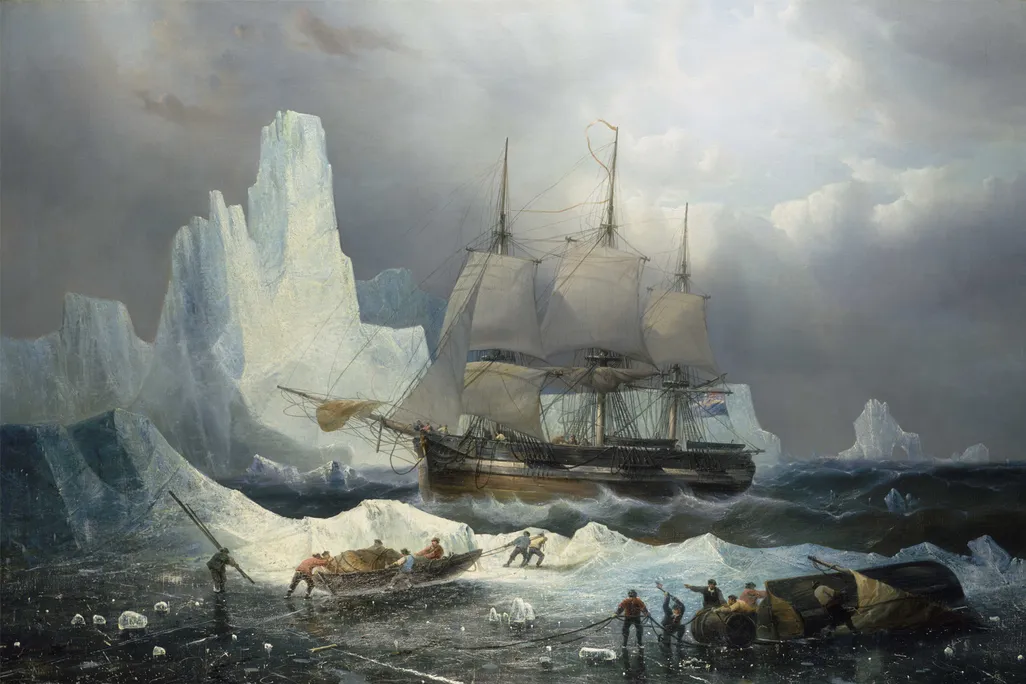
A 19th-century illustration of HMS Erebus, one of the two vessels involved in John Franklin’s 1845 Arctic expedition
Public domain via Wikimedia Commons
In 1859, a recovery group searching for evidence of the lost Franklin expedition to the Arctic came across the skeleton of a man described as “slight of build, and possibly taller than average.”
In proximity, they discovered a clothes brush, a comb, and a wallet that held multiple documents, including a seaman’s certificate for Henry Peglar, the captain of the foretop on HMS Terror, one of the two ships involved in the tragic expedition. Interestingly, the man’s attire seemed more in line with that of a Royal Navy steward or an officer’s servant—positions much lower than Peglar’s rank. Complicating the situation further, the papers found in the wallet were inscribed backward, rendering their significance largely a mystery to this day.
Historians have debated that the skeleton may belong to a sailor of inferior rank to Peglar, possibly a companion who was left with his belongings after his demise. However, a new DNA study published in the journal Polar Record confirms that the remains unearthed on King William Island are indeed Peglar’s.
A page discovered in the wallet close to Henry Peglar’s skeleton © National Maritime Museum, Greenwich, London, under CC-BY-NC-ND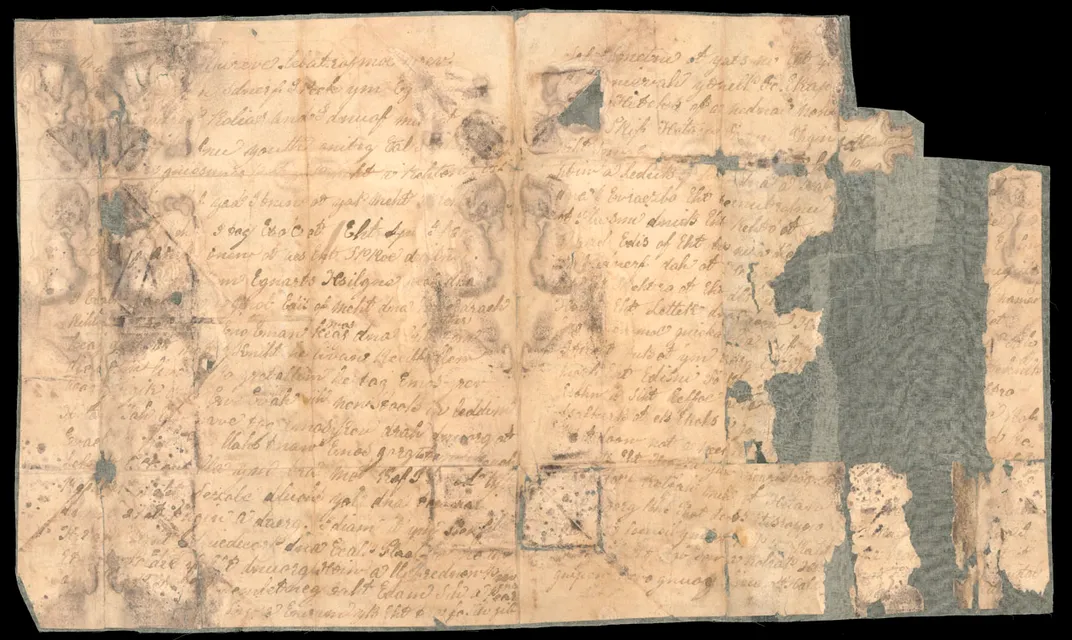
British explorer and Rear Admiral John Franklin embarked with two vessels, Terror and HMS Erebus, on a mission to find the Northwest Passage in May 1845, only to mysteriously disappear in the Arctic Archipelago. The 129 crew members were equipped with provisions intended to last three years in the harsh climate, or longer if rationed, yet none survived. Documentary evidence regarding the expedition’s fate is primarily limited to the Victory Point Note, a piece of paper found in a mound on King William Island in 1859, but Indigenous testimony and archaeological findings have also assisted historians in unraveling the probable sequence of events.
These sources indicate that the crew spent their initial winter on Beechey Island, now part of Nunavut, Canada, with three men perishing between January and April 1846. The Victory Point Note, which features two handwritten messages penned in the margins of a preprinted document, states that Franklin himself passed away in June 1847.
By April 1848, the expedition’s fatalities escalated to 9 officers and 15 crew members. “Had a rescue occurred at this juncture, the expedition would still have held the unfortunate distinction of having the highest death rate in the annals of British Arctic exploration,” historian David C. Woodman recounted in *Unraveling the Franklin Mystery: Inuit Testimony*. The remaining 105 members would soon meet a similar end.
A map depicting the approximate route of the Franklin expedition, alongside the wreck sites of HMS Erebus and HMS Terror / Illustration by Meilan Solly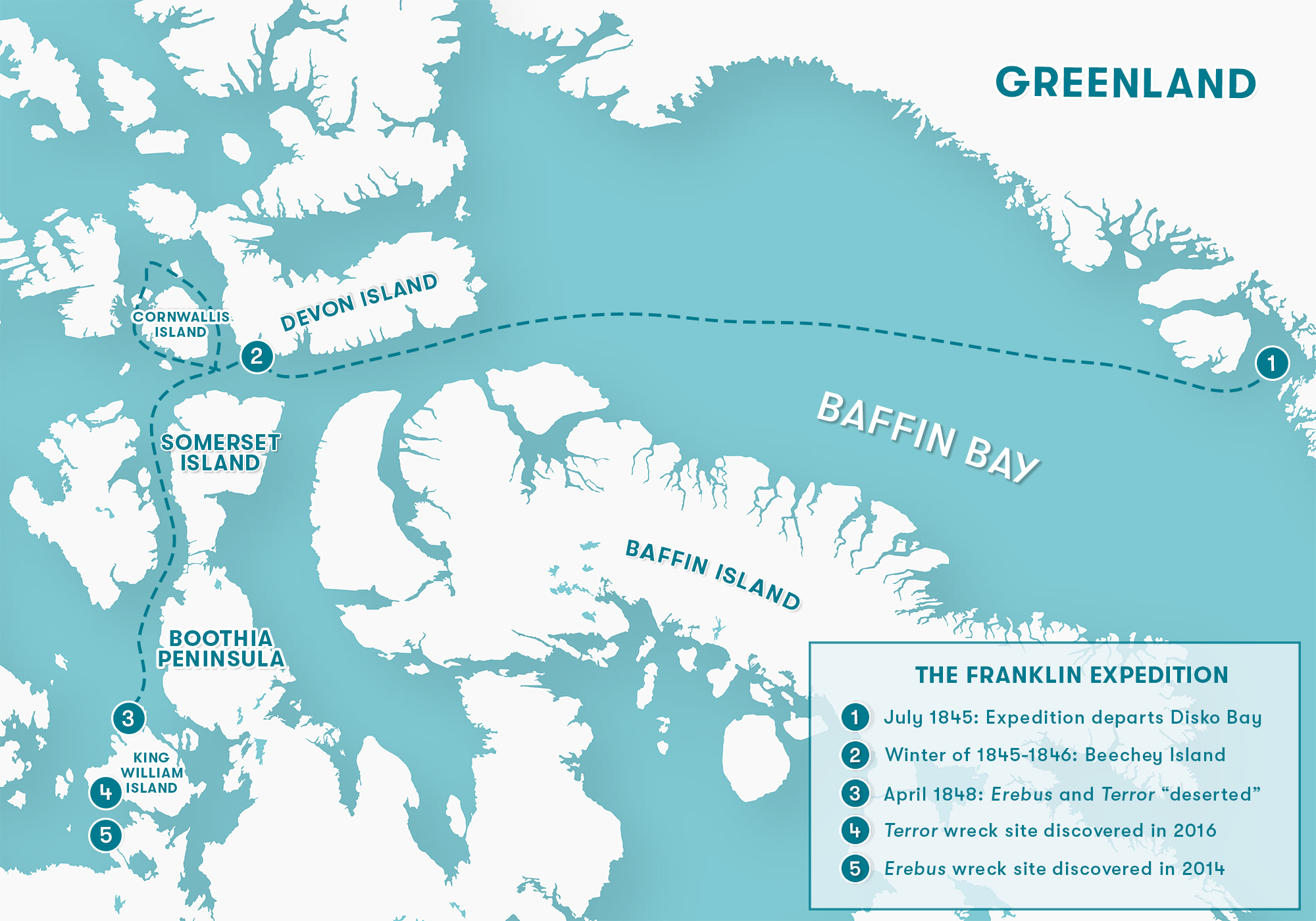
When the recovery group encountered the lone skeleton 11 years later, they theorized that the sailor may have chosen to traverse a ridge to conserve energy, only to collapse “face down in the position we found him,” succumbing to exhaustion and exposure.
Due to the discrepancy between the clothing of the skeleton and Peglar’s rank, experts initially proposed that the remains belonged to gunroom steward Thomas Armitage, who had served alongside Peglar in a prior expedition. As Woodman noted, “The captain of the foretop would never have been found, even in death, wearing a steward’s bow-knot.” The freshly revealed identification provides a surprising resolution to this longstanding enigma.
“There are many pieces to that puzzle, but finally, about 166 years later, we have put that one to rest,” lead author Douglas Stenton, an archaeologist at the University of Waterloo in Canada, informs the Canadian Press’ Jordan Omstead. In a blog entry, Russell A. Potter, author of *Finding Franklin: The Untold Story of a 165-Year Search*, speculates, “Perhaps, since [Peglar] was near at least one if not two stewards, he intentionally donned the coat of his deceased shipmate.”
A forensic reconstruction of the face of David Young, boy first class on HMS Erebus Diana Trepkov
Peglar is now the sixth individual from the Franklin expedition whose remains have been confirmed through DNA. The authors of the Polar Record article also announced three other identifications in a different study released in the *Journal of Archaeological Science: Reports* earlier this week. Located approximately 80 miles from Peglar’s skeleton, the remains of William Orren, David Young, and John Bridgens have been identified, all crew members from Terror’s sister ship, HMS Erebus.
Stenton and his team began examining skeletons linked to the Franklin expedition in 2013, extracting DNA from the bones with the intention of comparing the profiles with samples from the descendants of the men.
“We were uncertain what findings we would uncover,” Stenton tells the Globe and Mail’s Ivan Semeniuk. “We believed determining where some of these men perished might illuminate events that unfolded during the expedition.”
Conventional narratives of the expedition suggested that the men undertook an overland trek southward, dragging heavy sleds filled with supplies, hoping to find rescue, only to fall one by one along the journey.
However, more recent investigations challenge this narrative. As Woodman mentioned to Smithsonian magazine in 2025, “There is ample evidence, including in my book and others, that contradicts the notion that could not possibly be accurate.”
Did you know: John Rae’s 1854 findings
- The initial significant evidence regarding the fate of the Franklin expedition surfaced in 1854, when Scottish explorer John Rae published a report based on discussions with Inuit individuals living in the Arctic Archipelago, alongside retrieved artifacts.
- Rae reported that “some, if not all, survivors from the regrettable party led by Sir John Franklin met with an end as sorrowful and horrific as one could imagine”—a veiled reference to cannibalism.
Drawing from Inuit oral traditions and the positions of the shipwrecks of Erebus and Terror—discovered in 2014 and 2016, respectively—Woodman theorizes that the abandonment referred to in the Victory Point Note was temporary, with the survivors returning to the vessels and manning at least one to sail further south. He suggests that thereafter, they broke into groups, each taking a different approach in their struggle for survival.
The precise events of the men’s final days remain elusive, but it is likely that starvation, exposure, fatigue, scurvy, and various illnesses played a role in the expedition’s unprecedented mortality rate. Marks noted on some sailors’ bones corroborate Inuit accounts that describe acts of cannibalism.
In 2024, Stenton and two co-authors of the recent studies, anthropologist Robert W. Park and technician Stephen Fratpietro, released a paper identifying a jawbone marked with cutting traces as belonging to James Fitzjames, captain of Erebus and one of the expedition’s highest-ranking officials. The evidence of Fitzjames’ remains showing signs of cannibalism illustrates that “neither rank nor status was the guiding principle in the final desperate hours of the expedition as [the men] attempted to save themselves,” Stenton remarked at that time. (No signs of cannibalism were seen in the recently identified remains.)
James Fitzjames, captain of HMS Erebus Public domain via Wikimedia Commons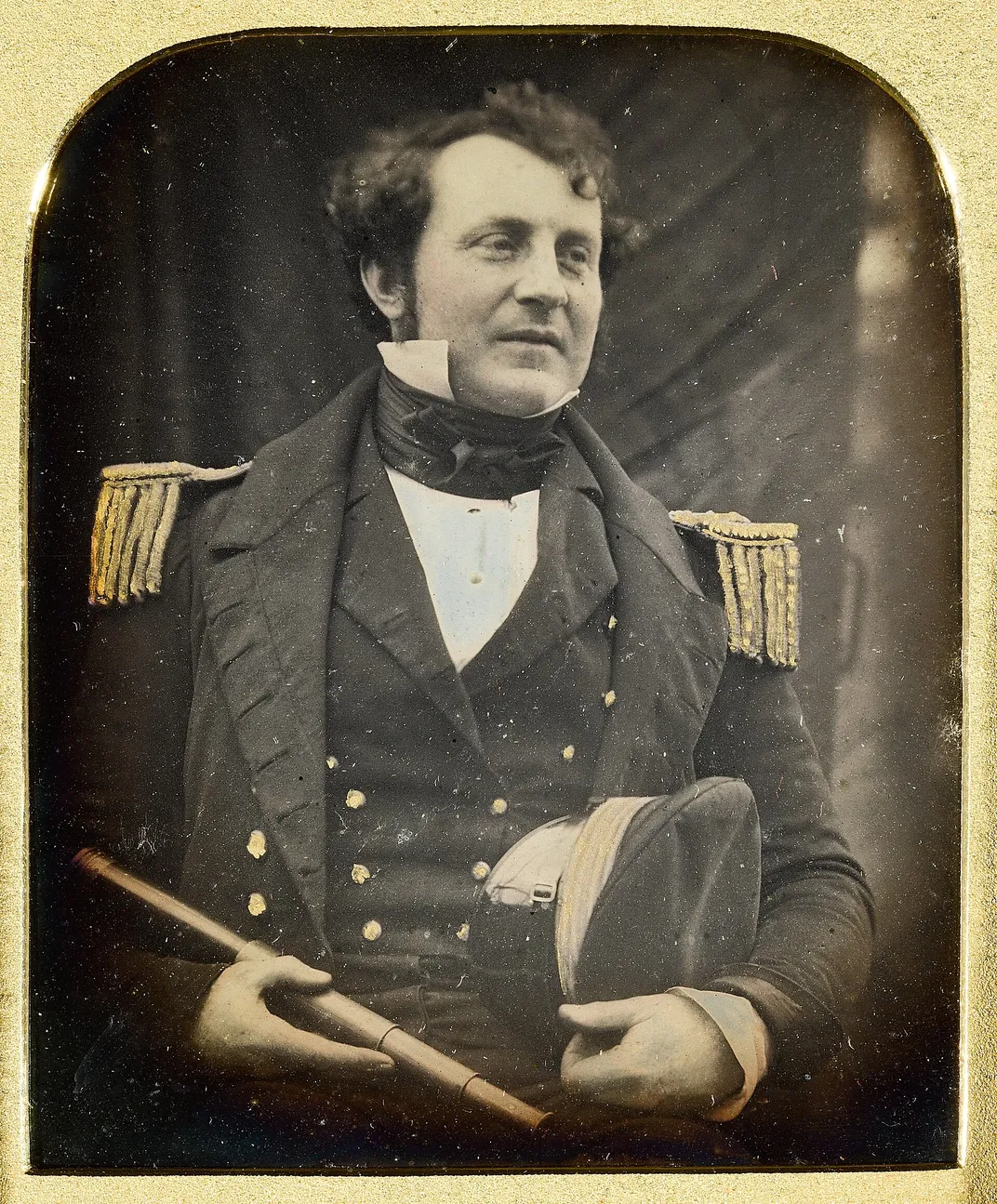
A plethora of Fitzjames’ correspondence home, penned just before the expedition, remains today, shedding light on his character. In contrast, Potter notes that “comparatively few letters” exist from the four newly recognized crew members. “It’s possible fewer were ever written, and those that were are less likely to have been preserved and saved,” he writes on his blog. “Yet, the evidence of a bone, unlike a letter, is undeniable: Here lay a man, and these are his remains.”
In a statement, Park emphasizes Peglar’s identification as particularly significant, stating, “It was fascinating to definitively identify this sailor since the body was discovered with nearly the only written documents from the expedition ever recovered.” While the so-called Peglar Papers are among the few records of their kind, they do not illuminate much about their “unfortunate owner and the disastrous journey of the lost crews,” as the searchers who retrieved the pages had hoped. Rather, the scant sections that can be read seem to focus on the author’s recollections of more temperate climates.
“At times he appears to reference the present, but most of it is recollections of warmer locations,” Potter told Smithsonian in 2025. “It’s the sort of content one would pen while shivering.”