
What prompted this affluent Scotsman to hire a jeweler to cover his teeth in gold wire centuries ago?
What an ancient dental bridge uncovers about health, wealth, and societal values during the late medieval and early modern eras
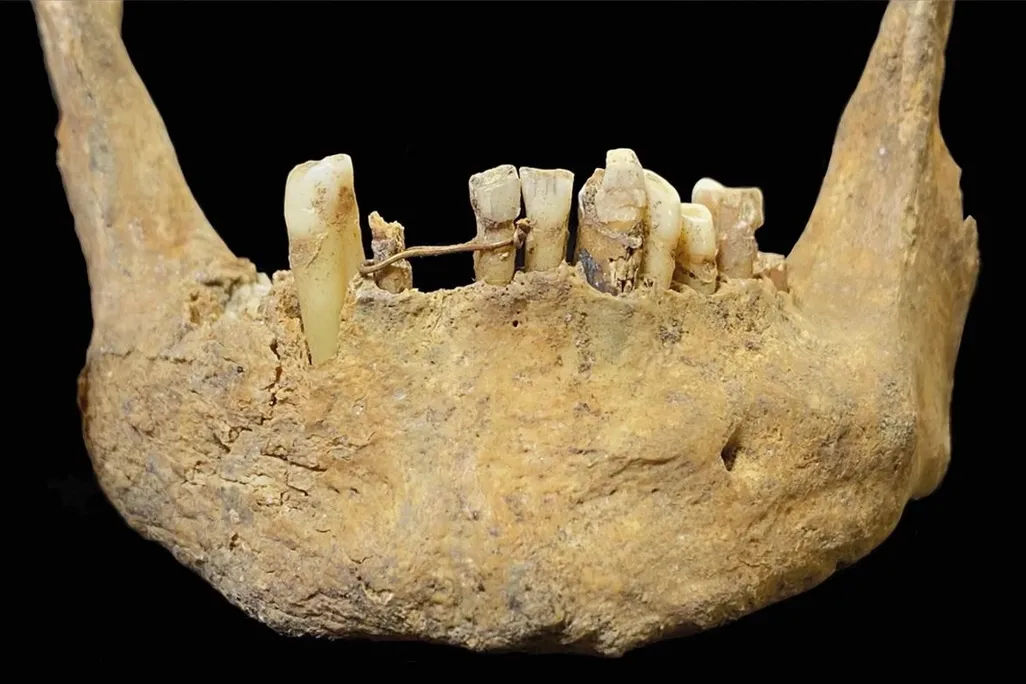
The 20-karat gold wire was placed prior to the man’s demise.
Dittmar, J., Crozier, R., Cameron, A. et al., British Dental Journal, 2026
Researchers have discovered the oldest dental bridge in Scotland, and it is quite extravagant. This twisted wire, affixed to the jaw of a man from the late medieval or early modern era, consists of 20-karat gold. As detailed in a recent study in the British Dental Journal, the bridge was positioned between the man’s lower anterior teeth, either stabilizing a loose incisor or securing a prosthetic tooth.
The mandible in question was unearthed two decades ago during an archaeological dig at St. Nicholas Kirk, a church dating back to the 11th or 12th century in Aberdeen, Scotland. In 2006, ahead of upcoming construction, excavators retrieved around 900 human skeletons and nearly four tons of scattered bones. Recently, the remains have been reevaluated “as part of a broader research initiative aimed at studying health trends over time across Scotland,” according to the study.
Among 100 evaluated remains from the early modern era, only one displayed evident signs of dental interventions. The man bearing the device passed away between 1460 and 1670 C.E. His mandible is approximately 70 percent intact, featuring nine remaining teeth. Four additional teeth became dislodged post-mortem, one was lost prior to death, and the researchers are uncertain if the wisdom teeth ever erupted. From the analysis of the jawbone and teeth’s development, characteristics, and wear patterns, the researchers deduced that the deceased was a male adult who reached middle age.
The gold ligature encircled the lower anterior teeth. Dittmar, J., Crozier, R., Cameron, A. et al., British Dental Journal, 2026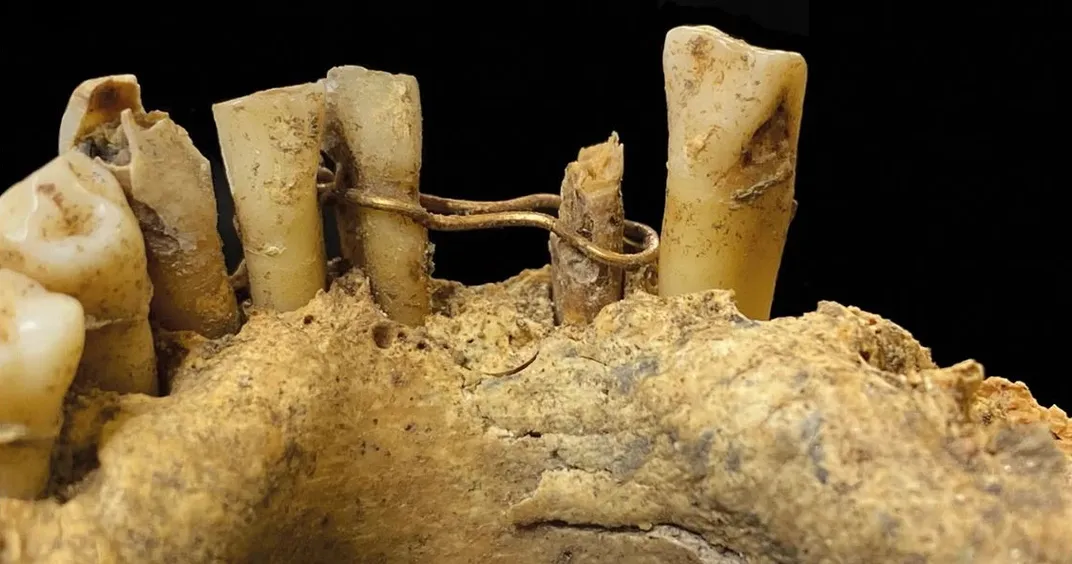
“An analysis of the teeth indicates that this individual suffered from poor oral health,” the researchers state. Various teeth exhibit minor and significant “carious lesions,” and all teeth were covered in slight amounts of tartar.
Nevertheless, the most “remarkable feature” of this mandible is undoubtedly the exquisite gold wire, according to the study. Dental ligatures are uncommon discoveries in archaeology, and few examples found in Europe predate the 17th century. Since the Aberdeen gold wire left indents on the teeth it touched, researchers surmise that the man wore it for “a considerable duration” before his passing.
Humanity has engaged in dental care for thousands of years, long before Colgate or lidocaine. Up to 9,000 years ago, Neolithic individuals practiced drilling into one another’s molars in what is now Pakistan. Around 6,500 years ago in Slovenia, someone filled a chipped canine with beeswax. Additionally, an ancient set of Egyptian teeth, dating back to approximately 2500 B.C.E., features a gold wire similar to that of the Scotsman. Referred to as the “El-Quatta dental bridge,” this wire likely served as a miniature prosthesis, holding a false tooth in place. It may have been placed posthumously to “complete” the remains before burial.
In Scotland centuries ago, dental care providers were barbers, craftsmen, barber-surgeons, or dentatores—individuals specializing in dentistry. The study indicates that local women were predominantly responsible for health care, including tooth extraction. Alternatively, those with decayed teeth could seek the services of a “tooth-drawer,” a traveling performer from carnivals offering “painless” removals. Historical records from Scotland recount folk remedies such as applying hot green sod to painful teeth and rubbing cow dung poultices on oral infections.
A close-up of the knotted end of the ligature Dittmar, J., Crozier, R., Cameron, A. et al., British Dental Journal, 2026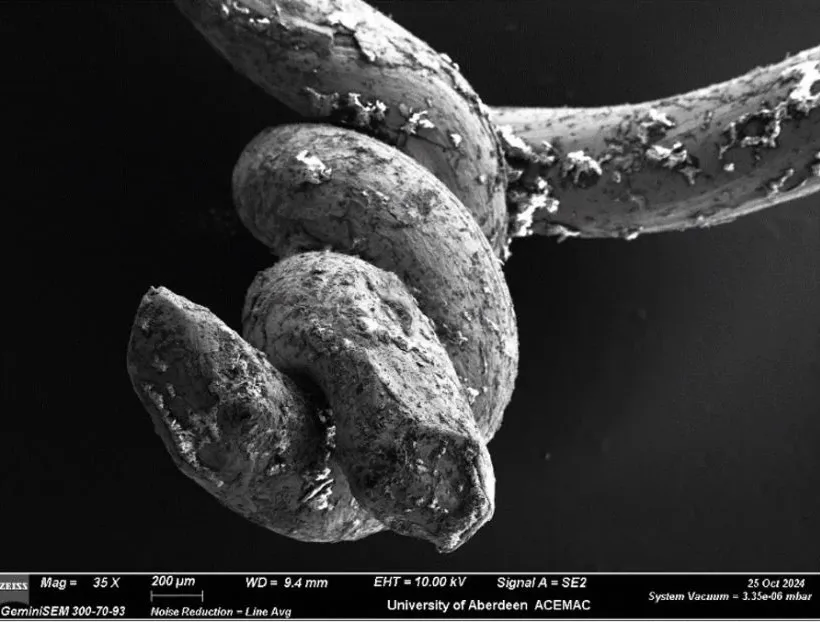
However, the absence of contemporary dental understanding may not have been as detrimental as one might assume. In 2022, Polish dentist Marta Szymańska-Pawelec studied six skulls from late medieval Poland and discovered that they were in fine condition. “This is not unexpected when considering the diet,” Szymańska-Pawelec informed Science in Poland’s Anna Gumułka. “In the past, individuals primarily consumed unprocessed or minimally processed foods: cereals, bread, smoked meats, vegetables, and fruits. Refined sugar was a luxury and a costly item.”
Nonetheless, many individuals during the late medieval and early modern periods dedicated significant effort to their dental hygiene. Instances of treatments included “dentures crafted from human teeth or bovine bone. … There were solutions to whiten teeth, techniques for calculus removal, and materials for filling cavities,” as osteo-archeologist Trevor Anderson stated to BBC News’ Jane Elliott in 2004. Cleanliness and wellness were indicators of social standing and integrity. “Consequently, the social significance of a person’s smile motivated those who could afford [dental] services to pursue them,” the researchers report.
A British illustration from the 14th century Public domain via Wikimedia Commons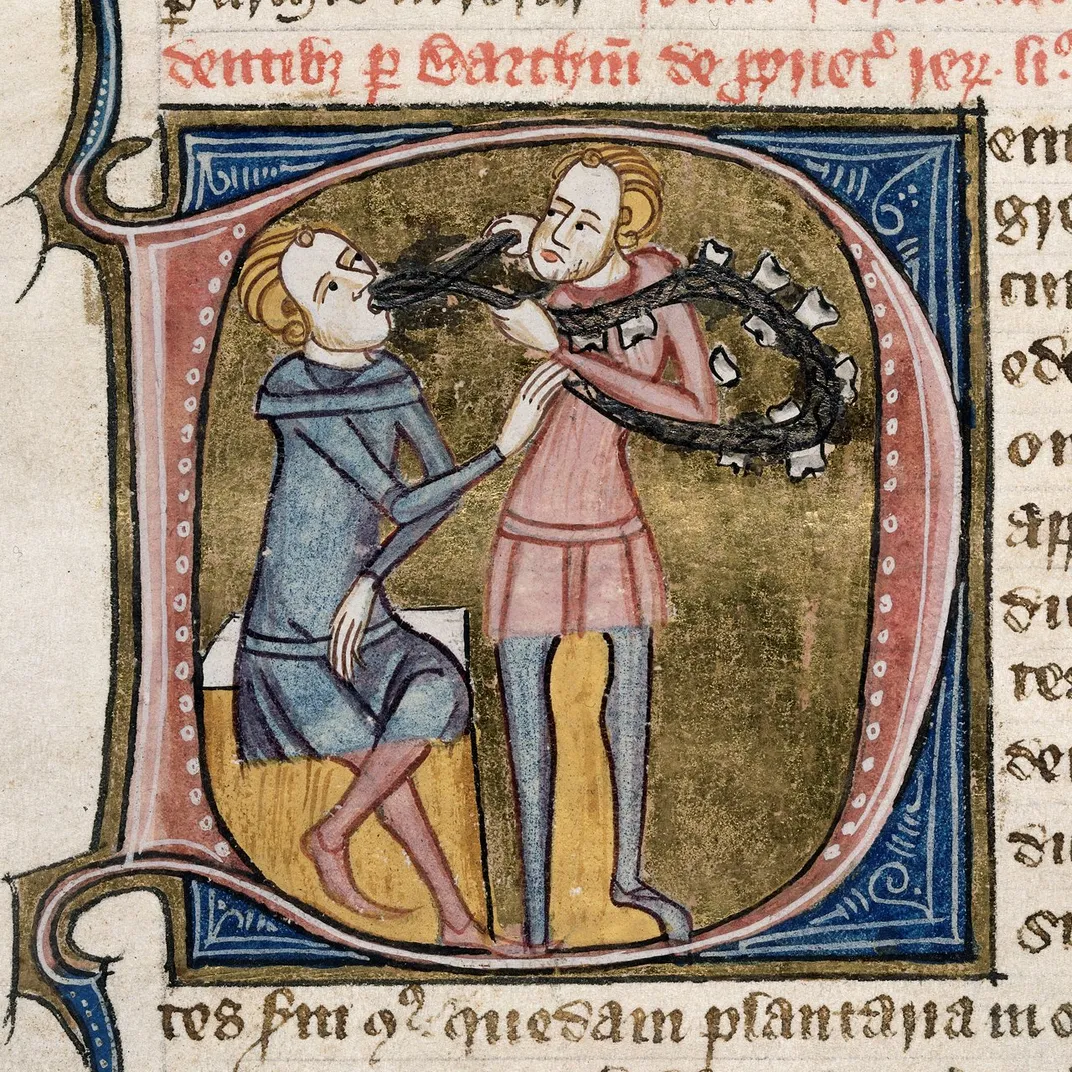
The research suggests that this Scotsman likely belonged to the upper class, inferred from his burial location. This implied he had the means to hire a skilled jeweler and access to gold—as well as potentially enjoying a sugary diet that deteriorated his teeth. The man’s gold wire bridge may have served a functional role, but it likely also carried aesthetic significance, according to the researchers.
Though these techniques may illuminate a historical route to contemporary dentistry, medieval practitioners still had considerable progress ahead. As per Anderson’s 2004 paper on medieval English dentistry, when faced with severe ailments like oral cancer, a prevalent treatment measure was, quite simply, prayer.