An Artist’s Perspective From the Easel
Welcome to the 331st installment of A View From the Easel, a series in which artists reflect on their workspace. This week, artists reach a flow state through the hum of industrial fans and luxuriate in the silence of the Italian countryside.
Want to take part? Check out our submission guidelines and share a bit about your studio with us through this form! All mediums and workspaces are welcome, including your home studio.
#### How long have you been working in this space?
Since 1980.
#### Describe an average day in your studio.
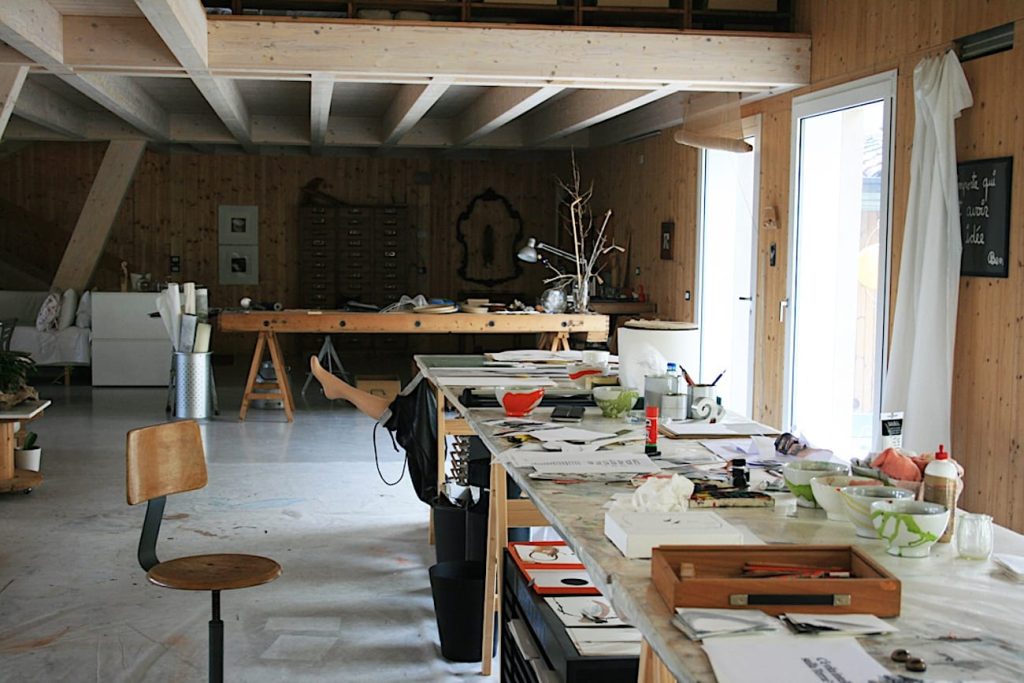
My studio is very quiet. I love the silence of the countryside, which produces a sort of expectation in me. I look at the things that are scattered around and I always find a good reason to start or complete a work. The essential element is the surprise of what happens. I don’t foresee certain results, but I welcome the provocation of the material and the form.
#### How does the space affect your work?
I have the opportunity to leave various works scattered around. The space is very large and allows me to accumulate various objects, which gaze back at me for long periods of time until, suddenly, they suggest a solution that I embrace with enthusiasm.
#### How do you interact with the environment outside your studio?
Yes, there are several artists working in my area with whom I maintain a strong collaborative relationship — at times involving a mutual exchange of ideas. They work in diverse genres, not only painting and photography but also music and cinema, which creates excellent opportunities for teamwork. I am also a member of an association of female photographers spread across the country. I maintain an ongoing relationship with them, and together we organize exhibitions and events — often related to themes of gender — to raise public awareness regarding unresolved social and political issues, such as violence against women.
#### What do you love about your studio?
The tranquility, but also the opportunity to invite artists and friends to stay and work together. The space offers the chance to both exhibit and create, as has already been done on numerous occasions through group exhibitions, gatherings, and dialogues.
#### What do you wish were different?
If it were closer to a large city, it would certainly be more convenient for me to get around. However, I might lose the atmosphere of the place where I have always lived and which I love.
#### What is your favorite local museum?
I find Palazzo Te in Mantova to be a place of great inspiration.
#### What is your favorite art material to work with?
I currently work with photography, but I really enjoy drawing — minimizing the medium to better understand its potential.
—
#### How long have you been working in this space?
One year.
#### Describe an average day in your studio.
I typically begin work at around 11am on a full studio day, and these drag until late at night. My practice consists of observational drawings, small paintings, and sometimes collages that then graduate to a large-scale piece that prioritizes movement and full-body movements. The day begins by boiling water to make coffee and clean brushes. From here, I sit down in front of the paintings I am aiming to work on and decide what needs to be developed that day.
Sometimes, my energy is distributed among all the works I have up in the studio, allowing for conversations between colors and making the paintings come out looking like families. I usually listen to music or watch podcasts on topics that will distract me enough to reach an autopilot mode when painting, allowing me to not overthink my choices and just react to what is in front of me. Not sure if this is a type of sensory overload, but I find that if my other senses are engaged in one way or another, my mind can take over.
#### How does the space affect your work?
The space is communal among seniors at Purchase College and MFA students. There is storage for stretcher bars in the back, so sometimes the rest of the undergrads will walk by. I find that whenever I reach this “flow state,” seeing people walk by the studio or someone yelling (they do this often) takes me out of the zone. Besides that, the industrial building has the constant noise of fans spinning and sometimes resetting, a sort of static that also creates enough noise to make listening to one’s thoughts a bit easier.
#### How do you interact with the environment outside your studio?
I think I am somewhat disconnected from the local artist community, both because of the nature of my work and because I commute to the college as opposed to the vast majority of people in the studio, who live on campus. Despite this, I find that being isolated from the rest of urban New York allows for more vibrant colors and quiet moments to appear and converse among my paintings.
#### What do you love about your studio?
I love that it has these huge windows facing northeast that allow the sunrise to peak through into the studios and the sunset to cast a cool light into the windows in the afternoon. They usually turn a warm blue