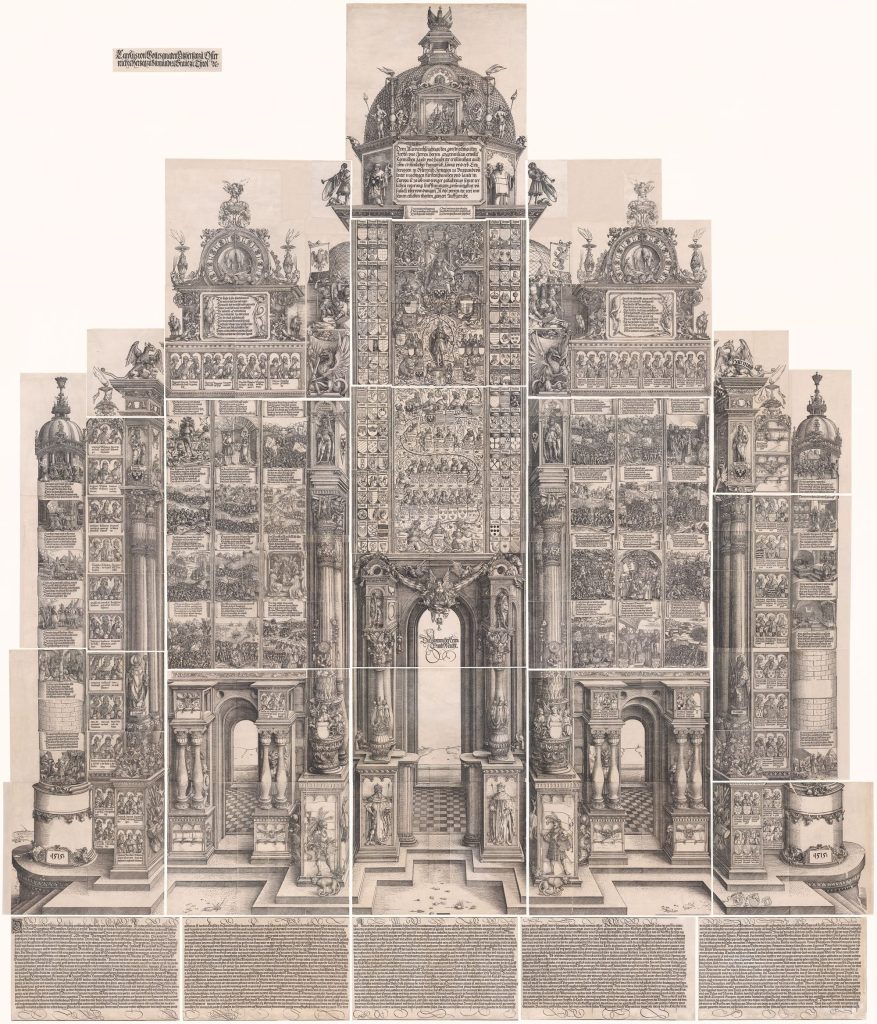
Opportunity to View Dürer’s Monumental Print in NYC Before It’s Gone
In 1512, Holy Roman Emperor Maximilian I commissioned the renowned German printmaker Albrecht Dürer to produce a monumental work of imperial propaganda, designed for display on palace walls and city halls. This creation, known as Maximilian’s “Arch of Honor” at the time and now referred to as the “Triumphal Arch,” is a multi-paneled woodcut print measuring approximately 13 feet (four meters) in height, making it one of the largest prints ever made. Dürer assembled a studio of assistants, students, carvers, and advisors to assist with the intricate woodcut over the course of more than two years.
Today, the New York Public Library (NYPL) houses several panels from a 1515 first edition of the “Triumphal Arch,” which have been on exhibit since the opening of the Polonsky Treasures exhibition in 2021. Given the work’s age and fragility, the library plans to store it in the print vault later this fall, making this potentially the last chance for the public to view it for some time. Madeleine Viljoen, curator of Prints at NYPL, noted that the “Arch” was originally donated to the library in 1903 by Atheron Curtis.
Initially displayed in the library’s Great Hall, the piece was re-mounted after being framed, which in retrospect, given its delicateness, was considered somewhat reckless by Viljoen. In 1984, it was determined that the print required conservation, prompting its storage in boxes. The “Arch” re-emerged in 2009 when the Philadelphia Museum of Art requested it for their “Grand Scale” exhibition, during which the print underwent restoration, including changing its backing material. Post-exhibition, it returned to storage until its display years later.
The enduring fascination with the “Arch” can be attributed to its richly symbolic imagery that conveys narratives of power, myth, and dynasty. Viljoen explains that it traces Maximilian’s lineage to the mythological city of Troy and includes his well-documented family members like his father, Frederick III, and wife, Mary of Burgundy. The print also features themes of Maximilian’s military achievements, paralleling the practice of Roman emperors who erected triumphal arches to commemorate conquests.
Dürer’s choice to create a print instead of a physical structure reflects both the budgetary constraints of the emperor and the innovative capabilities of print media in disseminating imperial messages widely. Utilizing the relatively novel printmaking technology, enabled by Gutenberg’s printing press, Maximilian’s “Arch” could reach a broad audience, being reproduced in hundreds of impressions for display across city halls and palaces.
The scale and detail of the “Arch” leave visitors in awe, as observed by Viljoen. While Dürer is credited for the artistry, this colossal print was a collaborative effort with numerous artisans contributing to its completion. Nonetheless, Dürer’s expertise is evident in the imaginative and aesthetically captivating elements woven throughout the work, including whimsical images of monkeys and dragons.
After October 18, while library visitors can schedule viewings, the work’s extensive size restricts it from being fully displayed on library tables, allowing only piecemeal viewing of individual panels.