The World According to Gabriele Münter
It is her home, her landscape, her family and friends, portrayed in these images that feel miles away from her contemporaries’ modernist abstraction.
When a woman artist is among a milieu of more successful men, the comments often go like this: “She’s just as good as them.” Or, for an artist couple, “she was his inspiration.” Gabriele Münter, the Berlin-born modernist who co-founded the German Expressionist group The Blue Rider (Der Blaue Reiter) in 1911, isn’t exactly overlooked; she’s had multiple institutional surveys, and her former home in Murnau, Germany, is now a museum. Yet in the United States, she lacks the name recognition of her male contemporaries, in particular her partner of 10 years, Wassily Kandinsky.
In fact, Kandinsky is a phantom presence in the Guggenheim’s current Münter retrospective, Contours of a World. Not only is he in some of her paintings, but the museum’s founding collection includes over 150 of his works and only one of hers — a gift, not a purchase. We can chalk that up to a single, powerful person who overlooked her: Solomon R. Guggenheim.
Left: Gabriele Münter, “Annie (Scheuber) Smith with young girl [probably Allie May Smith], Mary (Bruce Scheuber) Allen, and Jerusha Allen, Marshall, Texas” (July 1900, printed 2006/7), gelatin silver print; right: Gabriele Münter, “Still Life with Madonna” (1911), oil on board
This line of thought crossed my mind when I visited Contours of a World, a beautiful tour through Münter’s creative life installed in the museum’s fourth- and fifth-floor side galleries rather than its majestic ramp. I heard at least one “she’s as good as them” while I was there. I’d counter that she more than equaled her celebrated counterparts. As a driving force of The Blue Rider, her timeless talent arguably surmounted the other members’ formal innovations.
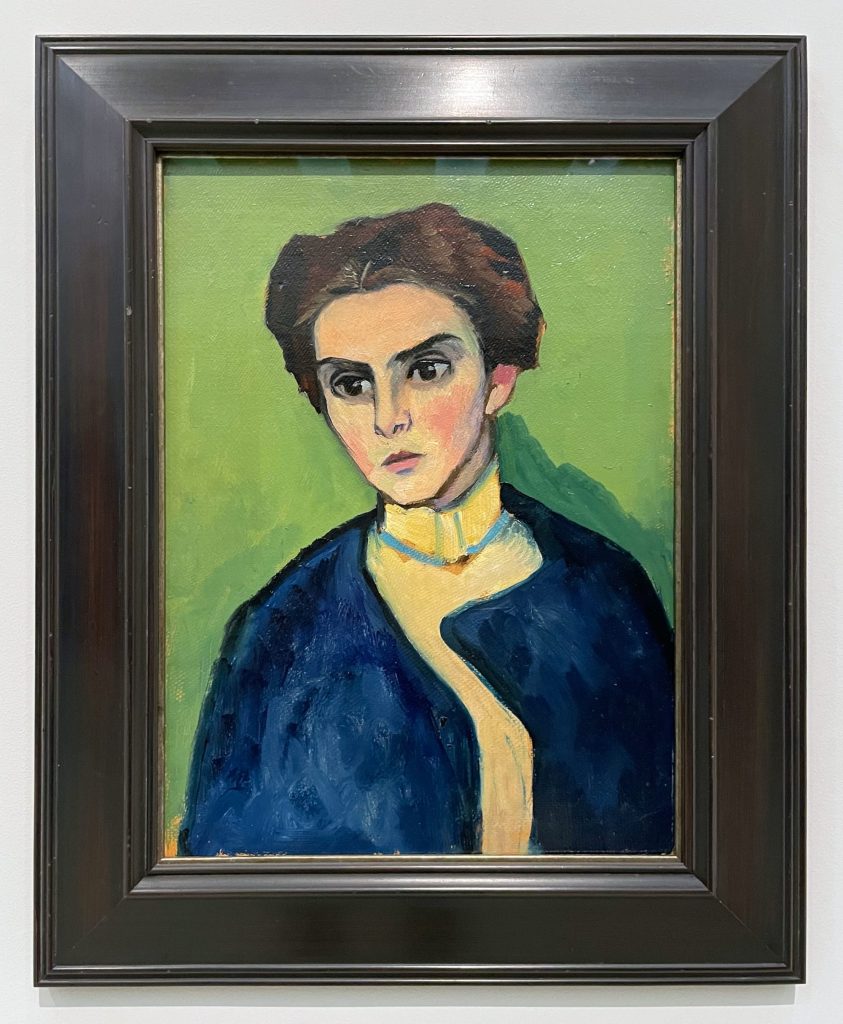
The title comes from Münter’s explanation of her process (quoted in the wall texts): “The forms gather in outlines, the colors become fields, and contours — images — of the world emerge.” And it is her world: her home, her landscape, her family and friends, portrayed in figurative images that can feel miles away from her contemporaries’ modernist abstraction. What she accomplished is more radical than the subject matter suggests. Münter’s art is a masterclass in the phenomenological experience of seeing. Her images are windows into a scene, but her visual strategies redefine the static act of viewing art as something dynamic, as if her world is moving around us, demanding our perception to focus and refocus.
That act of viewing structures the gorgeous “Breakfast of the Birds” (1934). A figure seen from behind (probably the artist) sits at a table in front of a window that looks out onto a wintry, bird-lined tree. The sitter is a version of the Rückenfigur, a stand-in for the