Jean Shin’s Tribute to the Trees of Green-Wood Cemetery
Cemeteries serve as profound spaces where rituals and reflections intertwine, offering a serene environment to honor life and ponder mortality. At Brooklyn’s historical Green-Wood Cemetery, a pair of innovative installations by artist Jean Shin delve into how rituals and reflections eternally shape our existence, illuminating both what we cherish and what we leave behind.
One of the installations, “Offering” (2026), unveiled on April 18, stands prominently in a meadow, situated beside the cemetery’s iconic brownstone Gothic Revival gates. This site-specific creation is a regenerative earthwork, thoughtfully commemorating trees that once thrived throughout their life at Green-Wood. Drawing inspiration from tumuli—traditional burial mounds noted globally—Shin was particularly captivated by the tumulus forms rooted in Korean funerary traditions, distinctively different from the prevailing American cemetery designs.
Harry Weil, Green-Wood’s vice president of education and public programs, initiated this collaboration with Jean Shin, recognizing her talent for employing found materials creatively. He aspired to construct something ambitious and monumental, utilizing the cemetery’s raw materials. This endeavor is a testament to Green-Wood’s commitment to artistic exploration and sustainability.
During her initial visit post-commission, Shin observed a couple of venerable oaks—both nearing life’s end and needing removal due to safety concerns. This encounter ignited her determination to honor these ‘elder trees’ with a dignified commemoration. Her earlier work, “Fallen” (2021), at Olana State Historic Site, shared this spirit, laying a fallen hemlock tree to rest in a crafted leather shroud.
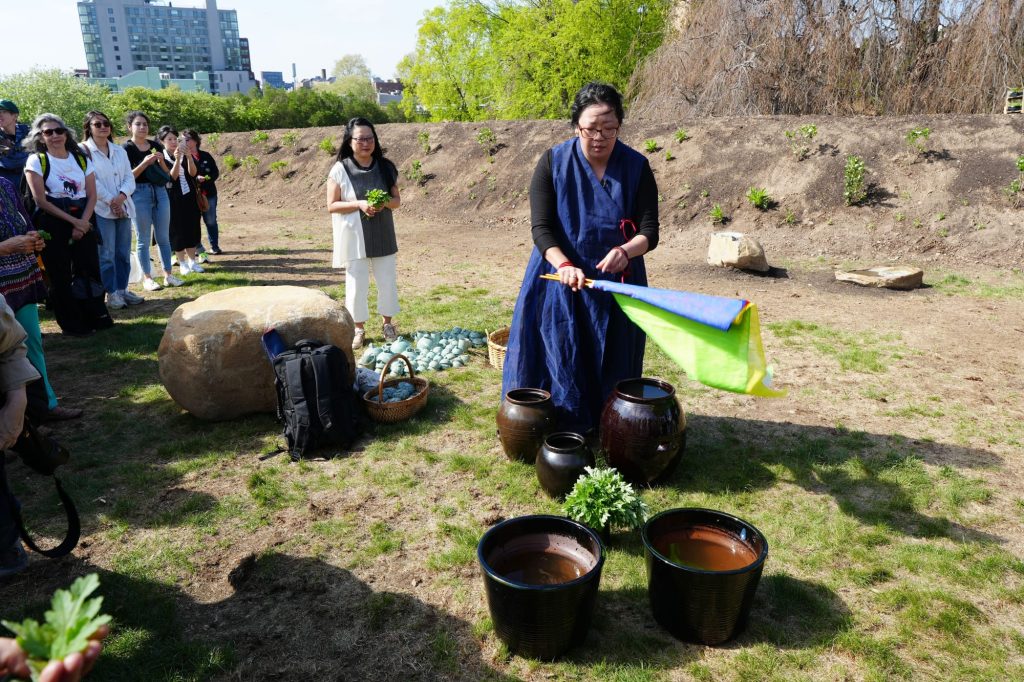
“Offering” extends this vision, translating burial rituals into permaculture methodologies. Collaborating with cemetery gravediggers, Shin carved a trench over a hundred feet long to embrace the fallen trees, embodying the magnitude of their natural forms. Surrounding foliage and branches were also buried alongside. As the installation developed, it became a canvas for a dynamic community ritual led by Korean shaman Mudang Jenn, enhancing its spiritual essence as wildflowers and shrubs broke through the sheltering soil, forming living memorials.
Underpinning the installation is the theme of rebirth, emphasizing death as a transitional phase rather than an end. This resonates deeply this spring at Green-Wood, concurrent with the revitalizing opening of the historic Weir Greenhouse.
The Weir Greenhouse, positioned at the convergence of Fifth Avenue and 25th Street, symbolizes an intriguing overlap between historical preservation and modern utilization. Originally built in the 1880s and lovingly restored, this architectural gem now functions as a visitor center equipped with gallery spaces, archives, and offices, harmonizing the past with contemporary needs.
Within the restored structure lies a permanent exhibition outlining Green-Wood Cemetery’s rich history, alongside a gallery hosting Jean Shin’s evocative “Celadon Landscape” (2015–2019). Previously exhibited at prestigious art institutions, it features monumental vessels formed from myriad discarded ceramic shards, submerged in a reflective pool. These shards, sourced from Korea, epitomize the fragmented Korean diaspora, with Shin viewing them as remnants striving to retain their cultural identity amidst displacement.
Interactive by nature, this gallery invites visitors to engage with the installation, reflecting upon whom they carry in their hearts through memory and written tributes. As an evolving artwork, these testimonies will be collaged onto a significant scroll, creating a tapestry of collective remembrance and participation.
Shin’s creations at Green-Wood riantly explore the concept of belonging, drawing upon shared memories and experiences to inspire persistence amidst life’s fragmented reality. Her works poignantly reframe cemeteries from resting places to thriving arenas for growth, community, and transcendence, resonating through the cycles of life and beyond.