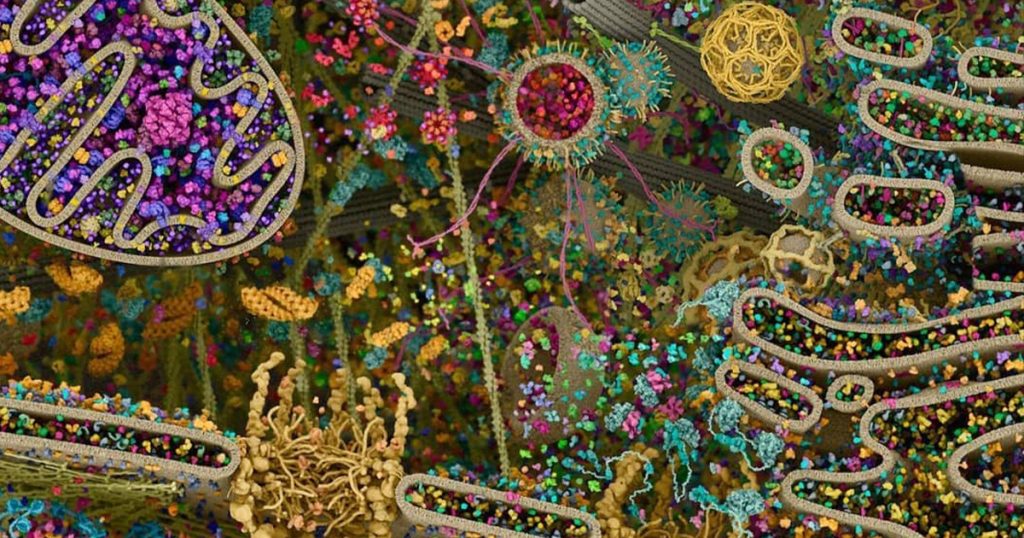
Researchers Chart the Complex and Lively Interior of a Human Cell
At approximately 0.05 millimeters (less than 0.002 inches) in diameter, a human cell is comparable in size to a grain of dust, yet it exhibits an astonishing degree of complexity. Inside this tiny realm, there are around 60 billion proteins, 2 trillion lipid molecules, 5 trillion sugars and amino acids, and roughly 60 billion RNA molecules, all collaborating to uphold life.
To aid in the comprehension of the inner workings of a human cell, scientific animators Evan Ingersoll and Gael McGill (from Digizyme) developed a digitally generated model of a eukaryotic cell. While it does not serve as a precise representation of an individual cell, the remarkable visualization, crafted between 2009 and 2015, illustrates how innumerable molecules interact within an active, intricately linked system. It also showcases the astounding nature of cells, akin to miniature universes brimming with continual activity and intricate processes.
The interactive graphic was produced for Cell Signaling Technology, Inc., influenced by the artistic work of David Goodsell, a computational biology professor at Scripps Research Institute, revered for his vibrant watercolor depictions of cells and viruses. Coupled with some artistic interpretation, segments of the image were digitally created using data collected via scientific techniques.
“This 3D model of a eukaryotic cell is constructed utilizing X-ray, nuclear magnetic resonance (NMR), and cryo-electron microscopy datasets for all of its molecular components,” clarifies McGill. “It aims to replicate the numerous pathways involved in signal transduction, protein synthesis, endocytosis, vesicular transport, cell-cell adhesion, apoptosis, and other functions.”
Although some on the internet are referring to it as “the most intricate image of a human cell ever made,” Evan Ingersoll and Gael McGill stress that it is primarily an educational resource. Aspects of the cell have been simplified, and in certain instances “compressed,” to aid viewers in grasping what transpires within it.
“Think about gathering a group of friends for a selfie; they wouldn’t typically be that close, but it enhances the image,” Ingersoll states. “Moreover, it’s not an image of a specific cell; it serves as a background to explore as many pathways as possible. For instance, this particular cell displays both breast cancer and Alzheimer’s.”
The interactive rendition showcases each cellular component in more detail and enables users to hover over specific areas to discover what they represent. Explore it on the Cell Signaling Technology, Inc website.
To aid in the comprehension of the inner workings of a human cell, scientific animators Evan Ingersoll and Gael McGill (from Digizyme) developed a digitally generated model of a eukaryotic cell.
While it does not serve as a precise representation of an individual cell, the remarkable visualization illustrates how innumerable molecules interact within an active, intricately linked system.
Digizyme: Website
Sources: Cell Signaling Technology, Cellular landscape; ‘Human cell’ image isn’t what it seems when put under the microscope
Related Articles:
– [Google and Harvard Team Up to Make the Most Detailed Map of Human Brain Ever](https://mymodernmet.com/google-harvard-brain-map/)
– [Scientists Have Completed Mapping the Last 8% Of the Human Genome](https://mymodernmet.com/mapping-the-human-genome/)
– [Psychiatrist Hand-Knits an Anatomically Correct Replica of the Human Brain](https://mymodernmet.com/knitted-human-brain-dr-karen-norberg/)
– [Photographer Zooms Into a Single Honeycomb Cell Using a Macro Lens to Reveal Its Microscopic Patterns](https://mymodernmet.com/macro-photography-honeycomb/)