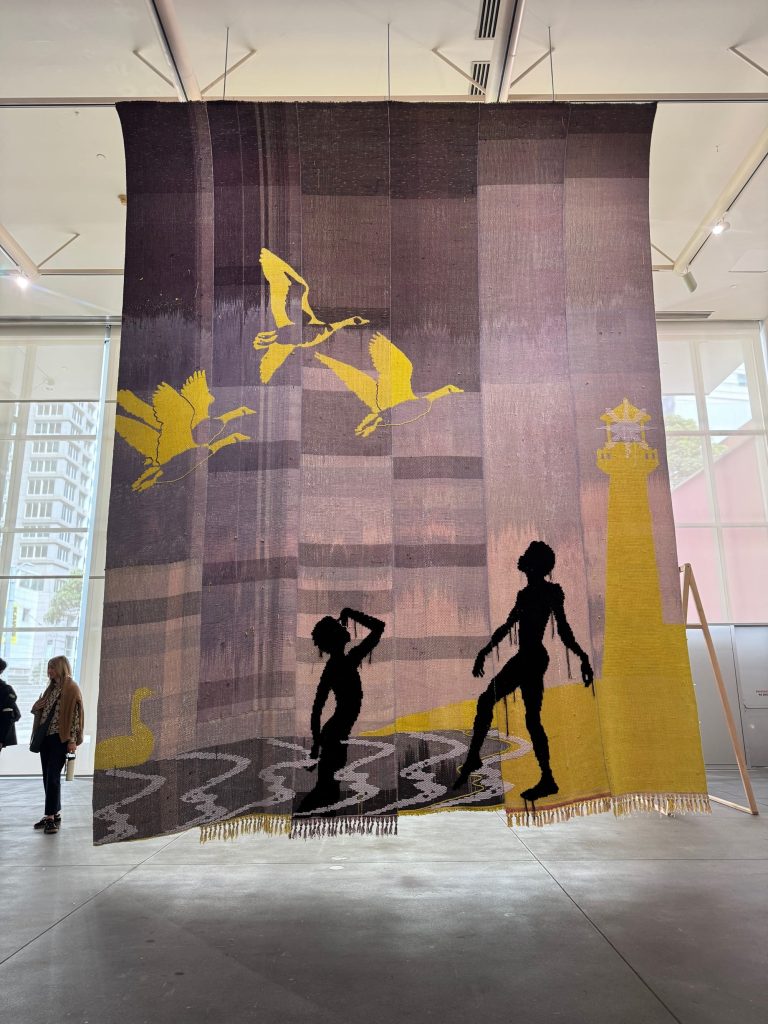
Diedrick Brackens’s Tapestries Illuminate the Quest for Freedom
San Francisco, a city rich in artistic expression, is currently hosting an exhibition that prompts a deep reflection on the craft of weaving, an art form that transcends mere visual appeal to explore themes of memory, identity, and cultural inheritance. At the Yerba Buena Center for the Arts, Diedrick Brackens presents his first solo exhibition in the Bay Area, titled “gather tender night,” guest-curated by Eungie Joo. This exhibition stands as a significant homecoming for Brackens, who completed his MFA at the California College of the Arts in 2014.
Diedrick Brackens asks a profound question through his body of work: “What does a weaver weave today?” His answer is not simply in the form of objects but woven narratives that are deeply entrenched in personal and communal histories. Using hand-dyed cotton and acrylic yarn, Brackens crafts tapestries that illustrate stories and embody cultural traditions, reimagining them within the present context and projecting them into the future. His art blends multiple influences: West African weaving, California fiber arts, European tapestry traditions, and the improvisational style of the Gee’s Bend quilters.
The exhibition features 15 tapestries created since 2020, including three new works from 2026. These pieces transform the gallery space into a cinematic experience, where each tapestry acts as a still frame within a larger narrative. In “clearing” (2026), Brackens extends his storytelling into three-dimensional space, incorporating elements such as a bed and a handwoven basket of Dove soap that evokes the artist’s childhood. This installation highlights the intersection of utilitarian and aesthetic aspects of weaving, emphasizing themes of care and ritual.
Brackens’s artistic journey was notably shaped during his time at CCA, where he was influenced by Josh Faught’s “sloppy craft” ethos. This approach embraces imperfection and transparency, allowing for a rich exploration of the weaving process. Loose threads and unfinished edges in Brackens’s work subvert traditional expectations of textile art, prioritizing the transmission and evolution of knowledge over polished presentation.
A recurring motif in Brackens’s work is the silhouetted Black figure, reminiscent of artists like Kara Walker and Kerry James Marshall. These figures, often woven in cotton—a material fraught with historical connotations of violence and labor—stand as powerful symbols of the Black experience. “Blood Compass” (2023), Brackens’s largest tapestry to date, uses the imagery of migrating geese and standing figures to delve into themes of Black migration, resilience, and the interconnection between the human and natural worlds. This piece eloquently reinterprets migration as a process of cultural memory and trauma.
The exhibition evokes a sense of collective storytelling and memory, reminiscent of the vibrant juke joint sequence in Ryan Coogler’s film “Sinners.” Through his weaving, Brackens creates a space where multiple histories are honored and celebrated, one thread at a time.
“gather tender night” is a journey through time, intricate in its storytelling and profound in its reflections. It continues to engage audiences at the Yerba Buena Center for the Arts in San Francisco, inviting visitors to experience the tactile beauty and emotional depth of Brackens’s woven narratives until August 23.