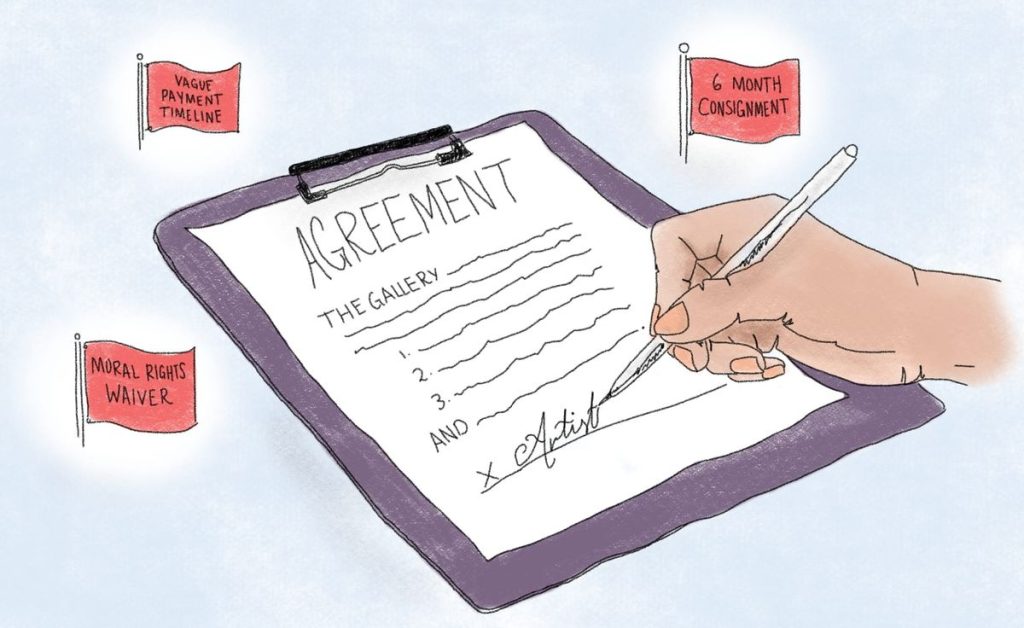
What Artists Forfeit in Contracts
Title: The Silent Shift in the Art World: Protecting Objects Over Artists
In the labyrinthine corridors of the art world, a subtle yet significant truth often emerges for artists: the industry is generally more inclined to safeguard the objects created than the creators themselves. This revelation does not announce itself with fanfare. Instead, it quietly embeds within routine documents labeled as “standard agreement” or “minor revision,” only truly exposing itself when an artist decides to cease skimming and start reading these agreements with a scrutinizing eye.
An artist’s journey into understanding the precarious balance of control and ownership typically begins with the consignment agreement—a pivotal document that enables galleries to take possession of artworks and sell them on an artist’s behalf. While ownership remains with the artist until a sale is completed, the terms defining this relationship can often be skewed unfavorably against them.
For instance, an artist, newly acquainted with legal intricacies, may discover unsettling clauses—like a consignment period extending months beyond an exhibition’s conclusion, leaving artworks in a state of “contractual limbo.” When ownership is confined by such terms, the artist’s autonomy over their work is undermined, especially if the gallery has no intentions of representing the work post-exhibition.
Artists face a crucial decision: negotiate for fairer terms or accept unfavorable conditions. Attempts to amend agreements are sometimes met with passive acknowledgment but no actual revision, underscoring a perceived power imbalance between artist and institution—often leaving artists with the stark reality that their requests might not be taken seriously.
Moreover, the issue extends to more personal realms, such as when participating in residencies. Agreements here can include waivers of moral rights—protections under the Visual Artists Rights Act—allowing institutions the power to alter, modify, or present an artist’s work without their consent. Often, such clauses are downplayed in significance while actually diminishing the artist’s long-term control and attribution of their work.
Rejecting such terms becomes a rare point of agency for artists. Though declining opportunities can come at a cost, it clearly delineates what an artist is willing to accept, challenging the status quo. The pervasive ambiguity surrounding payments, insurance, and other terms in the art industry would be intolerable in other sectors where clarity is paramount. Yet, within the art world, this vagueness is often framed as trust—trust that an artist knowingly relinquishes something fundamentally important.
Historically, attempts to rebalance this relationship, such as “The Artist’s Reserved Rights Transfer and Sale Agreement” by Seth Siegelaub and Robert Projansky, proposed that the value of an artwork—and the artist’s stake therein—should transcend its purchase. However, the art market’s resistance to relinquishing power and enduring obligations stifled its broader adoption.
The art world thrives on perceived informality, but in truth, this structure thrives on opacity and imbalance. However, there is a growing awareness among artists who, equipped with more knowledge and support, are questioning this framework. While legal counsel remains a privilege not all can access, dialog among artists offers crucial insights and shared experiences. What was once settled as standard is increasingly scrutinized.
More artists are reading the fine print, questioning the norm, and sharing experiences—forming a collective mindful of their rights and the true distribution of power within agreements they sign. As more artists unite in understanding and questioning the system, the potential to redefine what is considered standard emerges, advancing towards a future where artists are equally protected as the art they create.
The documents arrive. The terms are presented as ordinary. Yet, in these moments, the real power lies in reading them anyway, discerning their implications, and understanding the precedent they set for artists’ rights in the art world.