
This Souvenir Bowl May Have Commemorated an Ancient Roman Soldier’s Service at Hadrian’s Wall. It Was Discovered on a Spanish Farm 1,900 Years Later
The artifact is decorated with an illustration of the defensive fortification in northern England, but it was unearthed some 1,200 miles away. A new study suggests the design reflects a soldier’s achievements at the site
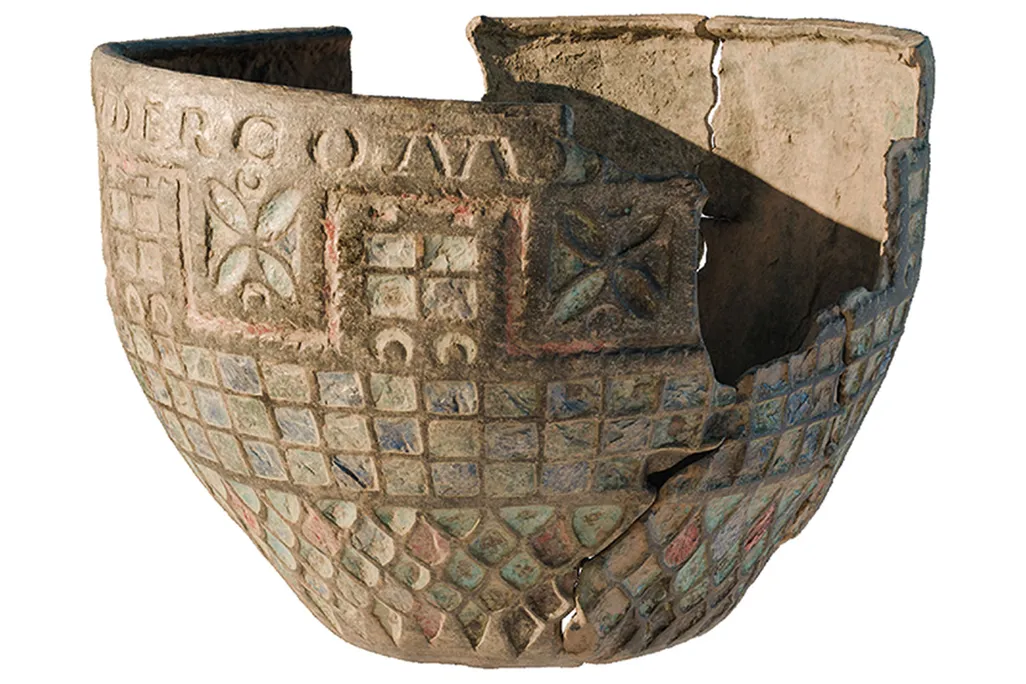
A virtual reconstruction of the Berlanga Cup
3D Stoa—Archaeology and Heritage / Cambridge University Press under CC BY 4.0
Archaeologists may have identified the origins of a recently discovered 1,900-year-old bowl decorated with bright red, green, blue and turquoise patterns. These designs appear to depict Hadrian’s Wall, the 73-mile-long fortification that once protected the Roman Empire’s northwest frontier.
The wall is in northern England, but the bowl was found in Berlanga de Duero, a central Spanish town some 1,200 miles away. Researchers say the artifact may have commemorated a Roman soldier’s service near the wall—and when he returned home, he brought the keepsake back with him.
“It was commissioned or purchased by a Roman army officer, either as a souvenir or as a retirement gift,” according to a new study published in Britannia, a journal devoted to the study of Roman-era Britain. The cup dates to between roughly 124 and 150 C.E., according to a statement from the researchers. Based on a lead isotope analysis, they concluded that it was made in northern Britain using local materials. Perhaps he kept it to “[remember] his time and service at one of the monumental frontiers of the empire,” the researchers write.
Part of the inscription on the Berlanga Cup Susana De Luis / Cambridge University Press under CC BY 4.0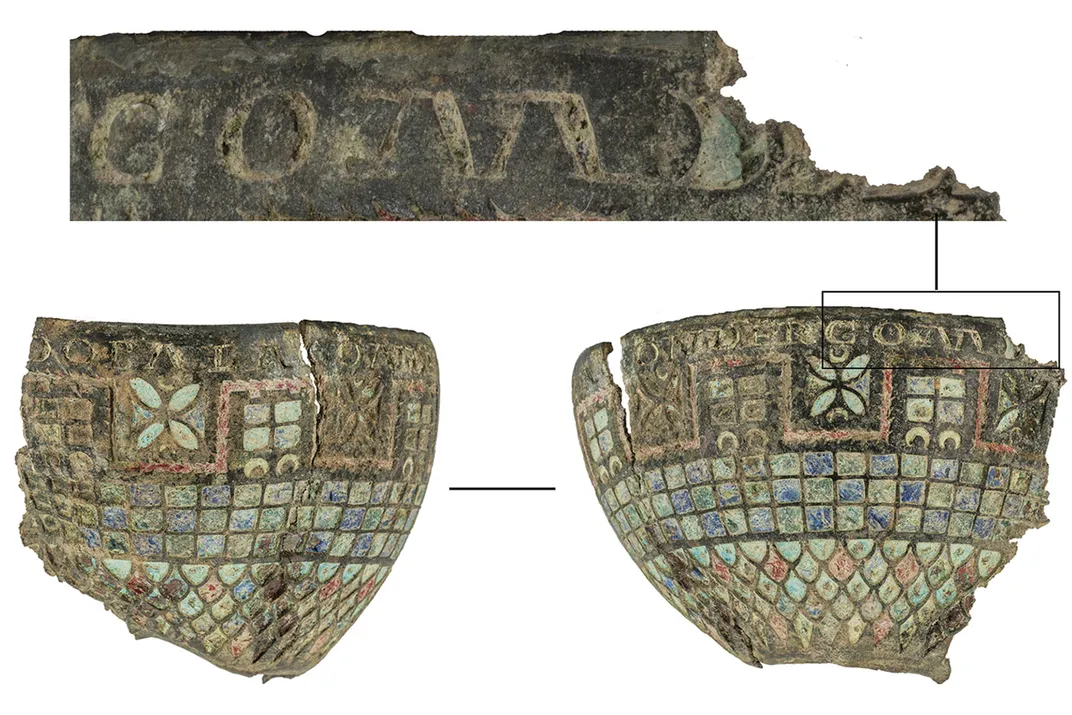
The cup features an inscription, though some of its letters have been lost to history. The surviving segments read, “[…]RNVMONNOV[…]DOBALACONDERCOMDDDD.” Filling in the gaps, the researchers think these letters once spelled the names of four forts: Cilurnum, Onno, Vindobala and Condercom.
Archaeologists have discovered artifacts of this kind before. In 1725, an object now known as the Rudge Cup was found near the village of Froxfield in western England, and a few similar items were unearthed in the 20th century. “The idea of collecting objects as a way of safekeeping memories is extremely old,” Frances McIntosh, a curator at Historic England, said in 2022, when the Rudge Cup went on display.
These souvenir cups are known as trullae, a type of ancient Roman drinking vessel that was “characteristic of Roman military equipment,” per the study. They often featured the names of Roman forts or similar images of Hadrian’s Wall—thought to be some of history’s oldest known depictions of the sprawling fortification. The wall, which began construction in 122 C.E., reached from the Solway Firth on the west coast of Britain across to the Tyne River, near its confluence with the North Sea.
Measuring 4.5 by 3.1 inches, the Berlanga Cup is the second example of its kind found in the Iberian Peninsula. Unlike previous finds, which only referenced forts on the western side of Hadrian’s Wall, the newly discovered cup names forts on the eastern side.
Orthographic display of the cup’s outer surface 3D Stoa—Archaeology and Heritage / Cambridge University Press under CC BY 4.0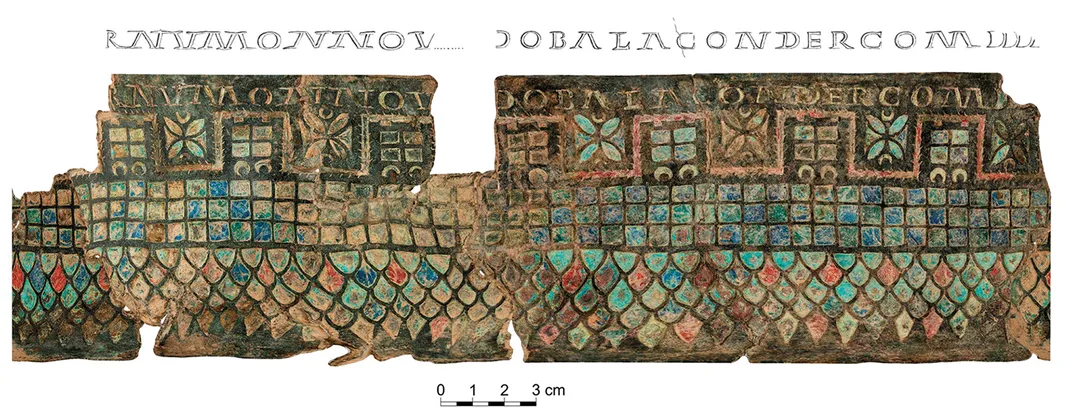
“Up until this cup, the fact that the forts named [on other cups] were from the west sector of the wall inclined me to think it was perhaps an object type possibly being produced in that western sector only,” Rob Collins, an archaeologist at Newcastle University in England, tells Tom Horne of the blog “A Whole Lot of History.” “The Berlanga Cup opens up the likelihood of these being made for the entire wall.”
Souvenirs from tourist destinations, rather than military fortifications, were common throughout the Roman Empire, where they were often owned by “people who could not travel to such sites in person,” Maggie Popkin, an art historian at Case Western Reserve University, wrote for Aeon in 2022.
Much like today’s tourists, the ancient Romans collected tiny replicas of famous monuments and cities, and well-known statues “spawned veritable souvenir industries,” Popkin added. “By taking ancient souvenirs seriously, we can glimpse how Romans themselves understood their empire and its cultural heritage.”
Fun facts: An ancient souvenir stylus
- During excavations between 2012 and 2014, archaeologists unearthed a nearly 2,000-year-old iron stylus in London.
- The artifact was inscribed with a message: “I have come from the city. I bring you a welcome gift with a sharp point that you may remember me. I ask, if fortune allowed, that I might be able [to give] as generously as the way is long [and] as my purse is empty.”
- In this inscription, “the sender acknowledges that it is a cheap gift and wishes that they could have given more,” according to a statement from the Museum of London Archaeology. “It is the Roman equivalent of ‘I went to Rome and all I got you was this pen.’”
But the researchers don’t think the Berlanga Cup “merely commemorated a visit” to Hadrian’s Wall. Instead, they argue that it was a tribute to a soldier’s experience serving at the site—perhaps an object that he purchased as a memento, or a gift he received from his superiors or fellow soldiers.
Based on their analysis, the researchers concluded that the inscription may have been added after the cup was produced, suggesting that a buyer may have requested the engraving when he purchased it.
“It is not only crafted with metals, but also expensive enamels, and later on customized,” co-author Jesús García Sánchez, an archaeologist at the Archaeological Institute of Mérida in Spain, tells Live Science’s Kristina Killgrove. “It is definitely not an industrial product.”