
Astronomers Discover 27 Potential Planets Each Orbiting Two Stars, Just Like the Fictional Tatooine in ‘Star Wars’
The findings could more than double our current database of worlds that loop around binary star systems. But researchers need to analyze more data before they can officially celebrate a new trove of far, far away exoplanets

Tatooine is a fictional desert planet with two suns. No such planet had been found when this scene in Star Wars: Episode IV–A New Hope was created.
Luke Skywalker Biography Gallery under Fair Use
In a memorable scene from Star Wars: Episode IV–A New Hope, future Jedi Luke Skywalker leaves dinner with his aunt and uncle and heads out to an unusual sunset. On the fictional desert planet Tatooine, not one, but two suns fall toward the horizon.
When the movie was released in 1977, scientists hadn’t yet discovered any planets outside of our solar system, called exoplanets, let alone one orbiting a two-star system. Now, in a study published in the journal Monthly Notices of the Royal Astronomical Society on May 4—considered Star Wars Day by fans—astronomers say they’ve identified 27 new potential planets, each with two stellar hosts. The trove could more than double the number of known circumbinary planets.
“When the original Star Wars was released, we didn’t know that there were exoplanets at all,” says Sara Webb, an astrophysicist at the Swinburne University of Technology in Australia, who was not involved in the research, to the Guardian’s Donna Lu. “A lot of things that are predicted in art and in artistic concepts of what the universe might be, we tend to find it … in science as well.”
Need to know: Why is it “Star Wars” Day?
May 4—or May the 4th, some might say—is an informal commemorative day that’s a play on the popular Star Wars phrase “May the force be with you.” The date spread online among fans, and Disney, which acquired the production company behind Star Wars in 2012, now uses it to promote the franchise, reported the Associated Press’ Andrew DeMillo in 2025.
Astronomers have now discovered more than 6,000 confirmed exoplanets, but fewer than 20 of them loop around binary star systems. Most of these far, far away planets have been found by tracking a star’s light, because it dims when an object passes in front of it. This method works best for finding planets with simple orbits that happen align perfectly with a ground- or space-based instrument’s line of sight. In binary or multiple star systems—how most of the universe’s stars are thought to exist—planets are more likely to have irregular orbits and not come into our view.
Still, the transit method allowed astronomers to find some circumbinary planets, including the first confirmed one, Kepler-16b. It’s a gas giant roughly the size and mass of Saturn located nearly 250 light-years from Earth.
“Of course, we can’t see the individual object, all we see is the total light coming from it,” Joshua Carter, who helped discover Kepler-16b in 2011 as an astronomer at the Harvard-Smithsonian Center for Astrophysics, told Smithsonian magazine’s Joseph Stromberg at the time. When a planet moves in front of its star, “you see a very small, little dip in the total light from the system, and then we infer based upon its shape and basic properties that it’s an object transiting.”
Astronomers can also watch how two stars in a binary system eclipse one another, which happens on a predictable schedule, in a technique called apsidal precession. When a variation can’t be explained by stellar interactions or the general theory of relativity, that hints that a third body might be throwing off the stars’ dance.
Real-life Tatooine planet candidates discovered orbiting twin suns
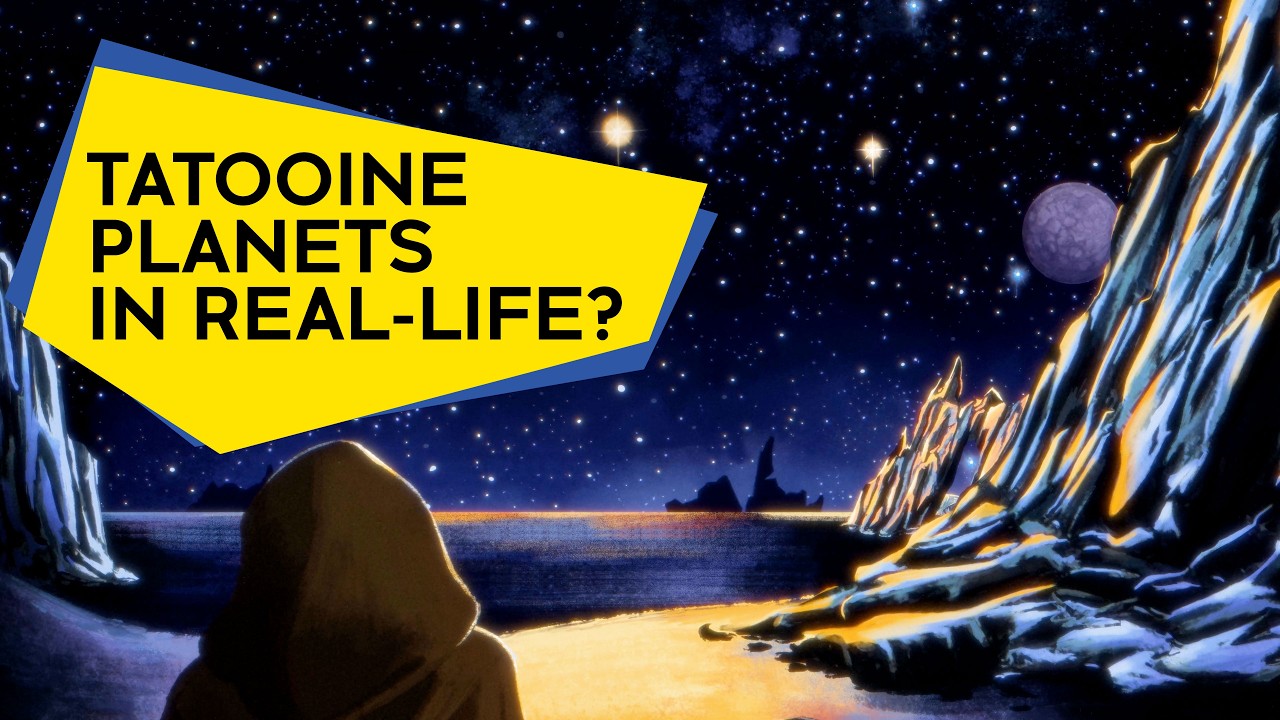
This method hasn’t previously been used in a large-scale planet search. So, researchers tested it out on data from 1,590 binary star systems collected by NASA’s Transiting Exoplanet Survey Satellite. Their analysis revealed that 27 of them might host planetary mass objects, and more than half of the perturbers might contain less mass than Jupiter. To confirm that planets are truly present, however, the team must analyze more data, such as the light emitted by the candidates, says study co-author Margo Thornton, an astronomer at the University of New South Wales in Australia, to the Guardian.
In an earlier study, published last December in the Astrophysical Journal Letters, another team of astronomers proposed that planets are rarer in binary star systems, as the unique physics of those environments isn’t conducive to maintaining an orbit long-term.
“Two things can happen: Either the planet gets very, very close to the binary, suffering tidal disruption, or being engulfed by one of the stars, or its orbit gets significantly perturbed by the binary to be eventually ejected from the system,” said study co-author Mohammad Farhat, an astronomer at the University of California, Berkeley, in a statement. “In both cases, you get rid of the planet.”
Still, with the discovery of more than two dozen potential circumbinary planets, the team behind the new study hopes to change how researchers hunt for exoplanets, particularly around unusual star systems.
“Most of our current knowledge on planets is biased, based on how we’ve looked for them,” Thornton says in a statement. “We’ve mostly found the easiest ones to detect. This new method could help us uncover a large population of hidden planets.”