
The Eta Aquarid Meteor Shower Peaks This Week, but a Bright Moon Might Spoil the Show
This annual event, which peaks on the night of May 5 into the next morning, comes from the trail of debris left by Halley’s comet. It’s best viewed from the Southern Hemisphere, but skywatchers in the north can catch a glimpse
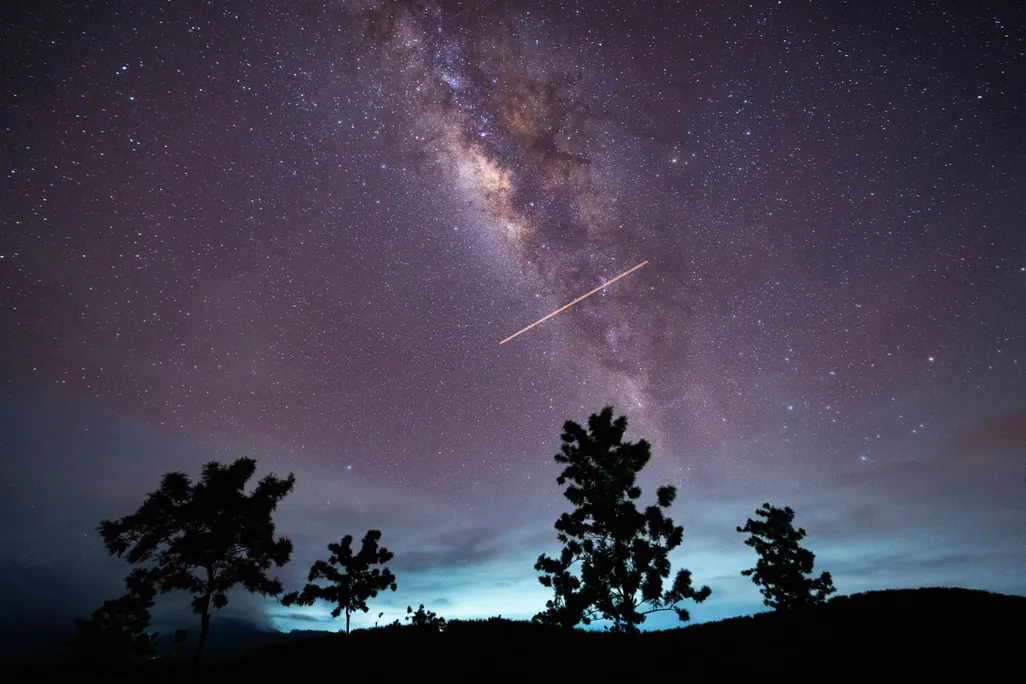
The Eta Aquarids as seen from Sri Lanka in 2024
Thilina Kaluthotage / NurPhoto via Getty Images
May has arrived, which means it’s also time for the peak of the Eta Aquarid meteor shower, an annual affair that is best viewed from the Southern Hemisphere. However, the moon will be 84 percent full, according to the American Meteor Society, making it harder to spot fainter meteors.
This year’s Eta Aquarids—also called the Eta Aquariids—are active from April 19 to May 28. The shower will peak in the evening of May 5 into the next morning, when lucky viewers in the Southern Hemisphere will have a chance to see up to 50 meteors zooming across the sky per hour. That number will be closer to ten for Northern Hemisphere stargazers, per NASA.
“For us in the Northern Hemisphere, it’s not going to be as impressive,” says Teri Gee, manager of the Barlow Planetarium in Wisconsin, to Adithi Ramakrishnan at the Associated Press. “The farther south you are, the better you’ll see it.”
That’s because of where the meteors look like they’re coming from, a point in the sky called a radiant. It’s near a bright star in the Aquarius constellation called Eta Aquarii, which is also the shower’s namesake. Aquarius is higher in the sky in the Southern Hemisphere than it is in the Northern Hemisphere, making it and the “shooting stars” it appears to spit out easier to see from the lower part of the globe, according to NASA.
Like most meteor showers, the Aquarids occur when the Earth passes through the cosmic debris left behind by a comet. These shooting stars come from the famed Halley’s comet, or 1P/Halley, which gets close to our home planet roughly every 76 years, and is next due for a visit in 2061. Halley’s debris also spawns the Orionid meteor shower each October.
Fun fact: Finding Halley’s comet
In 1705, English astronomer Edmund Halley pulled together several past observations of comets and realized they were actually just one body regularly zipping by Earth. It became the first known periodic comet, 1P/Halley. Now, researchers have found observations of this famous space rock spanning more than 2,000 years.
The Aquarids are known for their speed. The meteors zoom into Earth’s atmosphere at around 40.7 miles per second, burning up and leaving glowing “trains” that can last for several seconds to minutes, according to NASA.
To have the best chance of seeing this year’s show, get outside during the night of May 5 into the next morning before dawn. Find somewhere dark with as little light pollution as possible. David Dickinson at Universe Today suggests positioning your viewing spot so that the moon is physically blocked from view behind a building or hill.
Put your phone away and let your eyes get used to the darkness for about 30 minutes. Look toward the east, in the region surrounding the constellation Aquarius. You won’t need any special equipment like binoculars or a telescope—just get comfortable and stay warm.
“You’re looking for bright streaks that appear in the corner of your eye for a fraction of a second,” says Nico Adams, an astrophysicist with the STEM education nonprofit SSP International, to the AP.
Then, all you have left to do is enjoy the show. If you miss this one, you can look forward to the Southern Delta Aquariids’ peak in late July, though those are also better suited to viewers in the Southern Hemisphere. One of the most popular meteor showers—the Perseids—will also grace our skies this summer.